

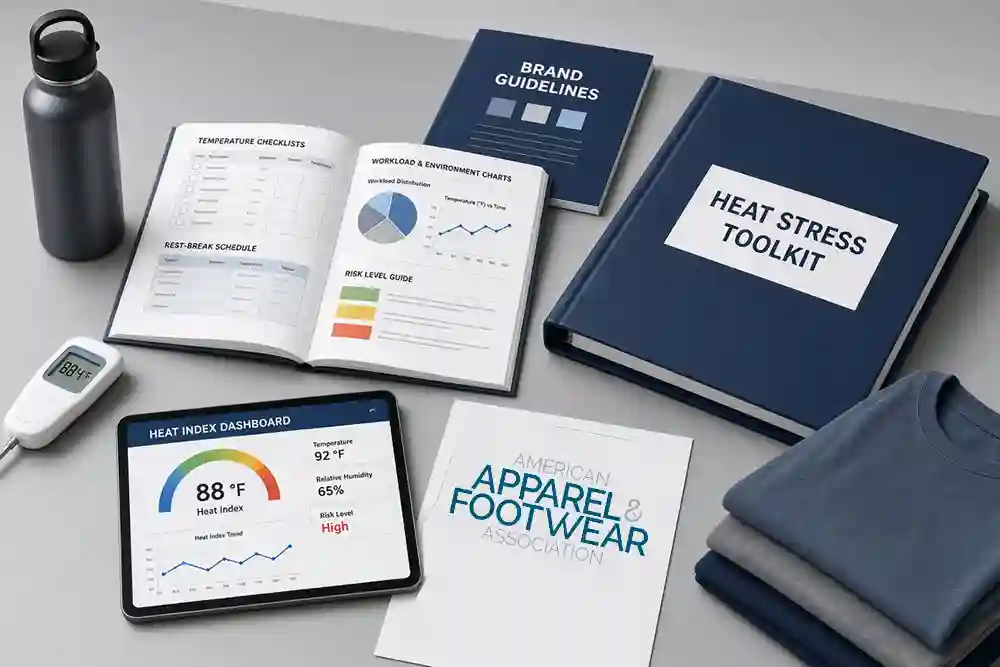
The new five-part framework gives brands and factories practical tools to manage worker heat exposure while explicitly calling for shared financial responsibility rather than another supplier audit.
The American Apparel & Footwear Association (AAFA) has launched an industry-wide Heat Stress Toolkit to help apparel and footwear brands and manufacturers manage rising workplace temperatures across global sourcing regions.
Unveiled at Cascale’s 2026 Annual Meeting in Athens on September 16, the toolkit translates AAFA’s earlier heat-stress guidance into facility-level implementation tools, manufacturer workbooks, brand guidelines and a standard supplier questionnaire. It is freely available to industry stakeholders.
Not another compliance audit
AAFA stresses that the toolkit is not an audit protocol or certification standard. Instead, factories are expected to develop heat-management plans suited to their own climatic, operational and financial conditions.
Its five principles cover worker protection, using measurements to trigger action, shared financial responsibility, locally appropriate controls and two-way communication between brands and manufacturers.
Practical heat controls can include hydration, rest periods, acclimatisation, ventilation, cooling areas, altered work schedules and engineering measures to reduce radiant or ambient heat. OSHA similarly identifies water, rest, training and engineering or administrative controls as core elements of heat-illness prevention.
Suppliers helped design the system
The framework was developed with brands, worker advocates and manufacturers. Contributing companies included Elevate Textiles, Epic Group, Shahi Exports and YKK, with review support from manufacturers including Pakistan’s Crescent Bahuman, alongside MAS, TAL Apparel and others.
That manufacturer involvement matters because heat adaptation can require investment in ventilation, insulation, cooling, building upgrades and production rescheduling.
Climate risk becomes sourcing risk
AAFA’s most significant message is therefore commercial: brands should not expect factories to absorb the entire cost of climate adaptation.
Extreme heat can reduce productivity, disrupt delivery schedules and increase worker-health risks. The toolkit explicitly calls for buyers and suppliers to share the financial and operational consequences of resilience investment.
For textile and apparel factories in hot production regions such as South Asia, heat management is consequently moving from occupational-health policy toward core production planning, capital expenditure and sourcing-risk management.
