

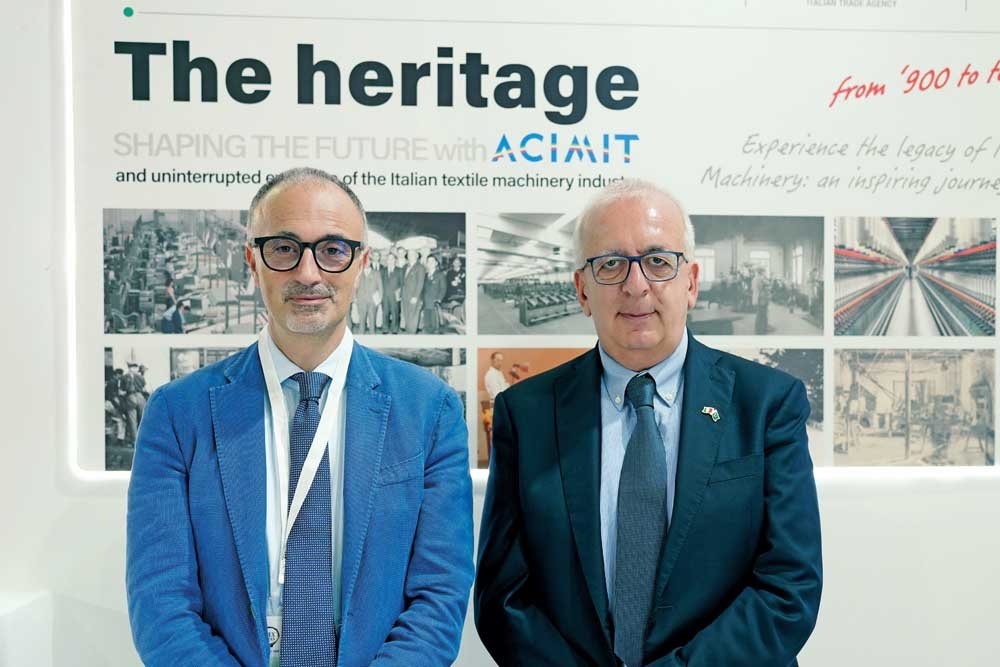
In an interview with TEXtalks, Giorgio Calculli, Director of ACIMIT (Association of Italian Textile Machinery Manufacturers), shares valuable insights into the Italian textile machinery sector’s strategy for innovation, sustainability, and strengthening global partnerships, particularly in emerging markets like Pakistan. ACIMIT is a private, non-profit organization that has been promoting the Italian textile machinery industry globally for 80 years. It supports manufacturers through trade promotion, international exhibitions, and strategic initiatives aimed at growing exports and showcasing Italian innovation.
TEXtalks: How many Italian companies are currently exhibiting at IGATEX this year?
Giorgio Calculli: There are many Italian companies exhibiting at IGATEX 2025. While I don’t have the final count, I estimate there are more than 50 companies present. Out of these, 11 are exhibiting through official Italian Pavilions, which are organized and supported by the Italian Trade Agency (ITA). This strong presence highlights the importance Italy places on the South Asian market, especially Pakistan.
TEXtalks: What advancements do you see shaping the future of textile machinery over the next 5 to 10 years?
Giorgio Calculli: The future of textile machinery will be shaped by Industry 4.0 technologies. Italian companies are leading in the integration of IoT, artificial intelligence, and automation to enhance machine performance, energy efficiency, and production control. Alongside technology, sustainability is becoming a primary focus. New machinery is being designed to significantly reduce water and energy consumption and to support eco-friendly materials and sustainable production.
TEXtalks: How do you envision maintaining Italy’s leadership in this evolving global market?
Giorgio Calculli: Global competition is becoming increasingly price-focused, but Italian companies can maintain their leadership through innovation. The key to staying ahead lies in continuously upgrading and enhancing the technological value of our machines. Rather than competing on price, our manufacturers compete by offering cutting-edge, high-performance, and energy-efficient solutions.
TEXtalks: How are current trade tariffs and global duties affecting Italian machinery exports?
Giorgio Calculli: Right now, the U.S. policies on tariffs are not fully defined, so we will need a few more months to understand their full impact. However, I believe the consequences for Italian machinery manufacturers will be more indirect. Tariffs on textile exporters in countries like the U.
S. and Italy may reduce their willingness to invest in new technologies, potentially slowing down machinery sales in those regions.
TEXtalks: How important are international partnerships for ACIMIT, and how do you plan to strengthen Italy’s presence in emerging markets?
Giorgio Calculli: Creating global business opportunities is one of ACIMIT’s core missions. We participate in major international exhibitions like IGATEX to connect with potential buyers and partners. Additionally, we invite international entrepreneurs and decision-makers to Italy to meet our member companies and explore their solutions firsthand. These interactions are crucial for building trust, expanding our footprint, and promoting the strengths of Italian manufacturing.
TEXtalks: What are some of the biggest challenges and opportunities facing the Italian textile machinery industry today?
Giorgio Calculli: One of the major challenges our companies face is the industry-wide shift toward sustainability and circularity. Italian manufacturers must rise to this challenge by developing solutions that enable more responsible, environmentally friendly textile production. At the same time, this is a major opportunity to lead the transformation toward a greener industry. Our companies are well-equipped to play a central role in this transition by offering machinery that supports eco-friendly processes and materials.

