

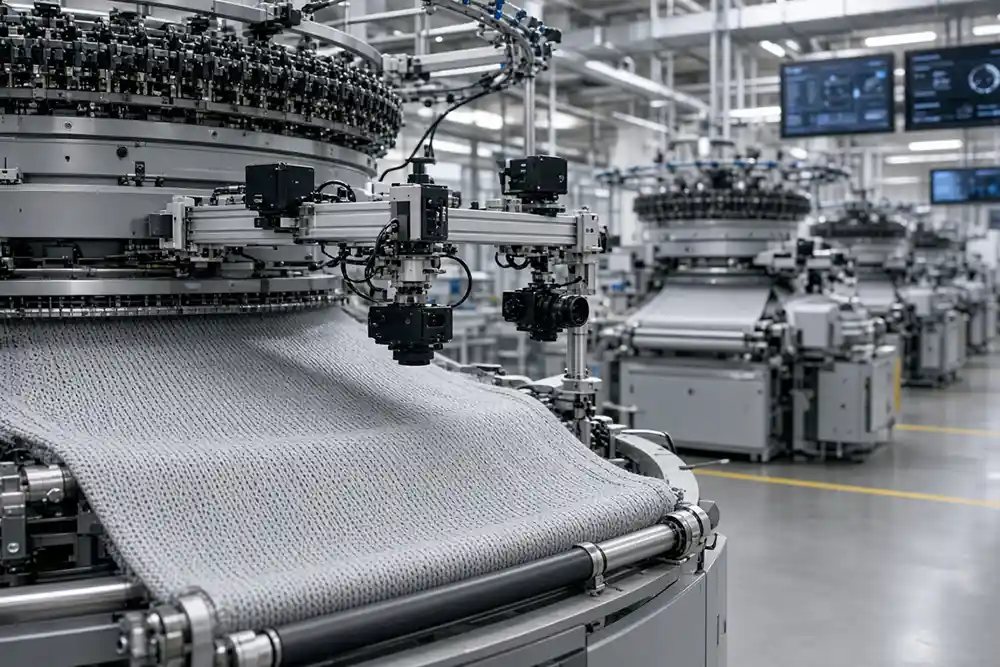
BCC Research identifies a shift from pilot projects toward factory integration, with AI increasingly applied to quality control, resource efficiency, material prediction and automated manufacturing.
Artificial intelligence is moving beyond experimental use in textiles and into production control, quality inspection, predictive maintenance and material development, according to a new qualitative assessment from BCC Research focused on technical textiles.
The report identifies labour shortages, Industry 4.0 investment, sustainability requirements and supply-chain volatility as the principal forces accelerating adoption. Applications now extend across weaving, knitting, thermoforming, polymer processing and advanced 3D manufacturing.
Defect reduction shows measurable returns
One of the clearest examples comes from Yeşim Group, where Smartex optical sensors and machine-learning software used on Lycra jersey production have reduced fabric defects by nearly 70%. The system detects problems during knitting, allowing mills to intervene before defective fabric proceeds into dyeing, finishing and garment manufacturing.
Ekoten Tekstil is similarly using AI-enabled real-time inspection to reduce reprocessing and unnecessary dyeing, linking defect prevention directly with lower water and resource consumption. The Turkish manufacturer was also included on CDP’s 2025 climate A List.
AI expands beyond inspection
BCC identifies emerging applications in material screening, polymerisation control, production optimisation and prediction of tensile strength, abrasion resistance, thermal behaviour, flame resistance and electrical conductivity. Predictive systems are also being deployed to anticipate machine failures and optimise raw-material and supply-chain decisions.
Automation is advancing further through AI-enabled 3D weaving. US technology company unspun raised $32 million in Series B funding in July 2026 to expand its OneWeave platform, after Walmart, REI and manufacturing partners backed plans for automated US production hubs.
Data quality becomes the bottleneck
For technical-textile manufacturers, AI’s commercial value will ultimately be measured through first-pass yield, downtime, energy and water use, labour productivity and material performance consistency.
BCC nevertheless cautions that adoption remains uneven, particularly where mills lack digital infrastructure, skilled AI personnel and reliable production data.
The next competitive divide may therefore be less between companies that “use AI” and those that do not, and more between mills capable of converting machine and quality data into closed-loop process decisions and those still operating largely through manual intervention.
