

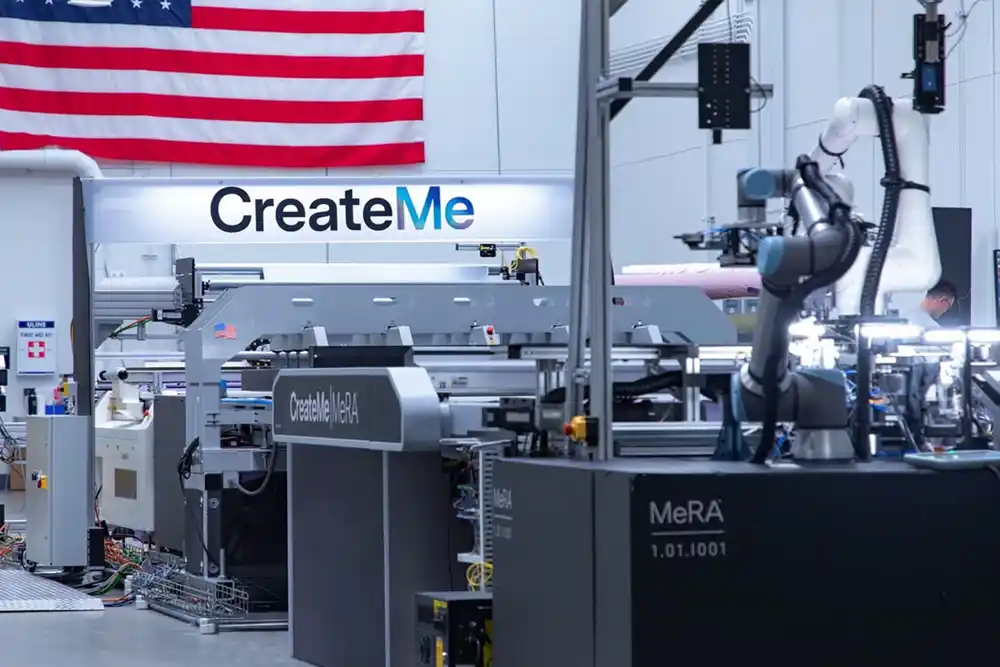
On-demand, automated no-sew systems like CreateMe’s can realistically bring some apparel manufacturing back to the U.S., but not mass fashion as we know it. The biggest wins are in speed-critical, customization-heavy, labor-intensive categories where traditional offshore sewing is weakest.
Below is a structured assessment of why this matters, where it works, and where limits remain.
What CreateMe is actually changing
CreateMe has developed a Modular-engineering Robotic Assembly system (MeRA™) that replaces sewing with micro-adhesive bonding (Pixel™).
This is not incremental automation—it removes sewing itself, the most labor-intensive, offshoring-dependent step in apparel.
Key technical shifts
- No thread, no seam tape → bonded seams <1 mm
- Robotics + CNC precision instead of skilled sewing labor
- End-to-end automation (already proven in intimates)
- Design-to-production compression: months → days
- Clean material separation → improved recyclability
In effect, CreateMe is doing for apparel what surface-mount technology did for electronics: redesigning the product so it can be automated.
Why this can enable U.S. reshoring (in parts)
- Labor arbitrage collapses
Sewing is why apparel offshored.
If sewing disappears, wage differentials matter far less.
CreateMe claims:
- 20× faster than manual sewing
- 1,200 sq ft footprint for a T-shirt line
- Cost-competitive with offshore production by end-2026
That puts U.S. production back into contention—without needing cheap labor.
- Speed becomes the competitive weapon
Offshore apparel economics depend on:
- Forecasting
- Volume
- Long lead times
Automated no-sew enables:
- On-demand production
- Micro-batches
- Local replenishment
- Rapid trend response
This aligns perfectly with:
- E-commerce
- DTC brands
- Corporate uniforms
- Intimates
- Performance basics
In these segments, speed > labor cost.
- Sustainability and regulation favor it
Bonded construction:
- Eliminates thread (often polyester contamination)
- Enables cleaner end-of-life separation
- Cuts transport emissions
- Reduces overproduction
As EPR, recyclability, and Scope 3 pressure increase, localized, low-waste production becomes a compliance asset—not just a cost decision.
Where it will work first (very important)
Strong candidates for reshoring
- Intimates & underwear ✅ (already proven)
- T-shirts & basics (pilot in 2026)
- Athleisure / performance wear
- Uniforms & workwear
- Medical & technical textiles
- Automotive seating & interiors (major interest already)
These categories value:
- Consistency
- Fit precision
- Seam comfort
- Rapid turnaround
Where it will not replace offshore sewing (yet)
- Fashion-heavy woven garments
- Complex tailored apparel
- High-embellishment styles
- Ultra-low-cost fast fashion
Traditional sewing will still dominate style-driven, labor-dense fashion for years.
The strategic implication (the real story)
This is not “bringing apparel back” in the old sense.
It is creating a new manufacturing geography:
- Fewer mega-factories
- More distributed micro-factories
- Located near consumers
- Producing fewer SKUs, faster, with higher margins
Think:
Apparel manufacturing as a service layer, not a distant supply chain.
Bottom line
On-demand, automated no-sew production will not reshore all apparel—but it absolutely can reshore the most strategic, time-sensitive, and margin-critical categories.
CreateMe’s approach works because it doesn’t automate the old system—it redesigns the garment for automation.
That is exactly how reshoring becomes economically credible.
If you want, I can:
- Map which U.S. brands are best positioned to adopt this
- Compare no-sew vs sewing economics side-by-side
- Analyze implications for Pakistan, Bangladesh, and Vietnam
- Explore what this means for future textile design & fiber selection

