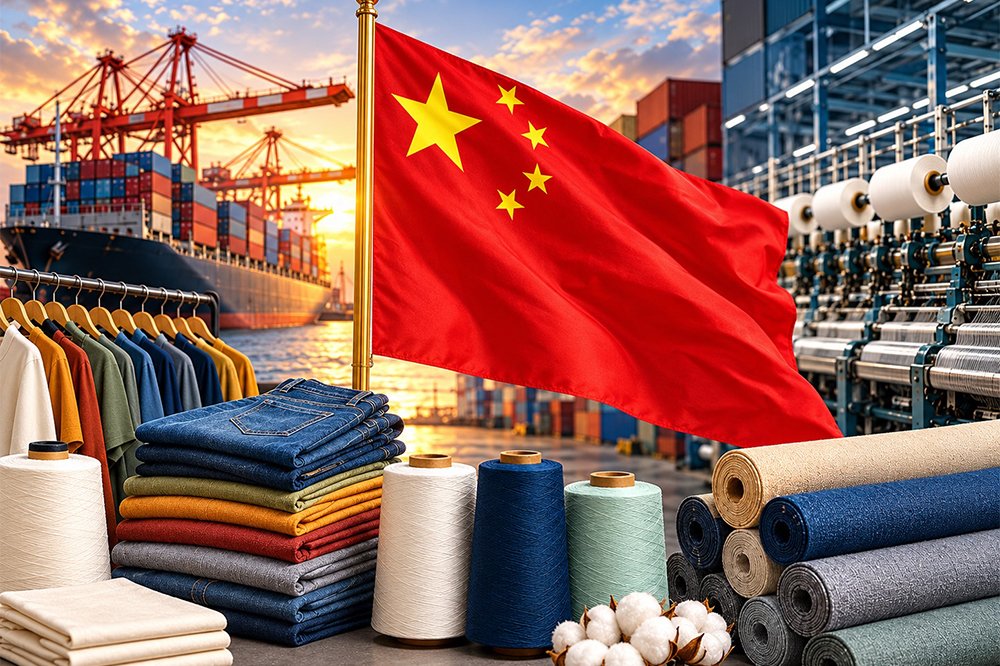
China’s September surge across both fabrics and finished garments shows that sourcing diversification has not weakened the country’s ability to compete across the full textile value chain.
China’s textile and apparel exports increased 5.1% year on year to $232.96 billion during January–September 2026, according to customs data reported by the China Chamber of Commerce for Import and Export of Textiles.
Textile products including yarns, fabrics and related articles rose 5.4% to $112.26 billion, while garments and accessories increased 4.8% to $120.69 billion.
September growth accelerates sharply
The strongest performance came in September, when combined exports reached $29.66 billion, up 21.5% year on year and 3.8% from August.
Textile exports rose 19% to $14.24 billion, including a 12.2% month-on-month increase. Garment exports climbed 24% year on year to $15.42 billion, although they declined 2.9% from August.
The China textile chamber attributed the acceleration partly to recovering overseas demand and a relatively weak comparison base in September 2025. The September surge lifted nine-month export growth from roughly 3% at the end of August to 5.1%.
China remains powerful upstream
China’s strength is increasingly important beyond finished garments. Textile products represented almost 48% of its nine-month textile and apparel exports, reinforcing its role as a major supplier of yarns, fabrics and intermediate materials to garment-producing countries across Asia.
China’s imports of textile yarns and fabrics also increased 21.9% to $8.81 billion, indicating stronger raw-material demand within its own manufacturing base.
China’s performance challenges the assumption that sourcing diversification automatically creates market share for Pakistan and other Asian exporters. China remains competitive simultaneously in fibre, yarn, fabric, garments, speed, scale and product development.
Pakistan therefore needs to compete where vertical integration can create differentiation: shorter lead times, MMF and blended fabrics, performance textiles, product development, automation and traceable lower-carbon manufacturing.
The strategic objective should not simply be taking orders displaced from China. It should be developing capabilities that give buyers a compelling reason to source from Pakistan even when Chinese supply remains available.