

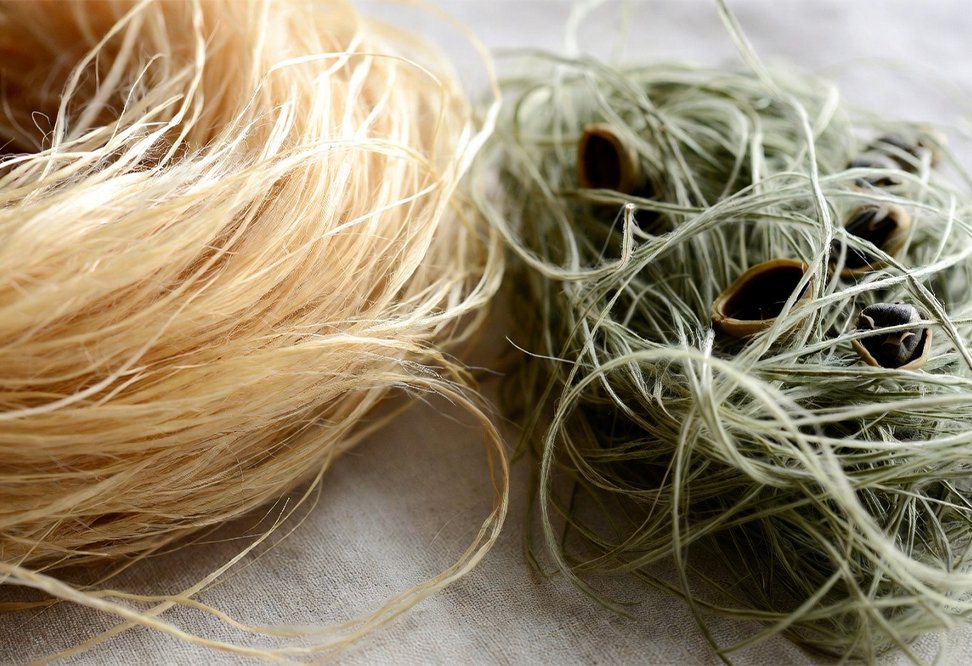
New developments in filament winding, 3D printing, pultrusion and automated fibre placement show natural fibres entering higher-value industrial applications.
The Alliance for European Flax-Linen & Hemp says flax-linen and hemp fibres are moving beyond traditional hand lay-up into advanced composite manufacturing, opening new applications in automotive, construction, design and engineering. The shift is important because it positions bast fibres not only as sustainable textile materials, but as functional reinforcements for lightweight, high-performance structures.
Automation changes the proposition
Recent progress in thin-ply prepreg technology has allowed flax rovings, including those developed by Depestele, to be converted into ultra-lightweight composite structures with improved damage tolerance. Automated prepreg systems and back-injection moulding are also being used to support repeatable, higher-volume production, particularly for automotive components.
Coreless filament winding is another major step. The robotic process winds resin-impregnated flax fibres into complex three-dimensional geometries without conventional moulds, reducing material waste while enabling structurally optimized shapes. Eindhoven University of Technology’s FIBRAS project is developing handling methods for flax rovings to manage natural-fibre variability in controlled manufacturing environments, with a focus on lightweight architectural structures.
Automotive and construction applications emerge
The DynaMill project, led by ContiTech AVS France with Nautix and ComposiTIC, has mechanically validated a lightweight automotive engine support connecting rod using injection moulding, automated fibre placement, flax reinforcement and a bio-based PA11 matrix. The project builds on earlier Dynafib work and points to future bio-based structures combining lower weight with scalable production.
In construction, the University of Stuttgart’s ICD/ITKE has developed the “Con[knit]uous Rubble” process with support from Safilin. It uses continuous circular knitting to encase demolition waste in seamless flax-fibre structures, enabling self-supporting arches and columns without binders or mortars and allowing later disassembly and reuse.
3D printing widens the design field
Continuous flax-fibre-reinforced 3D printing is also gaining momentum, using co-extrusion of flax yarns with thermoplastics such as PLA to produce customized structural components. French designer Alyssa Cartaut recently used PLA filament reinforced with European flax-linen fibres in footwear components for The Cushion Issue, which won the City of Hyères Prize for Fashion Accessories.
The next test is industrial reliability: whether natural-fibre composites can meet repeatability, moisture durability, certification and cost requirements at scale. If they can, flax and hemp could move from sustainability showcases into mainstream composite supply chains.
