

ITMF’s latest statistics show fewer conventional spindles, stable shuttleless-weaving capacity and softer fibre consumption, signalling cautious investment amid difficult market conditions.
Global textile production capacity consolidated in 2024 as manufacturers responded to weak demand, margin pressure and persistent overcapacity in several major markets, according to the International Textile Manufacturers Federation.
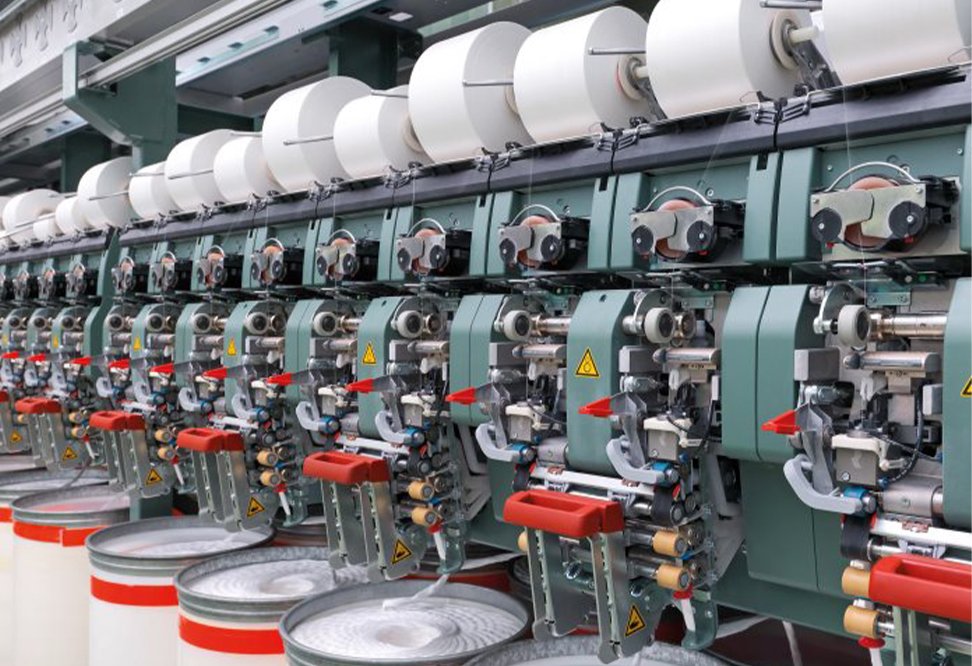
ITMF’s International Textile Industry Statistics report estimates that installed short-staple spindle capacity fell to 219 million units, down from 232 million in its revised 2023 dataset. Installed open-end rotors also edged lower to 9.6 million, while air-jet spinning capacity continued to increase, led by China.
Productivity replaces simple expansion
The divergent spinning trends point to gradual substitution rather than broad-based capacity growth. Conventional ring-spinning assets remain dominant, but mills are increasingly evaluating technologies that offer higher output, lower labour intensity and more automated production.
Air-jet spinning is gaining relevance where manufacturers can justify the capital cost through speed, process integration and consistent yarn quality. Its application remains product-dependent, however, and it cannot replace ring spinning across all yarn counts, fibres and quality requirements.
The decline in installed spindle numbers should also be interpreted alongside ITMF’s continuing revision of historical capacity and consumption series. The federation updates its estimates to reflect changes in industry structure, meaning movements may incorporate both mill closures and improved statistical coverage.
Weaving capacity holds steady
Installed shuttleless looms reached 1.67 million units in 2024, an increase of just 0.3%. Asia and Oceania accounted for 83% of the global total, confirming the region’s overwhelming concentration of modern weaving capacity.
Total raw-material consumption in the organised short-staple spinning sector slipped to approximately 42 million tonnes, from 43 million tonnes in 2023. Consumption of cellulosic and synthetic fibres rose slightly, indicating that the overall reduction was concentrated elsewhere in the fibre mix.
Machinery demand faces a selective recovery
The figures suggest mills are prioritising replacement, automation and productivity improvement over indiscriminate expansion. This is consistent with 2024 machinery shipments, when deliveries of new short-staple spindles and open-end rotors fell 40% and 39%, respectively.
The next market signal will be whether improving utilisation and order intake translate into renewed machinery investment. Until demand strengthens, technology suppliers are likely to find the best opportunities in energy efficiency, labour reduction and targeted modernisation rather than large greenfield capacity projects.
