

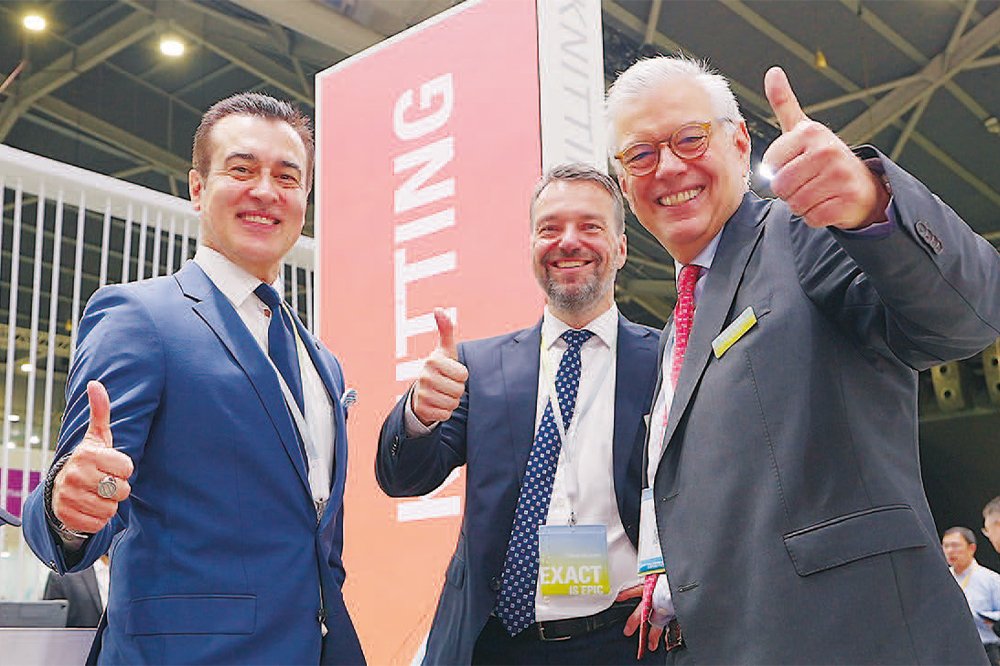
An interview with Eric Schöller, Managing Director and Member of the Executive Board at Groz-Beckert, discussing innovations set to revolutionize efficiency and sustainability, and cutting energy costs by up to 20% while boosting fabric quality!
Can you provide an overview of Groz-Beckert’s focus at ITMA Asia Singapore 2025, particularly the emphasis on artificial intelligence, automation, and digital integration?
At ITMA Asia + CITME 2025, Groz-Beckert is focusing on how innovation, automation, and digital integration are reshaping textile production. Across our six product areas — Knitting, Weaving, Nonwovens, Tufting, Sewing, and Spinning — we are showcasing solutions that combine efficiency, precision, and sustainability.
In knitting, our new LCmax™ energy-saving needle demonstrates how intelligent design can deliver up to 20% lower energy consumption through optimized geometry — a perfect example of technology supporting both productivity and sustainability. In sewing, our INH (Ideal Needle Handling) system digitalizes quality management, offering traceability and process control that align with the industry’s move toward automation.
More broadly, we are integrating digital tools and smart process concepts to help mills operate more efficiently, reduce downtime, and make data-driven decisions. ITMA Asia in Singapore provides the ideal platform to show how Groz-Beckert continues to evolve — combining our legacy of precision engineering with the digital intelligence needed to shape the future of the textile world.
Groz-Beckert is showcasing innovations across six product areas during ITMA Asia + CITME 2025. How does this diverse portfolio position your company as a global leader in supporting industries from fashion to aerospace?
Our strength as a global leader lies in the breadth and depth of our portfolio. At ITMA Asia + CITME 2025, we are showcasing innovations across all six product areas — Knitting, Weaving, Nonwovens, Tufting, Sewing, and Spinning — which together cover the entire spectrum of textile production, from fashion and home textiles to automotive, medical, and aerospace applications.
This diversity allows Groz-Beckert to serve not only traditional apparel sectors but also advanced technical industries that demand the highest levels of precision, durability, and process reliability. Whether it’s fine hosiery, nonwoven filters, airbags, or composite reinforcements, our solutions ensure consistent performance and long-term value.
By combining mechanical excellence with digital intelligence and sustainability, Groz-Beckert continues to support every segment of the textile world — helping shape its evolution from fiber to finished product.
Your LCmax™ needle for circular knitting promises energy savings and smoother performance. How does this innovation help textile manufacturers cut costs while boosting quality?
The LCmax™ needle is a prime example of how intelligent design can deliver both economic and environmental benefits. Its wave-shaped shank geometry reduces friction within the knitting system, which means smoother operation, lower heat generation, and up to 20% less energy consumption.
For textile manufacturers, this translates directly into lower power costs, longer machine life, and reduced downtime. At the same time, the needle’s precision ensures consistent loop formation and superior fabric quality, even at high production speeds.
In short, LCmax™ helps mills achieve higher efficiency with lower resource use — a perfect balance between cost optimization and sustainable performance.
The KnotMaster tying machine and your weaving accessories, like reeds and healds, aim to streamline production. How do these solutions make life easier for weaving mills?
Our KnotMaster tying machine and weaving accessories are designed to make weaving operations more efficient, reliable, and user-friendly. The KnotMaster offers automatic functions, intuitive touchscreen control, and easy maintenance, allowing mills to prepare warps faster and reduce downtime between batches.
Similarly, our high-precision reeds, healds, warp stop motions, and drop wires ensure stable thread guidance and flawless fabric formation, even at high speeds. Together, these solutions help weaving mills save time, minimize manual effort, and maintain consistent fabric quality, making daily operations smoother and more predictable.
Many of your innovations, like energy-saving needles and reduced-wear designs, align with sustainability goals. How is Groz-Beckert helping the textile industry reduce its environmental footprint?
Sustainability is a core principle in everything we design and produce at Groz-Beckert. Our innovations aim to reduce energy use, extend tool life, and minimize waste throughout the textile production process. For example, the LCmax™ energy-saving needle in circular knitting cuts power consumption by up to 20%, while our reduced-wear barb designs for felting needles and durable card clothing extend maintenance intervals and lower resource use.
Beyond products, we’re also optimizing our own manufacturing processes, recycling systems, and logistics to reduce emissions and material waste. In essence, every Groz-Beckert solution is developed to help customers produce more efficiently, responsibly, and sustainably — turning precision into environmental progress.
Looking beyond the show, how will Groz-Beckert support follow-up implementation of these technologies, and what emerging trends (e.g., in nonwovens or sewing) do you see shaping the textile industry post-ITMA?
For us, ITMA Asia is not just a showcase — it’s the start of collaboration. After the exhibition, Groz-Beckert will continue to support customers through our global network of technical service centers, training programs, and local partnerships, ensuring that new technologies are implemented smoothly in production.
We see strong momentum in areas like nonwovens, where demand for sustainable filtration and hygiene materials is growing, and in sewing, where digital process management through systems like INH (Ideal Needle Handling) is redefining quality control.
The next phase for the textile industry will be driven by automation, traceability, and smart materials — and Groz-Beckert will remain closely engaged with customers worldwide to help translate these trends into real, measurable progress.
As Managing Director, what’s your personal highlight for this year’s ITMA Asia, and how do you see Groz-Beckert’s role evolving in future events like ITMA 2027 in Hanover?
My personal highlight at ITMA Asia 2025 is seeing how our team has brought together innovation, precision, and sustainability into every product we’re presenting — from the LCmax™ energy-saving needle to our digital needle-handling and quality management systems. It’s a powerful reflection of how Groz-Beckert continues to evolve with the industry while staying true to our core values of quality and reliability.
Looking ahead to ITMA 2027 in Hanover, our focus will continue to expand toward digitalization, automation, and circular production concepts. We see Groz-Beckert’s role not just as a supplier of precision tools, but as a technology partner shaping smarter, more sustainable textile manufacturing worldwide.

