

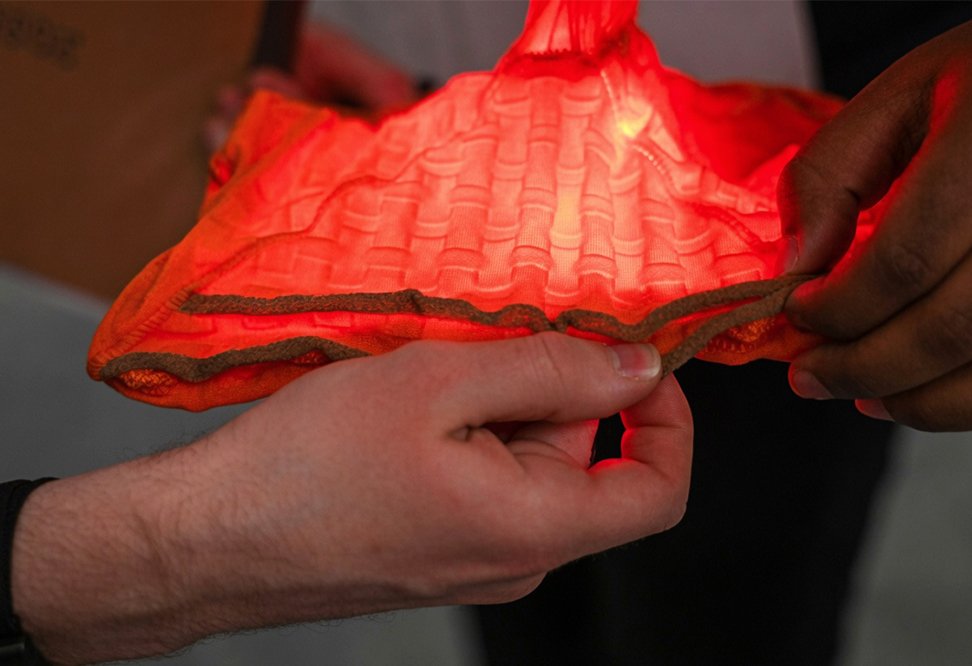
Standard industrial knitting can create fabrics that mechanically “snap” between stable forms, opening routes to soft switches, movement sensors and adaptive textile products.
Harvard University researchers have developed machine-knitted fabrics capable of switching between multiple stable three-dimensional shapes. The work converts conventional weft knitting into a manufacturing platform for mechanical metamaterials whose shape, tactile response and switching behaviour are programmed through yarn selection and fabric geometry. The peer-reviewed study, “Knitting Multistability,” was published in Advanced Functional Materials in June 2026.
Geometry provides the switching action
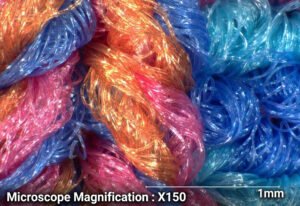
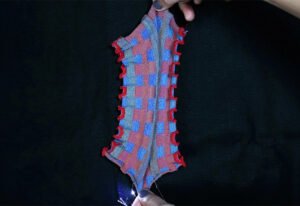
The researchers used highly elastic yarns and plating—a knitting method that places different yarns on opposite fabric faces—to introduce internal stresses into dense textile structures. By arranging horizontal and vertical knitted zones, they produced fabrics that curve naturally and snap between two or more stable configurations, comparable to the distinct positions of a mechanical light switch.
 A continuum-based simulation model predicted how material choice and geometry influence the transition between states without modelling every yarn loop individually. This could eventually help designers engineer the required force, shape and tactile feedback before producing physical samples.
Conductive yarn adds sensing
Fine conductive yarns were integrated into the structures, enabling the mechanical movement to open or close an electrical circuit. Demonstrators included a textile shell that controlled an LED, a wearable knee or elbow device whose snapping action could be interpreted by an Arduino to count movements, and a reconfigurable lampshade with three switches controlling different light colours.
The technology therefore avoids rigid switches within the fabric, but it is not entirely “electronics-free”: sensing applications still require conductive yarns and external circuitry for power, processing or output.
 Scalability meets unresolved questions
The samples were made using equipment similar to industrial double-bed weft-knitting machines, suggesting compatibility with established knit manufacturing infrastructure. Potential applications include sports and rehabilitation garments, tactile interfaces, adaptive interiors and shape-changing structures.
Commercialisation will depend on wash durability, switching-cycle life, conductive-yarn reliability, comfort, production speed and integration with removable electronics. The next decisive step is translating laboratory prototypes into washable products that retain predictable mechanical performance at industrial scale.
