


Page 35 - August-September-2017
P. 35
34                                                                                                             35
 cotton varieties on technology. We use technology to   sustainable fiber production by the US cotton
 cross breed; enhance the fiber characteristics of the   industry?  An Interview with
 cotton like lint, strength, micronaire and all of other   Willaim R. Bettendorf: The sustainability initiatives
 fiber characteristics. Today the cross breeding of the   taken by the US cotton industry are varied. We do have
 windows cross breeding is history. In today’s world, in   a lot of practices in place in order to manage and   Interview  Interview
 order to survive, and yet to be more efficient the way   produce sustainable cotton crop. Some of these   M. Anees Khawaja
 we maximize efficiency is, by using technology, to   includes, production practices such as no-tail or
 create superior seeds. The USA industry is leading the   low-tail production in order to minimize soil erosion                                                                   structures are not helping us at all. Mainly the energy   that is the only thing which is out there for CEPEC. We
 world in this and based on fiber properties, as well as   and water runoff. We use quite a bit of technology to   Director, Mahmood Group of Industries, Multan                  cost, to larger extents as well as now the raw material   need to have a better communication. We had a lot of
 our framing practices, we believe USA cotton is the   look at our fields of cotton. In order to measure various                                                                  and lastly the labor costs. This is not the cost that just   communication on government to government level
 most superior raw cotton in the world.    things that impact the production of cotton such as                                                                                    happened in Pakistan but this has happened       but he right people need to meet the right people and
 water, is the field too dry or is it too wet, there could be   year but, when you look at the consumption of   ours. Pakistan has been a loyal customer of US cotton             everywhere else. In rest of the countries the    the government needs to take more initiative in finding
 TEXtalks: What changes have been seen in the US   insect damage. Using satellite technology and GPS   synthetic fibers, it increases by 15-20% per year. When   for a long time. Why would you buy foreign cotton   government has really come out and helping the   who are these who are ready to go for a joint venture
 cotton production map over last 10 years?  technology or even a drone, we can take a picture of   you forecast it in 10, 20 or 30 years into the future there   because you have your own cotton which is great for   textile industry.   or have Chinese investors coming in or even to go in
 Willaim R. Bettendorf:  Production in United States   cotton fields and we can see where there is large   is going to be a huge gap. We will see synthetic fiber   certain uses. But because you are such a big                   china and invest over there as well. So what we need is
 has fluctuated; generally we remained pretty steady   insect infestations or where they are low so that when   up on the top and that of natural fibers specially cotton   exporters of textile to the global market you have to be   TEXtalks: What is efficiency level of industrial   more value added and I think Chinese can really be
 over the past 10 years. A little higher, somewhere a   we go into the field in order to apply the chemicals to   at the very bottom that is our challenge. It also not just   a net importer. Pakistan has to import cotton in order to   concerns in Pakistan? How the situation can be   helpful on that and with our GST Plus statuses the
 little lower, but generally our production is quite   manage a crop whether they need a fertilizer or a   a challenge for us as a cotton industry, it’s a huge   meet the demands of the customers.   improved?                   Chinese would obviously be more willing to come into
 consistent in terms of where the cotton is being grown.   pesticide or a herbicide, by using the GPS maps we   challenge for the environment.                                    Anees Khawaja: For the efficiency, I personally think   Pakistan as well.
 Based on competitive commodity prices, the US   can see where we need to apply those chemicals.   US cotton is used for contamination free textile product                       that a lot of mills in Pakistan really need to improve
 cotton has shifted a little bit further out of the west and   If you start Googling micro-beeds, polyester   that you are exporting to the global market. Or certain             their efficiencies. I think, we are way behind from our   TEXtalks: What more roles Government should play
 in towards central parts of the United States, around   We apply them using GPS technology tied into the   micro-beeds, we are finding that polyester has a low   higher quality products that have to be made from the   own standards not from the world, but to be more   for the betterment of textile sector?
 Texas. The state of Texas is now our largest cotton   tractor only where they are needed, down to about 3rd   price, it can produce some great fabric but   cotton that Pakistan does not produce.  We see   competitive we really need to work hard on that. The   Anees Khawaja: There is a long list, from where I see,
 producing state. Second largest cotton producing   of a meter. So that tractors as it go up and down in the   environmentally we have started to see some very   Pakistan as a great partner. Also CPEC, the Chinese   government, from the major part, where I disagree with   government is just nowhere right now because they
 state is Georgia on the east coast. If you look at the   field, it will apply those chemicals only where they are   negative ramifications setter. If you put a cotton shirt in   have a very high quality standard that is why US cotton   them on their policies but they have given a very   come up they make promises they make us clap at
 production map of the United States 10, 15 years ago   needed. In the old days they were spread all across   the ground, in 5 to years 10 years it will go back to the   has been the number one in fiber suppliers to the   attractive loan policy for a long term.  Which a lot of us,   whatever they announce for us and ultimately we stand
 you can see much larger production in the west coast   the field, those days are gone, we can’t do that. It’s   Mother Nature but polyester is going to be there for a   Chinese industry for year.   if possible, should need to avail and try to be more   at a place where they are not giving us anything at all.
 in California. Unfortunately, due to higher prices for   bad for the environment, it’s bad for the workers, and   long long time. We have to not think about today but           efficient with regards to being more on an automatic   My very strong suggestion to the government, ,
 grapes, nuts and vegetables, a lot of that production of   it’s bad for the bank account, it’s wasteful. The cotton   we have to think about tomorrow and how the use of   As china and Pakistan are coming close and close   industry where cost can be saved.  because this is the right time, that they just need to
 cotton has been moved out of California and into other   farmers are business people just like anybody else and   natural fiber is critical to our future well-being and not   together, I think, we will see greater market share for   implement whatever they promised, and that’s all
 regions.  buying expensive fertilizers and pesticide and   for us but for our kids and our grandchildren and future   US cotton, being consumed by the mills in Pakistan in      TEXtalks: What do you think have most influenced   we need.
                                                                                                                                                                                  the textile exports of Pakistan?
 herbicide, they don’t want us to spend money more   generations.   order to meet the quality requirements to the Chinese.                                                        Anees Khawaja:  As a country, we need more exports.
 TEXtalks: What does sustainability mean to   than they have to so they not just going to go and                                                                                                                                   TEXtalks: How do you see such international
 cotton USA?  spread it around without knowing that how it’s going to     TEXtalks: How do you see the scope of US cotton   They know they cannot compete the commodity level     What we need is more dollars to come in where we   events, as by Cotton USA, for Pakistan
 Willaim R. Bettendorf:  Firstly, sustainability for the US   effect the crop.  for Pakistan?  any longer; they are up in their game. We are seeing                               can have a better trade balance and something which   textile industry?
 cotton industry is critical. It is the only way, we can   Willaim R. Bettendorf: Pakistan is a great market, the   the Chinese start to nominate the US cotton in their          can help our country grow as per the targets that we   Anees Khawaja: This is a fantastic gathering. I think
 survive. Sustainability means; we are sustainable for   market has so much going for, it’ has a beautiful fabric   supply chain, in order to provide high quality products.      have. Ultimately, we are all Pakistani and this is what   this Cotton USA platform is something I have a very
 the environment, and we are not going to damage it.   TEXtalks: What challenges the US cotton is facing   with a long and very rich tradition of cotton industry   Pakistan is a great market and it’s going to be a great   we want that our country needs to grow more and thus   strong supporter of, for the last many years. I think they
 Because we need the environment, in order to   at the moment?  and there is so much potential. The US cotton industry   future market. We are looking forward to do a lot        the more exports.                                have been doing a wonderful job and more
 produce crop in the future. It has to be sustainable for   Willaim R. Bettendorf: The challenge is that the US   is very very excited to have Pakistan as a partner of   more in Pakistan industry and we are pleased to be       importantly, making us understand that what the
 our customers for the textile mills. We can’t price   cotton is facing right now its not cotton from the other   the partners.                                                   TEXtalks: How do you see the CEPEC having an     standards that world is looking at and not just
                                                                                                                                                                                  impact on the textile industry of Pakistan?
 ourselves out of the market and we have to be able to   countries, it is polyester. When you look at the global                                                                                                                   Pakistan. We need to get out of the shell. When they
 find a price point that is sustainable for our customers.   cotton trade, the United States is the largest global                                                                Anees Khawaja: Honestly up till now, the general   bring in a lot of people from Pakistan, it is a fantastic
 So that you can come back again to buy more US   supplier of raw fiber to the global mills.                                                                                      impression is that CEPEC is something will probably   interaction all across Pakistan as well with
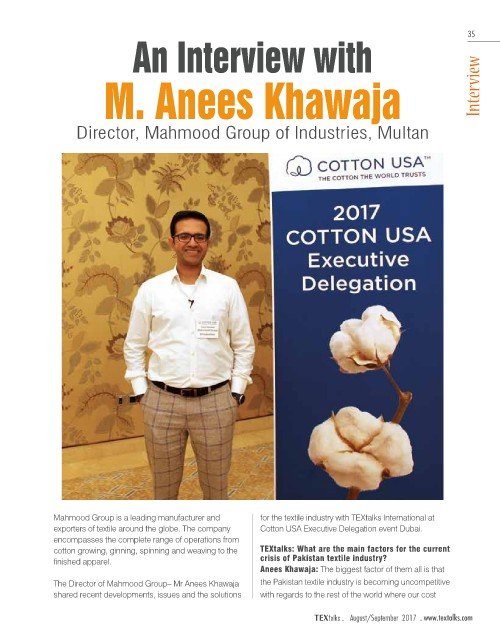
 Cotton USA promotes U.S. cotton fibre around the   shared recent developments and approaches of   cotton in the future. Thirdly it has to be sustainable for   Mahmood Group is a leading manufacturer and   for the textile industry with TEXtalks International at   going to whitewash the textile industry but I don’t think   the members.
 globe, which works in more than 50 countries through   Cotton USA with TEXtalks International at 2017 Quality   our producers because they have to make a profit as   exporters of textile around the globe. The company   Cotton USA Executive Delegation event Dubai.
 20 offices around the world with an aim to set global   Conference in Dubai.  We are the third largest producers, behind China and   encompasses the complete range of operations from
 standards of purity, quality and responsibility in the   well they have to feed their families. It’s a win-win-win   India but when you look at the global exports the US is   cotton growing, ginning, spinning and weaving to the   TEXtalks: What are the main factors for the current
 cotton industry.  TEXtalks: How would you compare the US cotton   combination between the buyer, the seller and, the   number one. Our challenge is not competitive cotton   finished apparel.   crisis of Pakistan textile industry?
 quality with other cottons of the world?  environment, in the middle.   from other countries but its polyester and synthetic   Anees Khawaja: The biggest factor of them all is that
 The Director of supply chain marketing at Cotton   Willaim R. Bettendorf: The quality of American cotton   fibers. When you look at global fiber consumptions,   The Director of Mahmood Group– Mr Anees Khawaja   the Pakistan textile industry is becoming uncompetitive
 Council International, USA– Mr William R. Bettendorf   is very good and reason is because we base our   TEXtalks: What initiatives are taken for a   cotton has a gradual increase, I think it may be 6% a   shared recent developments, issues and the solutions   with regards to the rest of the world where our cost

 August/September  2017                                                             August/September  2017

