


Page 66 - January-February-2018
P. 66
66                                                                                                                                                                                                                             67
                                                                                                                                   • Implement clothing collection at scale          • Alignment on the case for change
                                                                                                                                                                                     • A positive vision for a new system
            cause of the system’s wasteful nature directly, in   are designed, produced, sold, used, collected, and                4. Make effective use of resources and move to    • Broad stakeholder buy-in and time-bound
            particular, low clothing utilisation and low rates of   reprocessed. However, this should not discourage or            renewable inputs                                  commitments to a vision-led transformation
            recycling after use.                              delay action. The time to act is now, and the                        The need for raw material inputs in a new textiles   • Demonstration that the vision is possible with
                                                              ambitions below offer an attractive target state for the             economy would be drastically reduced due to higher   large-scale, pre-competitive, cross value-chain
            This report  proposes a vision for a new textiles   industry to align on and innovate towards.                         clothing utilisation and increased recycling. However,   collaboration
                     1
            economy aligned with the principles of a circular                                                                      virgin material input will likely always be required.   • Unprecedented levels of collaboration and
            economy: one that is restorative and regenerative by   In such a system clothes, textiles, and fibres are kept         Where such input is needed and no recycled        alignment in areas of action
            design and provides benefits for business, society,   at their highest value during use and re-enter the               materials are available, it should increasingly come
            and the environment. This vision is distinct from, and   economy after use, never ending up as waste.                  from renewable resources. This means using        To reach unstoppable momentum towards a new
            complements, ongoing efforts to make the textiles                                                                      renewable feedstock for plastic-based fibres and   textiles economy, the existing efforts to change the
            system more sustainable by minimising its negative   1. Phase out substances of concern and microfibre                 regenerative agriculture to produce any renewable   system should be consolidated by a new approach
            impacts. In such a new textiles economy, clothes,   release                                                            resources.                                        that would serve to:
            fabric, and fibres are kept at their highest value   First and foremost, a new textiles economy needs to                                                                 1. Align key industry players on a clear vision and
            during use, and re-enter the economy after use,   ensure that the material input is safe and healthy to                System-level change of the Textile Industry       secure their commitment to it
            never ending up as waste. This would provide a    allow cycling and to avoid negative impacts during                   Moving towards a circular economy goes far beyond   2. Drive large-scale, cross-value chain demonstrator
            growing world population with access to high-quality   the production, use, and after-use phases. This                 traditional measures to reduce the negative impacts   projects
            affordable, and individualised clothing, while    means that substances that are of concern to health                  of the current linear system. It entails shifting to an   3. Orchestrate complementary initiatives and
            regenerating natural capital, designing out pollution,   or the environment are designed out and no                    entirely new system, and cannot be achieved merely   reinforce their impact
            and using renewable resources and energy. Such a   pollutants such as plastic microfibres are                          through incremental improvements. Transforming the   4. Broadly engage stakeholders and ensure wide
            system would be distributive by design, meaning   inadvertently released into the environment and                      industry to usher in a new textiles economy requires   promotion of the vision
            value is circulated among enterprises of all sizes in   ocean.                                                         system-level change with an unprecedented degree   5. Establish a coordinating vehicle that takes on
            the industry so that all parts of the value chain can                                                                  of commitment, collaboration, and innovation.     these four activities
            pay workers well and provide them with good       2. Transform the way clothes are designed, sold,                     Existing activities focused on sustainability or partial
            working conditions.                               and used to break free from their increasingly                       aspects of the circular economy should be
                                                              disposable nature                                                    complemented by a concerted, global approach that        1
            The four ambitions of the new textiles economy    Designing and producing clothes of higher quality                    matches the scale of the opportunity. Some key    Source:  Ellen MacArthur Foundation, A new textiles
 Textiles and clothing are a fundamental part of   increased per capita sales in mature economies. The   textiles. Textiles production (including cotton farming)   of clothing utilisation, elsewhere rates are much   and providing access to them via new business   characteristics that support system shifts have been   economy: Redesigning fashion’s future, (2017,
 everyday life and an important sector in the global   latter rise is mainly due to the ‘fast fashion’   also uses around 93 billion cubic metres of water   lower. In the US, for example, clothes are only worn   models would help shift the perception of clothing   identified:  http://www.ellenmacarthurfoundation.
 economy. It is hard to imagine a world without   phenomenon, with quicker turnaround of new styles,   annually, contributing to problems in some   for around a quarter of the global average. The same   from being a disposable item to being a durable   org/publications).
 textiles. Clothes are worn by almost everyone, nearly   increased number of collection.  water-scarce regions. With its low rates of utilisation   pattern is emerging in China, where clothing   1  2  product. When garments can be worn more often
 all the time, and for many are an important   (leading to high levels of throughput) and low levels   utilisation has decreased by 70% over the last 15   PHASE OUT SUBSTANCES  INCREASE CLOTHING  3  than a customer is able or willing to do, rental
                                   UTILISATION
               OF CONCERN AND
 expression of individuality. Globally, the USD 1.3   Existing Linear Model of Clothing Industry  of recycling, the current wasteful, linear system is the   years. Globally, customers miss out on USD 460   MICROFIBRE RELEASE  models could provide an appealing business
 trillion clothing industry employs more than 300   The current system for producing, distributing, and   root cause of this massive and ever-expanding   billion of value each year by throwing away clothes   RADICALLY IMPROVE  opportunity. As the acts of buying and wearing
                                                RECYCLING
 million people along the value chain; the production   using clothing operates in an almost completely   pressure on resources.  that they could continue to wear, and some garments   clothes fulfil a complex array of customer needs and
 of cotton alone accounts for almost 7% of all   linear way. Large amounts of non-renewable   Clothing is massively underutilised. Worldwide,   are estimated to be discarded after just seven to ten   MAKE EFFECTIVE USE OF  desires, a variety of sales and service models is
 employment in some low-income countries. Clothing   resources are extracted to produce clothes that are   wears. Clothing users are acknowledging this as a   RESOURCES AND MOVE TO  needed in a new textiles economy. The take-up of
                         RENEWABLE INPUTS
 represents more than 60% of the total textiles used   often used for only a short period, after which the   problem, with, for example, 60% of German and   4  ANAEROBIC  new opportunities would benefit from collaborative
                                                     DIGESTION &
 and is expected to remain the largest application. In   materials are largely lost to landfill or incineration. It   Chinese citizens admitting to owning more clothes   RENEWABLY  COMPOSTING  action to stimulate the development of innovative
                                                     OTHER
 the last 15 years, clothing production has   is estimated that more than half of fast fashion   than they need.  SOURCED  MATERIAL  business models.
                               FEEDSTOCK
                                                     STREAMS
 approximately doubled, driven by a growing   produced is disposed of in under a year. This linear   Ambitions for A New Textiles Economy
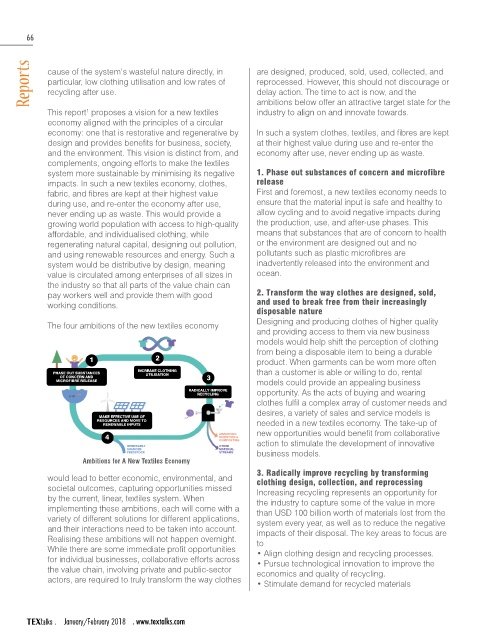
 middle-class population across the globe and   system leaves economic opportunities untapped,   The New Circular economy  would lead to better economic, environmental, and   3. Radically improve recycling by transforming
 puts pressure on resources, pollutes and degrades   In recent years, the industry and its customers have   societal outcomes, capturing opportunities missed   clothing design, collection, and reprocessing
 the natural environment and its ecosystems, and   become increasingly aware of the negative   by the current, linear, textiles system. When   Increasing recycling represents an opportunity for
 creates significant negative societal impacts at local,   environmental and societal impacts of the current   implementing these ambitions, each will come with a   the industry to capture some of the value in more
 regional, and global scales.  system. Brands and retailers have started to address   variety of different solutions for different applications,   than USD 100 billion worth of materials lost from the
 specific environmental or societal challenges within   and their interactions need to be taken into account.    system every year, as well as to reduce the negative
 Today’s linear system uses large amounts of   their supply chains, both individually and through   Realising these ambitions will not happen overnight.   impacts of their disposal. The key areas to focus are
 resources and has negative impacts on the   industry-wide organisations and initiatives. However,   While there are some immediate profit opportunities   to
 environment and people. The textiles industry relies   most of these efforts are focused on reducing the   for individual businesses, collaborative efforts across   • Align clothing design and recycling processes.
 mostly on non-renewable resources – 98 million   clothing utilisation – the average number of times a   impact of the current linear system – for example, by   the value chain, involving private and public-sector   • Pursue technological innovation to improve the
 tonnes in total per year – including oil to produce   garment is worn before it ceases to be used – has   using more efficient production techniques or   actors, are required to truly transform the way clothes   economics and quality of recycling.
 synthetic fibres, fertilisers to grow cotton, and   decreased by 36% compared to 15 years ago. While   reducing the impact of materials – rather than taking   • Stimulate demand for recycled materials
 chemicals to produce, dye, and finish fibres and   many low-income countries have a relatively high rate   an upstream, systemic approach to tackling the root


                January/February 2018                                                                                                                                                                      January/February 2018

