Page 68 - July-August-2017
P. 68

68                                                                                                                                                                                                                           69
                     Outlook for Digital                                                                                           interior e-textiles designed for health and fitness


                                                                                                                                   monitoring, self-cleaning, and communication.
         Reports  The textile printing industry represents 30 billion   implications, is not required as designs can be            the importance of Asian economies continues to                                                                                                                                                                   post-treatment. To date the huge reduction in water
                                                                                                                                   Global textile industry dynamics are changing and
                            Textile Printing
                                                                                                                                                                                                                                                                                                                                                    and power consumption when using digital textile
                                                                                                                                   increase, though there is also some
                                                                                                                                                                                                                                                                                                                                                    printing has not been a key driver for adoption of the
                                                                                                                                   backshoring/reshoring of production to North
                                                                                                                                                                                                                                                                                                                                                    technology. The increasing awareness of the
                                                                                                                                   America and Europe to ensure quality in high-value
                                                                                                                                                                                                                                                                                                                                                    environmental savings that digital printing offers
                                                                                                                                   applications.
                                                                                                                                                                                                                                                                                                                                                    compared to traditional methods is a long-term
             square meters of material volume on an annual
             basis worldwide. Most commercially available fabric
                                                              are minimal compared to conventional printing and
                                                              quantities as small as 1 metre can be provided.
             is rotary screen printed; each print run is typically   printed on demand. Lead times and start-up costs                                                                                                                                                                                                                               prospect for the success of the digital industry.
                                                                                                                                                                                                                                                                                                                                                    The two key factors in the future growth are
             several thousand yards. The high minimums are due   Double digit growth across 2016-2021, is expected                                                                                                                                                                                                                                  customisation and dynamics of the textile supply
             to the cost and time required to prepare a unique set   to make digital textile printing one of the most                                                                                                                                                                                                                               chain. The industry is led by changing consumer
             of screens, with each colour in a design requiring a   exciting market opportunity in the print and textile                                                                                                                                                                                                                            demand, particularly in Western markets where
             separate screen. Digital Textile printing is a   supply sectors according to the latest exclusive                                                                                                                                                                                                                                      personalisation and individualisation helped
             technique of applying colour to fabric in a particular   market data from Smithers Pira. The Future of Digital                                                                                                                                                                                                                         industries such as Direct-to-Garment printing. The
             design and pattern. Digital textile printing technology   Textile Printing to 2021 values this global market at                                                                                                                                                                                                                        other key factor comes from changes in the supply
             allows designs and images to be printed straight   €1.17 billion in 2016 with growth forecast at an                                                                                                                                                                                                                                    side of textile production. As brands and
             from the computer screen onto fabric creating    annual average of 12.3% for 2016-2021. This will see                                                                                                                                                                                                                                  manufacturers have looked to remain profitable in a
             exciting opportunities for customised design and   the market more than double in value over five years,                                                                                                                                                                                                                               tougher economic climate, both rising wages and
             allowing photographic quality reproduction onto   reaching €2.66 billion in 2021. Smithers’ exclusive                                                                                                                                                                                 technology continues to develop it is likely to   higher transportation costs have squeezed the
             natural fibres, such as silk, wool, linen and cotton.   analysis tracks how this will drive an even more rapid                                                                                                                                                                        become more affordable. As of now, the digital   profitability of products made in the Far East. As
             Industry data shows that after a decade of advances   increase in the volume of fabric printed with inkjet                                                                                                                                                                            printing process is significantly slower than the   countries such as China and India have grown, the
             in digital printing technologies for textile, less than   equipment – from 870 million m² in 2016 to 1.95                                                                                                                                                                             conventional printing techniques. For large parties of   growing middle class and gradual move towards a
             3% of the world’s printed textiles are produced   billion m² in 2021 – a 17.5% CAGR. In 2016 for                                                                                                                                                                                      fabric and limited requirements of colours and   service-driven economy have quickly increased the
             digitally. 25% of digital printing on textiles is done today   textiles the market share for digital processes is     Reactive Dye Digital Printing is the most versatile of                                                                                                          details, the conventional printing techniques remain   average wage, making it both more expensive to
             mainly on polyester fabrics using dye sublimation.  2.8% of overall volume. As this develops, major print             the high end digital printing technologies, with its                                                                                                            the most cost-effective. Digital printing is an   produce labour-intensive products but also creating
                                                              companies are increasingly taking an interest in the                 ability to print onto both silks and plant based                                                                                                                innovative development which has considerably    a large local market, thus increasing competition.
                                                              textile segment, fostering the development of new                    materials (e.g. cotton, linen and bamboo) and where                                                                                                             improved the sustainability. Digital printing is an   This has led to many companies expanding their
                                                              business models, printheads, inks, media, and high                   the print has no effect on the handle of the fabric as                                                                                                          inkjet-based application of colourants onto textile   sourcing into even lower cost markets such as
                                                              throughput machinery.                                                the dye bonds directly with the fabric fibres. This                                                                                                             materials. It is a clean technology because of a high   Bangladesh, Vietnam and Central America but digital
                                                                                                                                   also means that reactive printing has a greater light                                                                                                           degree of utilization of printing inks and minimum   also offers a secondary solution by lowering the
                                                              Based on application, the display segment has                        and rub fastness than other print technologies                                                                                                                  water and energy consumption during              labour cost input into production.
                                                              witnessed major growth in 2016 owing to increase in                  making it perfect for apparel and home ware. The
                                                              demand for touch panels and special effects                          sublimation ink segment has witnessed major
                                                              applications. Displays and signage are growing                       demand owing to increase in demand for
                                                              somewhat more slowly –from a larger base – but will                  dye-sublimation printer in computer printing
                                                              maintain double digit annual growth across the                       applications. Furthermore, the demand for
                                                              Smithers study period, which will convert into the                   pigment-based inks is projected to witness growth
                                                              largest absolute increase in value for 2016-2021.                    owing to its excellent archival print life coupled with
                                                              However, clothing and household segments are                         colour stability.
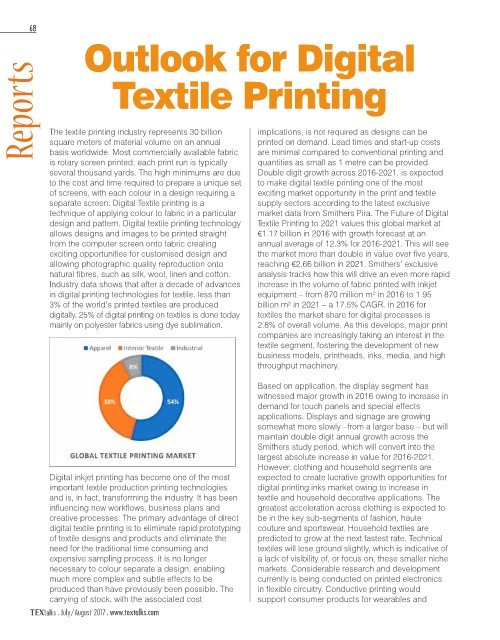
             Digital inkjet printing has become one of the most   expected to create lucrative growth opportunities for
             important textile production printing technologies   digital printing inks market owing to increase in                Digital fabric printing can completely customise and
             and is, in fact, transforming the industry. It has been   textile and household decorative applications. The          personalise the fabrics. Compared to almost a year
             influencing new workflows, business plans and    greatest acceleration across clothing is expected to                 required for design-to-market in traditional printing;
             creative processes. The primary advantage of direct   be in the key sub-segments of fashion, haute                    with digital printing it’s possible to go from the
             digital textile printing is to eliminate rapid prototyping   couture and sportswear. Household textiles are           design stage to finished fabric in a matter of weeks.
             of textile designs and products and eliminate the   predicted to grow at the next fastest rate. Technical             These possibilities are the strengths to offer
             need for the traditional time consuming and      textiles will lose ground slightly, which is indicative of           on-demand manufacturing of customised designs.
             expensive sampling process. it is no longer      a lack of visibility of, or focus on, these smaller niche            The major downside to digital printing is the cost
             necessary to colour separate a design, enabling   markets. Considerable research and development                      which is mainly attributed to low production speeds
             much more complex and subtle effects to be       currently is being conducted on printed electronics                  and high cost of the inks. As with any new
             produced than have previously been possible. The   in flexible circuitry. Conductive printing would                   technology, the costs are always high when it first
             carrying of stock, with the associated cost      support consumer products for wearables and
                                                                                                                                   becomes available. As time goes on and the
   63   64   65   66   67   68   69   70   71   72   73