


Page 70 - July-August-2017
P. 70
70
interior e-textiles designed for health and fitness 3. The approval process of establishment of 1,000 Syed Ali Ahsan said this seemed an election budget,
monitoring, self-cleaning, and communication. stitching units has been completed and its imple- as current year is the last year of government 5-year
Global textile industry dynamics are changing and mentation will start during FY 2017-18 and shall be tenure. He said the government is not serious in
the importance of Asian economies continues to post-treatment. To date the huge reduction in water completed in three years; increasing the GDP growth rate as it has not given
increase, though there is also some and power consumption when using digital textile 4. Textile Ministry will launch the first ever online textile any incentives to the industry without which their
backshoring/reshoring of production to North printing has not been a key driver for adoption of the business/trade portal for textiles using B2B (business dream of economic growth could not be materialized.
America and Europe to ensure quality in high-value technology. The increasing awareness of the to business) and B2C (business to consumer) mode. Former chairman APTMA Gohar Ejaz appreciated the
applications. environmental savings that digital printing offers This will bring Pakistan textiles’ value chain in line resolve of the government and hoped that the
The textile printing industry represents 30 billion implications, is not required as designs can be compared to traditional methods is a long-term with global marketing practices. industry will get incentives including uninterrupted
square meters of material volume on an annual printed on demand. Lead times and start-up costs prospect for the success of the digital industry. 5. The import duty on nonwoven fabric (used in the power supply. He said affordability but not availability
basis worldwide. Most commercially available fabric are minimal compared to conventional printing and pharmaceutical sector for manufacturing of band- of power is the real issue. He said hopefully the
is rotary screen printed; each print run is typically quantities as small as 1 metre can be provided. The two key factors in the future growth are ages, surgical gowns, wound dressings, etc.) was government will release sales tax refunds of the
several thousand yards. The high minimums are due Double digit growth across 2016-2021, is expected customisation and dynamics of the textile supply proposed to be reduced from existing 16 per cent to industry by August 2017 as announced by Federal
to the cost and time required to prepare a unique set to make digital textile printing one of the most chain. The industry is led by changing consumer 5 per cent. Minister Ishaq Dar in the budget speech. He was
of screens, with each colour in a design requiring a exciting market opportunity in the print and textile demand, particularly in Western markets where optimistic that the government will release tax
separate screen. Digital Textile printing is a supply sectors according to the latest exclusive personalisation and individualisation helped The minimum wage of labour is being increased from refunds in 90 days. APTMA leader Ali Pervez Malik
technique of applying colour to fabric in a particular market data from Smithers Pira. The Future of Digital industries such as Direct-to-Garment printing. The Rs 14,000 to Rs 15,000 per month. All the measures suggested that the government should have focused
design and pattern. Digital textile printing technology Textile Printing to 2021 values this global market at other key factor comes from changes in the supply announced in FY2016-17 like duty-free import of on solving the issues of current account deficit and
allows designs and images to be printed straight €1.17 billion in 2016 with growth forecast at an side of textile production. As brands and textile machinery will continue in FY2017-18. The trade deficit otherwise it is feared it has to go for
from the computer screen onto fabric creating annual average of 12.3% for 2016-2021. This will see manufacturers have looked to remain profitable in a recap of key measures in the past is below another IMF program. The government should
ensure zero rating of all inputs in true spirit including
exciting opportunities for customised design and the market more than double in value over five years, tougher economic climate, both rising wages and • The mark-up rate on Long Term Finance Facility packaging materials, spare parts and fuel and
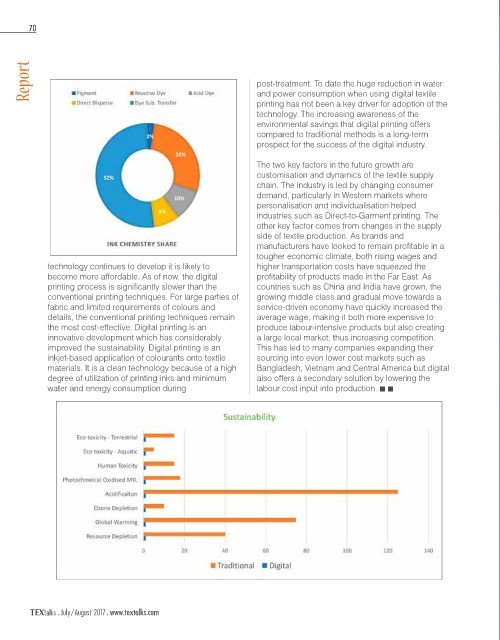
allowing photographic quality reproduction onto reaching €2.66 billion in 2021. Smithers’ exclusive technology continues to develop it is likely to higher transportation costs have squeezed the has been gradually reduced from 11.4pc in June energy, he further opined. APTMA said, the govern-
natural fibres, such as silk, wool, linen and cotton. analysis tracks how this will drive an even more rapid become more affordable. As of now, the digital profitability of products made in the Far East. As 207-18 Budget and 2013 to 6pc for exporters and 5pc for textile sector. ment is not serious about implementing the Rs. 180
Industry data shows that after a decade of advances increase in the volume of fabric printed with inkjet printing process is significantly slower than the countries such as China and India have grown, the • Duty free import of textile machinery is allowed; billion Prime Minister's export led growth package as
in digital printing technologies for textile, less than equipment – from 870 million m² in 2016 to 1.95 conventional printing techniques. For large parties of growing middle class and gradual move towards a • Uninterrupted supply of electricity and gas is the government has allocated only Rs. 4 billion next
3% of the world’s printed textiles are produced billion m² in 2021 – a 17.5% CAGR. In 2016 for fabric and limited requirements of colours and service-driven economy have quickly increased the its imapact on Textile Sector ensured for the textile sector; year. It was further said that due to wrong govern-
digitally. 25% of digital printing on textiles is done today textiles the market share for digital processes is Reactive Dye Digital Printing is the most versatile of details, the conventional printing techniques remain average wage, making it both more expensive to • Technology Up-gradation Fund (TUF) Scheme ment policies, the country’s merchandise trade deficit
mainly on polyester fabrics using dye sublimation. 2.8% of overall volume. As this develops, major print the high end digital printing technologies, with its the most cost-effective. Digital printing is an produce labour-intensive products but also creating 2016-19 for the textile sector has been introduced; has reached $31 billion -- the highest in the history of
companies are increasingly taking an interest in the ability to print onto both silks and plant based innovative development which has considerably a large local market, thus increasing competition. • Prime Minister's package for exporters was Pakistan. The country’s exports, which was to the
textile segment, fostering the development of new materials (e.g. cotton, linen and bamboo) and where improved the sustainability. Digital printing is an This has led to many companies expanding their The federal budget of Pakistan was proposed on beneficiary of the said package was assumed to be announced in January 2017 in which the centre-piece tune of $25 billion in 2013, has come down to $20
business models, printheads, inks, media, and high the print has no effect on the handle of the fabric as inkjet-based application of colourants onto textile sourcing into even lower cost markets such as May 26, 2017 with a total outlay of the budget is Rs. the textile industry. Energy production was severely is the textile sector; billion in 2017. The cost of doing business has
throughput machinery. the dye bonds directly with the fabric fibres. This materials. It is a clean technology because of a high Bangladesh, Vietnam and Central America but digital 5, 104 billion, with resource availability during depressed for more than 10 years due to chronic • The government made five export oriented sectors increased despite considerable decrease in oil
also means that reactive printing has a greater light degree of utilization of printing inks and minimum also offers a secondary solution by lowering the 2017-18 estimated at Rs 4,714 billion. The develop- under-investment, inefficiencies in the power network - including textile, leather, sports goods, surgical prices, in the international market the price of electric-
Based on application, the display segment has and rub fastness than other print technologies water and energy consumption during labour cost input into production. ment expenditure for next year will be Rs. 1,001 and an inability to collect sufficient revenue to cover goods and carpets - as part of zero-rated sales tax ity has doubled. He said they were getting electricity
regime last year.
at Rs 6.76 Kwh where as in 2017 electricity stands at
witnessed major growth in 2016 owing to increase in making it perfect for apparel and home ware. The billion, 40 percent higher than the Rs. 715 billion costs. It was also reinforced that by summer 2018, Rs. 11.30 Kwh. Payment of all pending refunds of
demand for touch panels and special effects sublimation ink segment has witnessed major allocation last year. Since current government has nearly 10,000MW of electricity will be added to the Industry’s Response sales tax, which is more than Rs. 200 billion resulting
applications. Displays and signage are growing demand owing to increase in demand for been in office, the economy has exhibited an overall national grid, eliminating load-shedding completing. The All Pakistan Textile Mills Association (APTMA) in creation of severe liquidity problem to the industry,
somewhat more slowly –from a larger base – but will dye-sublimation printer in computer printing positive trend. The per capita income today stands at said that the budget 2017-18 has disappointed the duty drawbacks and incentive schemes claims
maintain double digit annual growth across the applications. Furthermore, the demand for $1,629 as compared to $1,334, four years ago. The Budget for the Textile Sector textile industry as the government has not should also be made without any delay. The
Smithers study period, which will convert into the pigment-based inks is projected to witness growth inflation was on average 12% between 2008-13. In Pakistani Textile Manufacturing Sector contributes announced implementation of the proposals given by demands included to reduce the Turn Over Tax to
largest absolute increase in value for 2016-2021. owing to its excellent archival print life coupled with this current year inflation is expected to be around 8.50% of the national income. Cotton is the prime the industry. Chairman APTMA Punjab Syed Ali 0.25 per cent from existing 1 percent and to advise
However, clothing and household segments are colour stability. 4.3%. To some extent, the slump in international oil crop of Pakistan and makes the textile industry the Ahsan, former chairman APTMA Gohar Ejaz and Ali commercial banks to provide long term loans and
Digital inkjet printing has become one of the most expected to create lucrative growth opportunities for prices have contributed to this. The GDP Growth at most significant industry of the country. The textile Pervez Malik addressed a press conference, after working capital to the textile industry at
important textile production printing technologies digital printing inks market owing to increase in Digital fabric printing can completely customise and 5.28% this year is the highest in the past decade. industry contributes more than 60% of the total announcement of the proposed budget. The textile competitive rates.
and is, in fact, transforming the industry. It has been textile and household decorative applications. The personalise the fabrics. Compared to almost a year Four years’ ago, the economic growth was 3.68%. export earnings of the country. The sector constitutes industry had demanded following of the government.
influencing new workflows, business plans and greatest acceleration across clothing is expected to required for design-to-market in traditional printing; The size of the economy has surpassed $300 billion. 46% of the total manufacturing and provides 38% of • To provide gas to the system at regionally competi- Though the government’s support is instrumental but
creative processes. The primary advantage of direct be in the key sub-segments of fashion, haute with digital printing it’s possible to go from the The industrial production grew by 5.02% and the manufacturing labour force. The new measures tive rate of Rs. 400/MMB sector also needs to adopt an innovative and radical
digital textile printing is to eliminate rapid prototyping couture and sportswear. Household textiles are design stage to finished fabric in a matter of weeks. businesses are now hiring additional workers. proposed in the FY 2017-18 begun on July 1, 2017 • To remove levy of GIDC and electricity rate for policy. Especially, to capture the losing share of
independent feeders and provide it at the rate of Rs.
of textile designs and products and eliminate the predicted to grow at the next fastest rate. Technical These possibilities are the strengths to offer Exports during the first ten months of current year are: 7 KWH China in the apparel sector as the cost of production
need for the traditional time consuming and textiles will lose ground slightly, which is indicative of on-demand manufacturing of customised designs. have shown an overall minor decrease of 1.28% 1. To stabilise cotton prices in the country, a system • To release export refunds. in China becomes less competitive. Bangladesh (with
expensive sampling process. it is no longer a lack of visibility of, or focus on, these smaller niche The major downside to digital printing is the cost compared to 7.8% decline during the same period of cotton hedge trading for the domestic cotton will • To pay the remaining amount of Rs. 180 billion as advantage of being a least developed country, LDC,
necessary to colour separate a design, enabling markets. Considerable research and development which is mainly attributed to low production speeds last year. The government has associated this be initiated in consultation with stakeholders; per the Prime Minister's Export Led Growth Package status) and Vietnam have done extremely well in
much more complex and subtle effects to be currently is being conducted on printed electronics and high cost of the inks. As with any new reversal to timely support to exporters in shape of a 2. In consultation with public and private stakehold- according to which the government has to pay Rs 10 recent years to do so. In addition, the sector also
produced than have previously been possible. The in flexible circuitry. Conductive printing would technology, the costs are always high when it first comprehensive package of Rs.180 billion in January ers, the government will launch Brand Development billion per month whereas only Rs. 2 billion has been need to seriously explore avenues in the nonwovens
carrying of stock, with the associated cost support consumer products for wearables and 2017 and commitment of the exporters. The major fund for textile sector; released so far during the last four months. and technical textiles.
becomes available. As time goes on and the

