


Page 74 - TEXtalks March/April 2022
P. 74
74


 versatility make them desirable for commercial,   much higher than the combined volume of nonwoven   known as a sustainable material. Synthetic   gowns, and other PPE products. Moreover,
 domestic, and industrial use.  and composites (20% each).  fiber-reinforced polymer composites provide   nonwoven fabrics witness higher growth owing to
 high-strength & stiffness materials widely accepted   their vapor transmission capacity, higher bacterial
 Market Size and Potential   Meanwhile, the increasing focus on the safety and   as aerospace components and automotive   resistance, and higher strength compared to other
 The total global market of technical textiles is   performance of end-users has led to the   industries. Synthetic polymers are made from raw   fabrics. The global medical textiles market will reach
 estimated between US$190-200 billion in 2020. The   development and use of highly functional materials in   materials such as petroleum-based on chemicals or   USD 26.21 billion by 2028, and it is expected to
 demand for technical textiles is likely to gain traction   sportswear and outdoor leisure clothing. The   petrochemicals. The application of synthetic polymer   expand at a CAGR of 4.5% from 2021 to 2028. The
 across Asia-Pacific countries. Europe and China   Sportech textiles market is expected to grow by USD   is used in bulletproof vests, heat resistant garments,   emergence of new areas of applications of medical
 together account for more than 50% of the global   34.71 billion from 2021 to 2026 at a CAGR of   high-performance sporting goods, heavy-lifting lines,   textiles, along with the development of new fibers
 technical textile production, while India accounts for   13.04%, as per the latest report by Technavio. About   tow cables, and others. Synthetic fiber followed by   and manufacturing technologies for yarn and fabrics,
 approximately 5% of the production. The global   31% of the market's growth will originate from APAC   natural fiber, regenerated fiber, and other fibers is   is expected to bolster the market growth over the
 technical textiles market is expected to rise to US$220   during the forecast period. China and India are the   used in various regions across the globe.  forecast period. Based on product, the nonwoven
 billion by 2025. According to the published research   key markets for the Sportech textiles market in APAC.   segment accounted for the largest revenue share of
 report of ResearchAndMarkets, the global technical   Market growth in this region will be faster than the   APAC region to lead the global technical textile   over 65.0% in 2020. The segment is also expected to
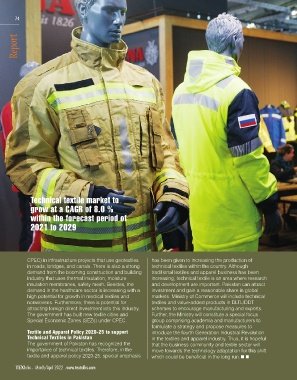
 textile market is expected to grow at a CAGR of 8.0 %   market's growth in South America. The popularity of   market by 2025  witness the fastest growth over the forecast period
 within the forecast period of 2021 to 2029.   sports and other fitness activities will facilitate the   As reported by MarketsandMarkets Research   due to the low production cost and enhanced
 Sportech textiles market growth in APAC over the   Company, the APAC region accounted for the largest   penetration in healthcare and hygiene products.
 The increasing demand for sports apparel is one of   forecast period.  market share in 2019. Factors such as improving the
 the key drivers supporting the Sportech textiles   global economy, expanding working population,   Technical fibers, yarns, and fabrics
 market growth. Sportech textiles are used to produce   Synthetic Polymer Leads the Technical Textile   rising domestic demand for hygiene products are   The volume of world exports in the technical fiber
 sports apparel, including jerseys, team uniforms, and   Market  expected to boost the market for technical textiles.   category is US$6.7 billion in 2019. Pakistan's exports
 other durable wear, for the performance training of   Nowadays, natural fibers replace synthetic fibers   The market for technical textile in APAC is growing in   in this category are nil; however, its imports were
 athletes. Technical textiles are either produced using   because of environmental concerns as reinforced   the automobile, agriculture, geotextiles, industrial   US$40 million in 2019. Aramid, coconut, jute, and
 woven/knitted fabrics, nonwoven or composite   material in polymer composites for engineering   military, medical / healthcare, and construction   other bast fibers, PP, abaca, and vegetable fibers   conventional textiles, and however, there are few   Pakistan: dedicated/specialized technical textile
 materials. The total volume of technical textiles   materials. Synthetic polymer plays a vital role in the   industries due to the unique functional properties   come under this category. The global export market   technical textile industries in the country. There are   industry clusters and conventional textile industry
 produced using woven/knitted fabrics is about 60%,   textile industry as it has dynamic properties & is also   offered by technical textiles, such as hygiene and   of the technical yarn category is US$16 billion,   three major building blocks of Pakistan's technical   producing technical textiles. The technical textile
 safety, cost-effectiveness, durability, strength,   including monofilament yarns, aramids, glass fibers,   textile market: large manufacturers, converters, and   industry exists in Pakistan as small industrial clusters
 lightweight, versatility, user-friendliness,   rubber, and nylon. Pakistan's total exports in this   end-users/society. The material/large-scale   of SMEs in Sialkot, Gujranwala, Faisalabad, Lahore,   Technical textile market to
 environmental friendliness, and logistical   category are US$0.5 million in 2019. In the same   manufacturers are few in Pakistan compared to other   and Karachi. The conventional textile industries of
 convenience.  year, Pakistan imported technical yarns worth   countries globally that are leading in technical textiles.   Pakistan (large-scale industries and SMEs) produce   grow at a CAGR of 8.0 %
 US$14.9 million. The global export market of the   technical textiles by diversifying their products,
 Medical Textiles an emerging technical textile   technical fabric category was US$12.5 billion in the   dealing with health care textiles, protective textiles,   within the forecast period of
 market  same period.  Pakistan's nonwoven industry is not very big in size,   and packaging textiles. These industries are mainly   2021 to 2029
 The COVID-19 outbreak in 2020 has exponentially   and about 15-20 manufacturers are producing   based in Faisalabad, Lahore, Multan, and Karachi.
 increased the demand for medical textiles, especially   Pakistan's Scenario and Potential  nonwoven for local and the export market. The   Pakistan's textile sector is currently running on
 nonwoven fabrics used to produce face masks,   In Pakistan, most of the textile sector is focused on   primary raw material used is polypropylene, and the   conventional textiles; however, the country must
 main fabrication techniques include needle punch,   move to technical textile production and exports to
 spunbond, spunbond-meltblown spun-bond (SMS)   further strengthen its roots to support its GDP.   CPEC) in infrastructure projects that use geotextiles   has been given to increasing the production of
 technique. Overall, more than 200 companies
 Technical Textiles are defined as textile materials and   fibers/filaments based on the desired properties of   manufacture technical textiles, composites, and   Strength and Opportunities  in roads, bridges, and canals. There is also a strong   technical textiles within the country. Although
 products manufactured primarily for their technical   the end product. The fibers/filaments used can be   nonwovens in Pakistan. These producers are   The total trade volume of technical textiles in 2019 in   demand from the booming construction and building   traditional textiles and apparel business has been
 and performance properties rather than their   broadly classified as natural or manmade. Natural   generally small and medium-sized companies, but   the world was equal to US$200 billion. Pakistan's   industry that uses thermal insulation, moisture   increasing, technical textile is an area where research
 aesthetic or decorative characteristics. Technical   fibers are important raw materials for the technical   some large-scale companies produce technical   share in exports was equal to US$455 million, which   insulation membranes, safety mesh. Besides, the   and development are important. Pakistan can attract
 textiles are used in different forms in various   textile industry due to the enhanced global demand   textiles. Most of the companies in Pakistan lie in the   accounts for 0.215%. At the same time, Pakistan   demand in the healthcare sector is increasing with a   investment and gain a reasonable share in global
 industries like construction, transport, agriculture,   for sustainable production. The natural fibers   category of "converters." They procure raw material,   imported about US$313 million worth of technical   high potential for growth in medical textiles and   markets. Ministry of Commerce will include technical
 medical, hygiene, and sporting. In industrial   predominantly used in technical textiles include   e.g., fiber, yarn, or fabric, and convert it into the final   textiles in 2019. However, Pakistan has great   nonwovens. Furthermore, there is potential for   textiles and value-added products in DLTL/DDT
 manufacturing operations, technical textiles are used   cotton, jute, silk, and coir. The demand for textile is   product. The end user includes local and export   potential to increase its production of technical   attracting foreign direct investment into this industry.   schemes to encourage manufacturing and exports.
 for filters, machine clothing, conveyor belts, and   increasing as per the needs & its application.   markets. The local end users are not relatively aware   textiles. Low labor cost, low energy rates, a large   The government has built new textile cities and   Further, the Ministry will constitute a special focus
 abrasive substrates. They are also incorporated into   of the importance and benefits of technical textiles,   number of SMEs, and a diverse industry are the   Special Economic Zones (SEZs) under CPEC.   group comprising academia and manufacturers to
 industrial products such as electrical components   Consumers are expecting better quality of textiles   and there has never been an organized campaign to   strengths of Pakistan that can do the needful in   formulate a strategy and propose measures to
 and cables, flexible seals and diaphragms, and   along with their sustainable property. These textiles   create awareness regarding its significance.   promoting technical textiles in the country. The   Textile and Apparel Policy 2020-25 to support   introduce the fourth Generation Industrial Revolution
 acoustic and thermal insulation for other domestic   are known for their superior characteristics over   Furthermore, the main focus of the converters is the   growth potential of the local market is very strong   Technical Textiles in Pakistan  in the textiles and apparel industry. Thus, it is hopeful
 appliances.   traditional equivalents and are utilized for specific   export market due to better profit margins.   due to the growing demand for technical textiles at   The government of Pakistan has recognized the   that the business community and textile sector will
 functionalities. Characteristics and features such as   the local level. This growing demand is primarily due   importance of technical textiles. Therefore, in the   move towards the technology adaptation for this shift
 Technical textiles are manufactured from a variety of   superior technical performance, higher strength, and   textile and apparel policy 2020-25, special emphasis   which could be beneficial in the long run.
 There are two types of technical textile industries in   to large government investments (mainly through
               March/April 2022

