


Page 77 - TEXtalks March/April 2022
P. 77
76                                                                                                             77

 Naia™cellulosic fibers                                            Researchers created


 biodegrade within 13 weeks                                        a fabric that can
                                                                   ‘Hear’ Heartbeat


 A recent study from the Woods Hole Oceanographic Institution (WHOI), the world’s leading independent
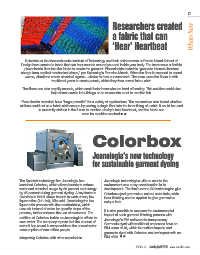
 nonprofit organization dedicated to ocean research, exploration, and education, shows that Naia™   Scientists at the Massachusetts Institute of Technology and their collaborators at Rhode Island School of
 cellulosic fibers entirely disintegrate in the ocean within 13 weeks, and are biodegradable within months,   Design have created a fabric that can hear sounds around you and inside your body. The team wove a flexible
 so they do not persist in our oceans.   piezoelectric fiber into the fabric to create the garment. Piezoelectric materials “generate internal electrical
             charge from applied mechanical stress,” per Sciencing’s Francine Mends. When the fiber is exposed to sound
 This means that fabrics made with Naia™ have a reduced impact on the environment and help us on   waves, vibrations create electrical signals—similar to how our ears work. The team wove the fibers in with
 our mission to achieve a more sustainable fashion industry. Furthermore, Naia™ cellulosic fiber is   traditional yarns to create panels, which they then sewed into a shirt.
 produced in a safe, closed-loop process where solvents are recycled back into the system for reuse.
 Naia™ is OEKO-TEX® 100 Product Class I certified and is made with no hazardous chemicals listed on   The fibers can also amplify sounds, which could help those who are hard of hearing. This solution could also
 the ZDHC Manufacturing Restricted Substances List.  help detect cracks in buildings or be woven into a net to monitor fish.

 With full transparency from tree to fiber, Naia™ is responsibly sourced from sustainably managed pine   Piezoelectric materials have “huge potential” for a variety of applications. The researchers also tested whether
 and eucalyptus forests and plantations to ensure no deforestation of ancient and endangered forests.   clothes could act as a fabric stethoscope by sewing a single fiber into the inner lining of a shirt. It could be used
 This effort to create a more sustainable textiles industry was recognized in Canopy’s 2020 Hot Button   in maternity clothes in the future to monitor a baby’s fetal heartbeat, and the fabric can
 Report, where Eastman ranked third for our sustainable production of Naia™ cellulosic fiber and was   even be machine-washed.
 acknowledged for fiber innovation through our recent launch of Naia™ Renew—a circular fiber produced
 from a portfolio of hard-to-recycle waste materials diverted from landfill. Thus, switching to these fibers
 could solve the pollution problem across the textile value chain.
                                                       Colorbox


                                                       Jeanologia’s new technology
                                                       for sustainable garment dyeing


 S360o: A new circular textile cycle process promoting sustainability
             The Spanish technology firm Jeanologia has        Jeanologia technologies with no cost to the
 Spain-based mill Textil Santanderina is closing the   The textile waste is processed with stripping   launched Colorbox, which allows brands to reduce   environment was a key consideration in its
 loop with its S360 production process. S360o is an   machines that break the yarns and fabric into smaller   water and chemical usage by 60 percent and energy   development. The firm’s ozone G2 technologies give
 innovative, sustainable circular cycle that gives   pieces during the recycling process before pulling   by 45 percent during garment dyeing. A key factor in   Colorbox-dyed garments a natural color fade, while
 fabrics a brand-new life. The solution takes pre-and   them apart into a fiber. The mix is carded several   Colorbox is that it allows brands to work at very low   laser finishing can be applied to give garments a
 post-consumer waste and upcycles it into new   times to clean and mix the fibers before being spun   liquor ratios (1:2-1:4), Silla said. Combining the low   unique look.
 textiles. At a recycling plant in Morocco, the fabric   into new yarns and textiles. Textil Santanderina is a   liquor ratio process with the nanobubbles, which
 first goes through stripping machines that separate   cutting-edge company located in Cantabria and one   uses air instead of water for specific steps of the   It is also possible to measure the environmental
 the scraps into smaller pieces, and then the fibers are   of the textile benchmarks for quality and service. The   process, further reduces the use of resources. The   impact of each garment finishing process with
 carded to clean and combine before spinning. The   company is customer-focused and has an extensive   addition of Colorbox builds on Jeanologia’s efforts to   Jeanologia’s EIM software for transparency.
 product range that includes everything from cotton
 mill saves on water, chemicals, and energy by   classics to the latest innovations using technical   save water. The company reports that the amount of   Garments dyed with traditional processes have an
 repurposing scraps and deadstock.  fibers.  water it has saved is comparable to the annual water   EIM score of 49, which is medium impact, and
             consumption of one million people.
                                                               garments dyed with Colorbox are low impact with an
             Integrating Colorbox with other sustainable       EIM of 30.

 March/April 2022                                                                        March/April 2022

