


Page 78 - TEXtalks March/April 2022
P. 78
78                                                                                                                                                                                                                              79
                   Drexel's TopoKnit System for                                                                                     Alchemie’s new Novara precision


                                 Functional Fabrics                                                                                     digital finishing solution offers


                                                                                                                                                      85% energy savings


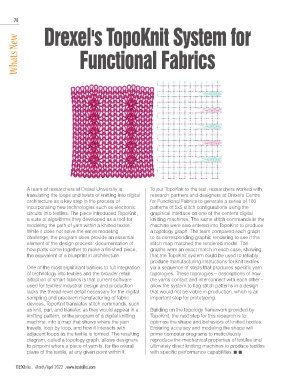
            A team of researchers at Drexel University is    To put TopoKnit to the test, researchers worked with
            translating the loops and twists of knitting into digital   research partners and designers at Drexel's Centre
            architecture as a key step in the process of     for Functional Fabrics to generate a series of 100                   DAlchemie Technology, based in Cambridge, UK, says   sided application. The technology enables high-value
            incorporating new technologies such as electronic   patterns of 5x5 stitch configurations using the                   its new Novara precision digital finishing solution can   finishes to be used cost-effectively.
            circuits into textiles. The piece introduced TopoKnit,   graphical interface on one of the center's digital           help European textile manufacturers save more than
            a suite of algorithms they developed as a tool for   knitting machines. The same stitch commands in the               €1 million a year and return to profitability as energy   The power and gas prices are increasing globally,
            modeling the path of yarn within a knitted textile.   machine were also entered into TopoKnit to produce              prices surge across the continent. Novara uses high   resulting in additional costs during finishing. For
            While it does not solve the entire modeling      a topology graph. The team compared each graph                       velocity jetting technology to apply nano-droplets of   example, EU gas prices soared throughout 2021 – and
            challenge, the program does provide an essential   to its corresponding graphic rendering to see if the               functional finishes, only where needed, on fabrics,   have risen even more sharply due to the conflict in
            element of the design process: documentation of   stitch map matched the rendered model. The                          using 85% less energy and up to 50% less chemistry   Ukraine, which has sparked fresh concerns about
            how parts come together to make a finished piece,   graphs were an exact match in each case, showing                  compared to traditional methods. Traditional textile   global energy supplies. The European gas price has
            the equivalent of a blueprint in architecture.   that the TopoKnit system could be used to reliably                   finishing is an energy-intensive process that applies   risen from €16 a year ago to a peak of €142 per MWh
                                                             produce manufacturing instructions for knit textiles                 liquid finishes by immersing the whole fabric in a   on March 1st. It requires over 2 kWh per kg of material
            One of the most significant barriers to full integration   via a sequence of steps that produces specific yarn        chemical bath and adding around 80% water by mass   to dry fabrics that have been through a padding bath.
            of technology into textiles and the broader retail   topologies. These topologies – descriptions of how               to the fabric, which needs to be dried. However,   Alchemie estimates that spiraling gas costs have
            adoption of smart fabrics is that current software   the yarns contact and interconnect with each other –             Novara precision digital finishing is a low-energy,   increased the annual energy costs for a typical EU
            used for textiles' industrial design and production   allow the system to flag stitch patterns in a design            single-sided application system that enables      textile finishing operation by over €1 million a year.
            lacks the thread-level detail necessary for the digital   that would not be viable in production, which is an         functional finishes to be applied at up to 20 times the   However, Novara has got you covered with its
            sampling and precision manufacturing of fabric   important step for prototyping.                                      concentration of traditional processes – with a more   cutting-edge technology. There is also a significant
            devices. TopoKnit translates stitch commands, such                                                                    even application and higher quality. This results in   sustainability benefit to the Novara system. The energy
            as knit, purl, and transfer, as they would appear in a   Building on the topology framework provided by               energy savings of up to 85%. Novara is suitable for   savings correspond to around 1 kg CO2 per kg in
            knitting pattern, or the program of a digital knitting   TopoKnit, the next step for this research is to              applying a wide range of finishes, including      reduced carbon emissions. The EU alone produces
            machine, into a map that shows where the yarn    optimize the shape and behaviors of knitted textiles.                waterproofing, stain resistance, self-cooling, fire   around 130,000 tons of technical textiles fabric per
            travels, loop by loop, and how it interacts with   Ensuring accuracy and modeling the shape will                      retardant, metallics / visual effects, and antiviral.   year, and switching to Novara technology would
            adjacent loops as the textile is formed. The resulting   prime computer programs to meticulously                      Flexibility for precision delivery of a wide range of   reduce more than 100,000 tonnes of carbon dioxide
            diagram, called a topology graph, allows designers   reproduce the mechanical properties of textiles and              finishes for technical textiles with 2D patterning and   emissions
            to pinpoint where a piece of yarn is, for the overall   ultimately direct knitting machines to produce textiles
            plane of the textile, at any given point within it.   with specific performance capabilities.

               March/April 2022                                                                                                                                                                                March/April 2022

