


Page 83 - May-June-2017
P. 83
83
 Seamless                                             Fraunhofer Institute                                         Whats New

 Whats New  The new totally-reversible seamless denim quilted  jacket  introduces new FIDYST
 denim quilted


                                                      nonwoven software


 new totally-reversible seamless denim quilted jacket
 produced on the Santoni machine aims to provide
 jacket produced on the Santoni machine aims to
 provide greater comfort due to its dedicated areas of
 increased fit and well-being as determined by the
 increased fit and well-being as determined by the
 use of embedded indigo Tencel fibre and elastomers
 use of embedded indigo Tencel fibre and elastomers
 to give higher elasticity and flexibility.  greater comfort due to its dedicated areas of
 to give higher elasticity and flexibility.
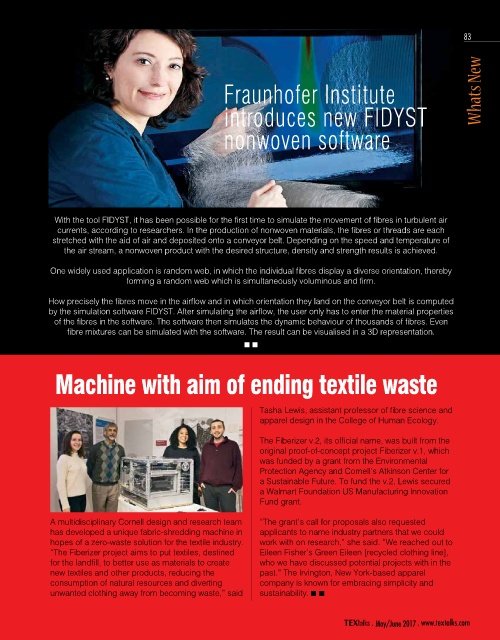
              With the tool FIDYST, it has been possible for the first time to simulate the movement of fibres in turbulent air
 The multi-layered seamless knitted panel consists of   The multi-layered seamless knitted panel consists of   currents, according to researchers. In the production of nonwoven materials, the fibres or threads are each
 three layers of different yarns with a reverse use. The   three layers of different yarns with a reverse use. The   stretched with the aid of air and deposited onto a conveyor belt. Depending on the speed and temperature of
 resulting quilting effect is obtained directly on the   resulting quilting effect is obtained directly on the   the air stream, a nonwoven product with the desired structure, density and strength results is achieved.
 machine by specific stitches that hold the two layers   machine by specific stitches that hold the two layers
 of fabric, together this produces a thickness in the   of fabric, together this produces a thickness in the   One widely used application is random web, in which the individual fibres display a diverse orientation, thereby
 fabric, so creating a quilting effect which increases   fabric, so creating a quilting effect which increases   forming a random web which is simultaneously voluminous and firm.
 the profile of the relief when compared to the rest of   the profile of the relief when compared to the rest of
 the fabric, giving a unique change in its texture. The   the fabric, giving a unique change in its texture.  How precisely the fibres move in the airflow and in which orientation they land on the conveyor belt is computed
             by the simulation software FIDYST. After simulating the airflow, the user only has to enter the material properties
              of the fibres in the software. The software then simulates the dynamic behaviour of thousands of fibres. Even
                 fibre mixtures can be simulated with the software. The result can be visualised in a 3D representation.
 Digital Textile

 Micro Factory at   Machine with aim of ending textile waste


 Texprocess

                                                              Tasha Lewis, assistant professor of fibre science and
                                                              apparel design in the College of Human Ecology.

 The first stage in the micro factory is the CAD/Design   Texprocess partners in the software and hardware   The Fiberizer v.2, its official name, was built from the
 area. With the help of computer-aided design (CAD)   business Ergosoft and Mimaki, as well as   original proof-of-concept project Fiberizer v.1, which
 and the Vidya 3D-simulation software, creative   Coldenhove and Monti Antonio are the ones ensuring   was funded by a grant from the Environmental
 designs are put into effect in a virtual reality and/or   optimum printing results at this station.  Protection Agency and Cornell’s Atkinson Center for
 adapted. The data that emerge from this are                  a Sustainable Future. To fund the v.2, Lewis secured
 immediately merged with data for subsequent   After this comes the cutting area. At this juncture in   a Walmart Foundation US Manufacturing Innovation
 processes, such as the digital printing of the textile,   the production process, the individual orders need   Fund grant.
 the cutting out and sewing. Texprocess partner for   first to be identified without anyone touching them.
 the Design area is Assyst, a company in the Human   Identification is made possible by automatically   A multidisciplinary Cornell design and research team   “The grant’s call for proposals also requested
 Solutions Group.  loading the appropriate data files for the cutting-out   has developed a unique fabric-shredding machine in   applicants to name industry partners that we could
 process. A feeder system at the cutter ensures that
 The next stage (printing) demonstrates large-format   the material is transported as smoothly as possible   hopes of a zero-waste solution for the textile industry.   work with on research,” she said. “We reached out to
                                                              Eileen Fisher’s Green Eileen [recycled clothing line],
             “The Fiberizer project aims to put textiles, destined
 inkjet printing, involving sublimation printing on   and without distortion. Camera systems recognise   for the landfill, to better use as materials to create   who we have discussed potential projects with in the
 polyester and pigment printing on cotton and mixed   the cutting points, as a result of which the path the   new textiles and other products, reducing the   past.” The Irvington, New York-based apparel
 fibres. Manufacturing tasks can be flexibly combined   cutter is to take is optimised and a top-quality cut can   consumption of natural resources and diverting   company is known for embracing simplicity and
 here with various printing parameters so as to   be achieved. Texprocess partner in this area is Zünd.  unwanted clothing away from becoming waste,” said   sustainability.
 produce a print with reproducible colours.

