


Page 84 - May-June-2017
P. 84
84
                                                           New digital


                                                           cutters by


                                                           Zünd


            Zünd has always put great emphasis on producing   manufacturer explains.
            cutting and software solutions that are completely
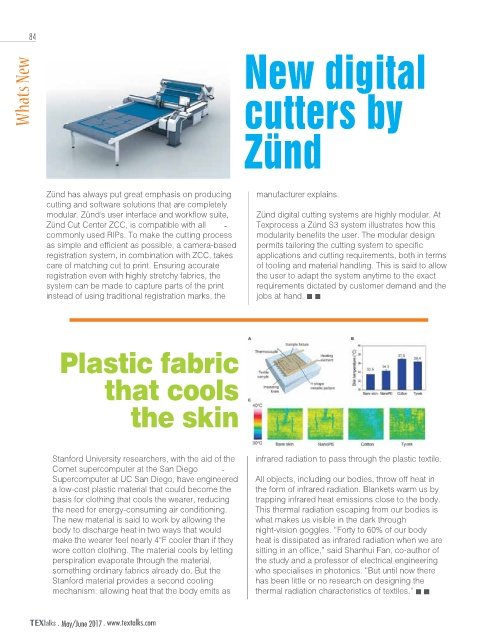
            modular. Zünd's user interface and workflow suite,   Zünd digital cutting systems are highly modular. At
            Zünd Cut Center ZCC, is compatible with all   -   Texprocess a Zünd S3 system illustrates how this
            commonly used RIPs. To make the cutting process   modularity benefits the user. The modular design
            as simple and efficient as possible, a camera-based   permits tailoring the cutting system to specific
            registration system, in combination with ZCC, takes   applications and cutting requirements, both in terms
            care of matching cut to print. Ensuring accurate   of tooling and material handling. This is said to allow
            registration even with highly stretchy fabrics, the   the user to adapt the system anytime to the exact
            system can be made to capture parts of the print   requirements dictated by customer demand and the
            instead of using traditional registration marks, the   jobs at hand.


               Plastic fabric


                          that cools


                                the skin


             Stanford University researchers, with the aid of the   infrared radiation to pass through the plastic textile.
             Comet supercomputer at the San Diego    -
             Supercomputer at UC San Diego, have engineered   All objects, including our bodies, throw off heat in
             a low-cost plastic material that could become the   the form of infrared radiation. Blankets warm us by
             basis for clothing that cools the wearer, reducing   trapping infrared heat emissions close to the body.
             the need for energy-consuming air conditioning.    This thermal radiation escaping from our bodies is
             The new material is said to work by allowing the   what makes us visible in the dark through
             body to discharge heat in two ways that would   night-vision goggles. “Forty to 60% of our body
             make the wearer feel nearly 4°F cooler than if they   heat is dissipated as infrared radiation when we are
             wore cotton clothing. The material cools by letting   sitting in an office,” said Shanhui Fan, co-author of
             perspiration evaporate through the material,    the study and a professor of electrical engineering
             something ordinary fabrics already do. But the   who specialises in photonics. “But until now there
             Stanford material provides a second cooling     has been little or no research on designing the
             mechanism: allowing heat that the body emits as   thermal radiation characteristics of textiles.”

