


Page 146 - TEXtalks. May-June 2023
P. 146
145


        Reports


 Fast fashion companies operate on the concept of   recycling of used textile products. This is done to
 introducing new designs and products at a rapid   ensure that less virgin materials like cotton or
 pace. Some companies come up with one new   polyester are reused. The recycling of polyester can
 design a day. This is against the basic concept of   reduce millions of tons of plastic that are thrown into
 sustainable clothing.  the sea every year. Recycling is not an easy job, it
 requires a lot of funds and new technology. Prior to
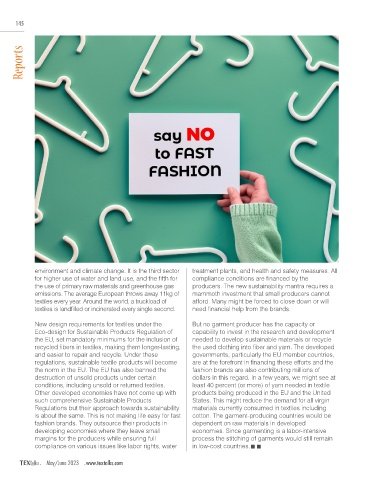
 The European Union has directed fashion retailers to   recycling accessories from the clothing are removed.
 reduce their monthly or yearly offerings that induce   These include zips, buttons, steel monograms, and
 consumers to buy more clothes than needed. The   other accessories. This again is a laborious task.
 textile sector employs over 1.5 million people in over   Again the funds for recycling are provided by
 160 000 companies, with a turnover of €162 billion in   consortiums of fashion brands and governments in
 2019. Thereafter global textiles production almost   developed countries.
 doubled between 2000 and 2015, and the
 consumption of clothing and footwear is expected to   The problem for fast fashion brands is that recycled
 increase by 63 percent by 2030. Now that it has been   polyester fiber is not as fine as virgin fiber. They are
 established that every piece of dress that is   investing millions to ensure that the recycled yarn   environment and climate change. It is the third sector   treatment plants, and health and safety measures. All
 produced taxes nature severely and leaves a sizable   and fabric are as fine as the virgin. The recycling of   for higher use of water and land use, and the fifth for   compliance conditions are financed by the
 carbon print. The fashion designs moreover have   PET bottles had been in vogue for over a decade and   the use of primary raw materials and greenhouse gas   producers. The new sustainability mantra requires a
 manmade fiber produced as a petroleum byproduct   the fiber produced is now being bought by the textile   emissions. The average European throws away 11kg of   mammoth investment that small producers cannot
 causes more harm to the environment than the   millers to produce yarn for fashion fabric. Another   textiles every year. Around the world, a truckload of   afford. Many might be forced to close down or will
 apparel produced from cotton which is a natural fiber   trend that is impacting fashion brands is the   textiles is landfilled or incinerated every single second.  need financial help from the brands.
 and is degradable when buried in soil. But then the   tendency among consumers in developed countries
 environmentalists raise objections to the way cotton   to buy used clothes or refurbished clothing. In some   New design requirements for textiles under the   But no garment producer has the capacity or
 is cultivated. The crop uses a lot of water, fertilizers,   countries, about 40 percent of consumers now prefer   Eco-design for Sustainable Products Regulation of   capability to invest in the research and development
 and pesticides that pollute the environment and   buying used clothes.  the EU, set mandatory minimums for the inclusion of   needed to develop sustainable materials or recycle
 weaken the soil. It is now almost made compulsory   recycled fibers in textiles, making them longer-lasting,   the used clothing into fiber and yarn. The developed
 for textile mills to use cotton produced in sustainable   According to a projection, some 100 billion garments   and easier to repair and recycle. Under these   governments, particularly the EU member countries,
 ways. It means using less water and using no or   will find their way to a United States landfill in the next   regulations, sustainable textile products will become   are at the forefront in financing these efforts and the
 minimum fertilizers and pesticides. There are   five years, and less than 1 percent of actual garment   the norm in the EU. The EU has also banned the   fashion brands are also contributing millions of
 hundreds of NGOs guiding and training these   waste is recycled. The fashion industry is responsible   destruction of unsold products under certain   dollars in this regard. In a few years, we might see at
 farmers in adopting the best cotton-producing   for between 8 and 10 percent of global greenhouse   conditions, including unsold or returned textiles.   least 40 percent (or more) of yarn needed in textile
 practices. These NGOs are funded by retail brands,   gas emissions, more than aviation and shipping   Other developed economies have not come up with   products being produced in the EU and the United
 which is a big expense. The traceability of cotton   combined. Some 70 percent of fashion's emissions   such comprehensive Sustainable Products   States. This might reduce the demand for all virgin
 used in any textile product is essential to rule out the   come from its supply chains, concentrated in raw   Regulations but their approach towards sustainability   materials currently consumed in textiles including
 possibility of the use of cotton produced from   material production, processing, and preparation. In   is about the same. This is not making life easy for fast   cotton. The garment-producing countries would be
 unsustainable methods or from areas where child   clothes and furniture, medical and protective   fashion brands. They outsource their products in   dependent on raw materials in developed
 labor exists.  equipment, buildings and vehicles, textiles are the   developing economies where they leave small   economies. Since garmenting is a labor-intensive
 fabric of everyday life. European consumption of   margins for the producers while ensuring full   process the stitching of garments would still remain
 The new concept introduced in recent years is the   textiles has the fourth highest impact on the   compliance on various issues like labor rights, water   in low-cost countries.
                May/June 2023

