Page 69 - November-December-2018
P. 69

68                                                                                                             69                                                           suppliers of textiles and garments with around 7 per   with WTO rules. Needless to say, if the US removes             expected to benefit suppliers such as the European   agency places textiles and garments at a high risk for


                                                                                                                                                                                                                                                                                                   Union, southeast Asia, and countries participating in
                                                                                                                                                                             cent, 5 per cent and 4.5 per cent share respectively.
                                                                                                                                                                                                                                                                                                                                                     non-compliance, given that import duty rates for
                                                                                                                                                                                                                              its tariffs, our measures will also be removed.”
 Reports  Textile Industry  & US Trade Wars                                                                                                                                  While China is by far the leading supplier of textiles   Canada’s Retaliation                                         China’s “One Belt, One Road” initiative. China has   China-made textiles and garments are now in some                                                                    distributed
                                                                                                                                                                                                                                                                                                   responded to each stage of the Section 301 tariff
                                                                                                                                                                                                                                                                                                                                                     cases relatively high. Moreover, a substantial share of
                                                                                                                                                                                                                              Canada imposed countermeasures (surtaxes)
                                                                                                                                                                                                                                                                                                                                                                                                                                                                            (FTC), many

                                                                                                                                                                                                                                                                                                   increases the U.S. has imposed against imports from
                                                                                                                                                                             and clothing, surprisingly, US tariffs are higher on
                                                                                                                                                                                                                                                                                                                                                     the US textile and garment imports from Southeast

                                                                                                                                                                                                                              against C$16.6 billion in imports of steel, aluminium
                                                                                                                                                                                                                                                                                                                                                                                                                                                                            labelling re
                                                                                                                                                                                                                                                                                                   China with duty hikes of its own. However, this
                                                                                                                                                                             clothing imports from many other Asian countries
                                                                                                                                                                                                                                                                                                                                                     Asia can claim preferential tariff treatment under the

                                                                                                                                                                                                                              and other products from the United States beginning
                                                                                                                                                                                                                                                                                                                                                                                                                                                                            accountable,
                                                                                                                                                                                                                                                                                                   retaliation has resulted in higher costs for imports
                                                                                                                                                                             compared to China. Garments from countries like
                                                                                                                                                                                                                                                                                                                                                     US Generalised System of Preferences (GSP). It

                                                                                                                                                                                                                              July 1. As per the full list of retaliatory tariffs released
                                                                                                                                                                                                                                                                                                   from the U.S., including key components in the
                                                                                                                                                                                                                                                                                                                                                     eliminates textile-garment tariffs for many of the
                                                                                                                                                                             Bangladesh, Cambodia, Sri Lanka, Pakistan and
                                                                                                                                                                                                                              by Canada’s department of finance, targeted

                                                                                                                                                                                                                                                                                                                                                                                                                                                                            Julia Hughes
                                                                                                                                                                                                                                                                                                   supply chains for finished goods produced in China.
                                                                                                                                                                                                                                                                                                                                                     world’s developing countries, including Southeast
                                                                                                                                                                             Vietnam attract higher duty in the United States
                                                                                                                                                                             compared to those from China, according to a
                                                                                                                                                                                                                                                                                                                                                                                                                                                                            awareness ab
                                                                                                                                                                                                                              similar furnishings of cotton; quilts, eiderdowns,

                                                                                                                                                                                                                                                                                                   remain in place for an extended period, Beijing has
                                                                                                                                                                                                                                                                                                                                                     Philippines, but excluding China.
                                                                                                                                                                             recent study by US fact tank Pew Research Centre
                                                                                                                                                                                                                              comforters and similar articles of textile material

                                                                                                                                                                                                                                                                                                                                                                                                                                                                            China-made p
                                                                                                                                                                                                                                                                                                   announced several rounds of duty decreases to
                                                                                                                                                                             that analysed data from the US International Trade   consumer products include pillows, cushions and                  Anticipating that these mutual tariff increases will   Asia’s Cambodia, Indonesia, Thailand and the                                                                      Association
                                                                                                                                                                             Commission (ITC). Mexico, Canada, Japan,         containing less than 85 per cent by weight of silk or                encourage more sourcing from other countries.     “One level to this is the simple relabelling to conceal                                                                minimise the
                                                                                                                                                                             Germany and South Korea enjoy much lower US      silk waste; other bedding and similar articles.                      Affected products have included cancer-related    real origin,” says Dane Chamorro, a
                                                                                                                                                                             tariffs than China, the study said. Canada has 1.25                                                                   drugs (effective May 1) and automobiles, auto parts,   Singapore-based senior partner of Control Risks, an                                                               “While we ar
                                                                                                                                                                             per cent share in US textile and apparel imports,   China’s Retaliation                                               and some consumer goods (effective July 1). The   international risk consultancy.                                                                                        effects of a
                                                                                                                                                                             according to OTEXA, whereas Japan, Germany and   Subsequent to imposition of tariffs on steel and                     latest round, which took effect Nov. 1, included                                                                                                                         be an increa
                                                                                                                                                                             South Korea have less than 1 per cent share.     aluminium products, US President Donald Trump on                     lowering the average duty rates for the following   Being clear on what is at stake for the US economy,                                                                  says Hughes.
                                                                                                                                                                                                                              June 15 announced tariffs of 25 per cent on $50                      products as indicated.                            the CBP in its latest textiles enforcement statistics
                                                                                                                                                                             Initially, the United States did not include textile and   billion worth imports from China that contain              - textiles, construction materials, etc. from 11.5   published in May emphasised that the textile sector                                                                 “Today, majo
                                                                                                                                                                             apparel products in the list of imports on which it has   industrially significant technologies. This includes        percent to 8.4 percent                            is a key component of the US economy, employing                                                                        USFIA member
                                                                                                                                                                             raised tariffs. But, the latest list of goods on which it   goods related to China’s ‘Made in China 2025’             - construction machinery, instruments, and other   more than 550,000 US workers. Adding even more                                                                        made and con
                                                                                                                                                                             wants to impose 10 per cent tariffs under Section   strategic plan to dominate the emerging                           mechanical and electrical equipment that have     urgency, in fiscal year 2017, textile and apparel                                                                      not going to
                                                                                                                                                                             301 on imports from China includes all textile raw   high-technology industries that in Tump’s words,                 substantial domestic demand from 12.2 percent to   imports generated US$13.5bn, or 41%, of all duty
                                                                                                                                                                             materials, yarn and fabric. Hence, tariffs on finished   “boost China’s growth, but hurt the United States”.          8.8 percent                                       collected by CBP, providing the US government with                                                                     Potential fo
                                                                                                                                                                             textiles and apparel at a future date cannot be   The United States began collecting duties on 818                    - resource commodities such as paper products and   substantial revenue. And in the same reporting                                                                       Abdul Razzak
                                                                                                                                                                             ruled out.                                       Chinese imports valued at $34 billion on July 6.                     primary processed products from 6.6 percent to 5.4   period, the CBP’s enforcement efforts led to the                                                                    on trade, in
                                                                                                                                                                                                                                                                                                   percent                                           seizure of around US$4.75m worth of textile                                                                            have told a
                                                                                                                                                                             Cotton, one of the main raw material for textiles, is   Ignoring Trump’s warning of additional tariffs if China                                                         products, following CBP visiting 145 factories in 10                                                                   Karachi that
                                                                                                                                                                             locally available in plenty and it is up to the   engages in retaliatory measures, China’s response                   While affected goods from the U.S. will also benefit   unidentified countries to verify production and                                                                   largest econ
                                                                                                                                                                             entrepreneurs to make good of it by venturing into   was immediate with imposition of ‘equal’ tariffs on              from these changes, they also remain subject to the   compliance with US trade preference programmes
                                                                                                                                                                             production of ‘Made in USA’ garments for the     US products. “We will immediately launch tax                         retaliatory duties described above. Because of these   and testing more than 450 laboratory samples to find                                                              Pakistan Bus
                                                                                                                                                                             domestic market. The longer the duration, greater   measures of equal scale and equal strength,” the                  and previous adjustments, China’s overall average   nearly 50% of the textile products sampled wrongly                                                                   quoted by th
                                                                                                                                                                             would be the scope for US companies to set up    Chinese commerce ministry said in a statement. The                   import duty rate has been reduced from 9.8 percent   classified.                                                                                                         has put Paki
                                                                                                                                                                             textile/apparel manufacturing units, serve the US   statement urged other countries to ‘take collective               in 2017 to 7.5 percent today.                                                                                                                                            have become
                                                                                                                                                                             market and create new employment opportunities in   action’ against what it termed as ‘outdated and                                                                     There are, as a result, “schemes designed to                                                                           areas like t
 The withdrawal of the United States from the   military and economic clout, would not like to lose its   Mexico. In terms of products, consumer products,   US textile and apparel trade  the process. Meanwhile, US consumers might end   backwards behaviour’ of the United States.             Impact on Taiwanese companies in China            circumvent textile tariff and trade laws including false                                                               to boost its
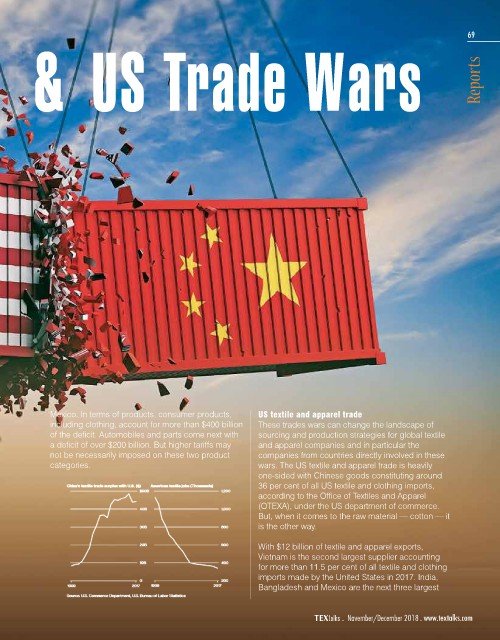
 12-nation Trans-Pacific Partnership (TPP) within days   status as the leading global economy to China,   including clothing, account for more than $400 billion   These trades wars can change the landscape of   up paying higher price for imported items.                                      Taiwanese companies are thinking of moving        invoicing, false marking and labelling, false claims of                                                                revive the c
 of President Trump’s inauguration on January 20,   which is the world’s largest economy by purchasing   of the deficit. Automobiles and parts come next with   sourcing and production strategies for global textile         For Chinese textile entrepreneurs, it is time for                    manufacturing operations out of China due to the   origin, illegal transhipment, mis-description,                                                                        in Punjab).”
 2017, was clear indication of President Trump’s   power parity, according to the International Monetary   a deficit of over $200 billion. But higher tariffs may   and apparel companies and in particular the   EU’s retaliation  action. First, a prolonged trade war would mean US             escalating trade war of the latter with the United   undervaluation, false declarations of right to make
 commitment to its campaign promises. President   Fund (IMF). Interestingly, China accounts for 66 per   not be necessarily imposed on these two product   companies from countries directly involved in these   As a retaliatory measure to the imposition of tariffs   cotton would become costlier, requiring a change in   States. The most likely to relocate are firms in the   entry, false trade preference claims and outright                                     Furthermore,
 Trump felt that by being a signatory to the TPP, the   cent of the total US trade deficit in goods.  categories.  wars. The US textile and apparel trade is heavily         by the Trump administration, Europe has gone     raw material sourcing strategy. Second,                              textile, electronics and bicycle industries, which   smuggling,” CBP says in its latest textile enforcement                                                              are likely t
 United States is giving away lot of trade advantages         one-sided with Chinese goods constituting around                                                               ahead and implemented a 25 per cent additional   entrepreneurs would have to accelerate the process                   export products to the United States, a survey by the   statistics, released in May this year (2018).                                                                    spinning and
 to other 11 countries, while it is not getting benefit to   To reduce the trade deficit, President Trump started   36 per cent of all US textile and clothing imports,      duty beginning June 22, 2018, on several American   of setting up manufacturing units in other countries              country’s Industrial Development Bureau (IDB) has                                                                                                                        manufacturin
 the same extent in return. In 2017, the total US trade   taking steps one by one. He announced reworking of   according to the Office of Textiles and Apparel               items, including t-shirts, singlets and other vests;   like Vietnam and Ethiopia. Once this is done, higher           found. The country’s textile industry, which has   US-based importers and retailers dealing with                                                                         Chinese busi
 deficit was $566 billion. President Trump wants to   the North Atlantic Free Trade Agreement (NAFTA)   (OTEXA), under the US department of commerce.                        shorts, trousers and breeches of cotton denim;   tariffs on Chinese products would not affect exports                 factories in Southeast Asia as well, is expected to   fraudulent imports would face stiff penalties under                                                                tariffs on t
 reduce this deficit as it is detrimental to the US   with Canada and Mexico. Then, he imposed tariffs   But, when it comes to the raw material — cotton — it                synthetic fibres, industrial and occupational; and   of goods made by Chinese companies to the United                 ramp up production in that region, while the      the US’s Wool Products Labelling Act, the Fur                                                                          intensifies,
 economy — the largest in terms of nominal gross   and quotas on imported solar panels and washing   is the other way.                                                       bedlinen of cotton.                              States, unless these countries also get embroiled in                 electronics and bicycle industries could move     Product Labelling Act, and the Textile Fibre Products
 domestic product (GDP). The second argument is   machines. In March this year, he announced that he                                                                                                                          trade wars with the United States by that time.                      operations back to Taiwan, according to the survey.  Identification Act. Violators are subject to monetary                                                               To overcome
 that prolonged trade deficit reduces competitiveness   would impose a 25 per cent tariff on steel imports   With $12 billion of textile and apparel exports,                EU commissioner for trade Cecilia Malmström      However, this would lead to loss of jobs in China.                                                                     civil penalties, injunctions and other remedies,                                                                       Government o
 of the US economy, leading to decline in expertise   and 10 per cent tariff on aluminium, which eventually   Vietnam is the second largest supplier accounting              termed the US step as “unilateral and unjustified                                                                     Threat of Fraudulent trade?                       including consumer redress, in a federal district                                                                      textiles and
 and competitiveness of the US companies, and   came into effect from May 31. President Trump’s   for more than 11.5 per cent of all textile and clothing                    decision”. She said that the rules of international   China Lowers Imports Tariffs to Diversify Sourcing              The trade war has raised the spectre of fraudulent   court action.                                                                                                       the governme
 thereby loss of jobs and decline in standard of living   so-called ‘protectionist’ measures would primarily   imports made by the United States in 2017. India,             trade which were developed over the years cannot   Effective Nov. 1 China lowered its import duties on                rerouting of Chinese textile-garment products
 of its citizens. The United States, given its political,   affect its main trading partners—China, Canada and   Bangladesh and Mexico are the next three largest            be violated without a reaction from the EU. “Our   1,585 tariff lines as part of a long-term plan to                  through neighbouring regions, notably Southeast   Because copies of the statutes, rules and prior
                                                                                                                                                                             response is measured, proportionate and fully in line   diversify sourcing away from the U.S. The move is             Asia. The US Customs and Border Protection (CBP)   decisions in the textile, wool and fur areas have been
 November/December 2018                                                            November/December 2018
   64   65   66   67   68   69   70   71   72   73   74