


Page 60 - October-November-2017
P. 60
60                                                                                                                                                                                                                             61


                                SPGPrints’ new


                           Experience Center


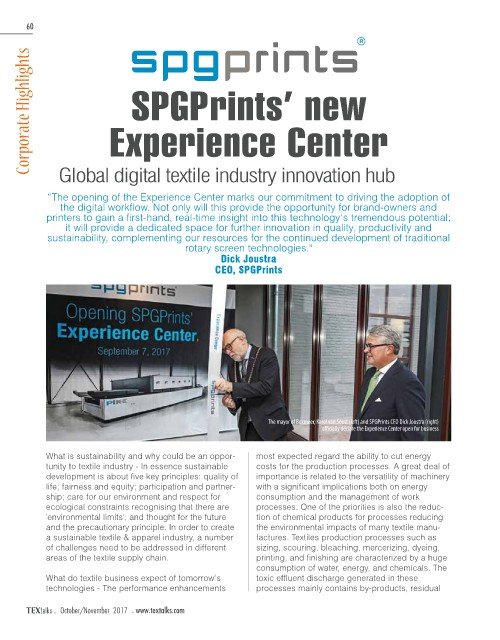
               Global digital textile industry innovation hub                                                                          The PIKE® digital printer at SPGPrints’ new Experience Center, Boxmeer, The Netherlands


            “The opening of the Experience Center marks our commitment to driving the adoption of                                  dyes, salts, acids and alkalis, auxiliary chemicals,   What are the new requests for the future green
               the digital workflow. Not only will this provide the opportunity for brand-owners and                               and other solvents. Their discharge into neighbor-  textile companies like Laros - Certifications for
            printers to gain a first-hand, real-time insight into this technology’s tremendous potential;                          ing water bodies is posing a serious threat to the   textile companies are important for the near future
                 it will provide a dedicated space for further innovation in quality, productivity and                             flora and fauna.                                 of “sustainable industry” at low environmental
            sustainability, complementing our resources for the continued development of traditional                                                                                impact. The aim of the standards (like GOTS) is to
                                             rotary screen technologies."                                                          Is the demand for sustainable textile additives high   define world-wide recognized requirements that
                                                     Dick Joustra                                                                  in the market - The demand from product compa-   ensure organic status of textiles, from harvesting of
                                                    CEO, SPGPrints                                                                 nies on sustainable and non¬toxic chemistry is   the raw materials, through environmentally and
                                                                                                                                   very strong. Many of the major players in the    socially responsible manufacturing up to labelling
                                                                                                                                   apparel industry have gone public with their     in order to provide a credible assurance to the end
                                                                                                                                   intention to phase out conventional chemicals.   consumer. Therefore, textile manufacturers are
                                                                                                                                   Textile manufacturers supplying the apparel      enabled to export their organic fabrics and
                                                                                                                                   industry need to cope with these restrictions and   garments with one certification accepted in all
                                                                                                                                   are therefore investing heavily into the implementa-  major markets. Another example is the Detox
                                                                                                                                   tion of eco-friendly products. Encourage initiatives,   campaign, that since July 2011 has mobilised
                                                                                                                                   project innovation and provide incentives could be   hundreds of thousands of people around the world
                                                                                                                                   the policy key points for the development and    to challenge major clothing brands to eliminate all
                                                                                                                                   take-up of environmentally friendlier textiles.  releases of hazardous chemicals from their supply
                                                                                                                                                                                    chains and products. In the last years, Laros is
                                                                                                                                   How is Laros changing to reach these changes -   extremely active to meet these market requests
                                                                                                                                   Textile processing is the major source of industrial   from its international fashion companies.
                                                                                                                                   water pollution across the world, and sizing and
                                                                The mayor of Boxmeer, Karel van Soest (left) and SPGPrints CEO Dick Joustra (right)   desizing operations account for nearly 30% of the   What could be the role of research organisations to
                                                                             o cially declare the Experience Center open for business   water consumed in a textile plant. Polyvinyl alcohol   increase the companies competitiveness -
                                                                                                                                   (PVA) is the non-degradable synthetic polymer that   Universities/research organisations and industry

            What is sustainability and why could be an oppor-  most expected regard the ability to cut energy                      dominates sizing chemical market with 2.5% global   have been collaborating for over a century, but the
            tunity to textile industry - In essence sustainable   costs for the production processes. A great deal of              share, and leads to severe pollution. To mitigate   rise of a global knowledge economy has intensified
            development is about five key principles: quality of   importance is related to the versatility of machinery           environmental problems caused by                 the need for strategic partnerships that go beyond
            life; fairness and equity; participation and partner-  with a significant implications both on energy                  non-biodegradable synthetic polymers, using      the traditional funding of research projects. When
            ship; care for our environment and respect for    consumption and the management of work                               natural macromolecules as replacements is a      companies and universities work in tandem to
            ecological constraints recognising that there are   processes. One of the priorities is also the reduc-                feasible approach. Laros has established a strong   push the frontiers of knowledge, they become a
            'environmental limits'; and thought for the future   tion of chemical products for processes reducing                  cooperation between research institutions (i.e.   powerful engine for innovation and economic
            and the precautionary principle. In order to create   the environmental impacts of many textile manu-                  ENEA) and universities (i.e. Polytechnic University   growth. The assiduous participation in R&D and
            a sustainable textile & apparel industry, a number   factures. Textiles production processes such as                   of Milan)  to develop new biodegradable products   technology transfer projects at national and
            of challenges need to be addressed in different   sizing, scouring, bleaching, mercerizing, dyeing,                    with similar properties like PVA. The strong     European level have allowed at many organizations
            areas of the textile supply chain.                printing, and finishing are characterized by a huge                  cooperation between company technical skills and   to consolidate a vast network of links and
                                                              consumption of water, energy, and chemicals. The                     several research teams in the world is the key   collaborations, with important industrial companies,
            What do textile business expect of tomorrow’s     toxic effluent discharge generated in these                          aspect of Laros’s green horizon.                 universities, research centres and companies service
            technologies - The performance enhancements       processes mainly contains by-products, residual                                                                       operating in Italy, Europe and wordwide.

               October/November  2017                                                                                                                                                                     October/November  2017

