


Page 88 - TEXtalks September/October 2021
P. 88
88                                                                                                                                                                                                                             89


 Apparel Technology is scientific art involving fashion   grounded coffee. A thermal-regulated, motion-adap-
 techniques and designing for specific purposes. The   tive all-day shirt brings ultimate comfort and efficien-
 garment industry is a significant contributor to the   cy with advanced tech and design.
 economies of many countries. The garment sector
 has been a crucial influencer for Pakistan. Countries   The importance of technology adoption in garment
 such as Bangladesh, Cambodia, and Pakistan have   manufacturing has been highlighted as a critical
 continued to focus on producing low-cost garments   element for garment producers to increase their
 primarily. This has proven to be a successful garment   efficiency and value addition. No doubt, the automa-
 exporting strategy indicated in terms of the value of   tion in the garment section could improve productivity
 exports. The profit margins are higher in exporting   and quality. However, according to International
 ready-made garments instead of raw materials.   Labor Organization's (ILO) latest report, the Asian
 According to the report of Statista, the global   garment industry has been slow in adopting new   The use of such technologies saves time, effort,   Smart clothing is driving the apparel sector. For
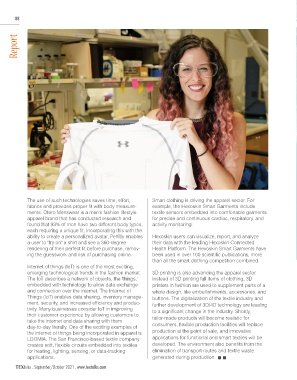
 garment sector value was worth 1.5 trillion U.S.   technology and innovation, partly due to low wages   fabrics and provides proper fit with body measure-  example, the Hexoskin Smart Garments include
 dollars in 2020 and is expected to reach about 2.25   causing fewer incentives to do so, but also due to   ments. Otero Menswear is a men's fashion lifestyle   textile sensors embedded into comfortable garments
 trillion dollars by 2025. The net worth of the market   technical impediments financing gaps.  apparel brand that has conducted research and   for precise and continuous cardiac, respiratory, and
 highlights the importance of the apparel sector. The   found that 93% of men have two different body types,   activity monitoring.
 Apparel Industry consists of companies that design   Talking about some recent innovative works,   each requiring a unique fit. Incorporating this with the
 and sell clothing, footwear, and accessories. Product   researchers have successfully created a shirt with   ability to create a personalized avatar, Perfitly enables   Hexoskin users can visualize, report, and analyze
 categories include everything from basics, such as   conductive fibers as wearable sensors, one of the   a user to "try on" a shirt and see a 360-degree   their data with the leading Hexoskin Connected
 underwear, to luxury items, for example, cashmere   latest developments. The developed shirt was   rendering of their perfect fit before purchase, remov-  Health Platform. The Hexoskin Smart Garments have
 sweaters and alligator-skin handbags.   designed by the Brown School of Engineering lab of   ing the guesswork and risk of purchasing online.   been used in over 100 scientific publications, more
 Matteo Pasquali at Rice University. They use the             than all the smart clothing competition combined.
 With the advancements in technology, the textile   conductive nanotube threads stitched into regular   Internet of things (IoT) is one of the most exciting,
 sector is getting maximum benefits. Similarly, the   apparel to add heart rate monitoring and continuous   emerging technological trends in the fashion market.   3D printing is also advancing the apparel sector.
 apparel sector has also equipped itself with   electrocardiogram (EKG) readings. According to the   The IoT describes a network of objects, the 'things,'   Instead of 3D printing full items of clothing, 3D
 cutting-edge tools to minimize wastage, source   researchers, the threads are as conductive as metal   embedded with technology to allow data exchange   printers in fashion are used to supplement parts of a
 sustainable materials, and promote awareness   wires but washable, comfortable, and far less likely to   and connection over the internet. The Internet of   whole design, like embellishments, accessories, and
 among consumers to buy green. The advancements   break when a body is in motion. A shirt enhanced   Things (IoT) enables data sharing, inventory manage-  buttons. The digitalization of the textile industry and
 in the apparel sector have been driven by the big   with them has proved better at gathering data than a   ment, security, and increased efficiency and produc-  further development of 3D/4D technology are leading
 brands themselves like H&M, Adidas, Nike, Louis   standard chest-strap monitor taking live measure-  tivity. Many businesses consider IoT in improving   to a significant change in the industry. Shortly,
 Vuitton, Mango, etc. These brands are constantly   ments during experiments. When matched with   their customer experience by allowing customers to   tailor-made products will become realistic for
 developing new concepts to increase their brand's   commercial medical electrode monitors, the carbon   take the internet and data sharing with them
 image and sales by offering new innovative products   nanotube shirt gave slightly better EKGs.   day-to-day literally. One of the exciting examples of   consumers, flexible production facilities will replace
 in the market. Significant advancements have been   the internet of things being incorporated in apparel is   production at the point of sale, and innovative
 made to promote sustainability. For example, TRAN-  One of the highly appreciated advancements in the   LOOMIA. The San Francisco-based textile company   applications for functional and smart textiles will be
 ZEND brand has introduced Ultra Shirt. Ultra Shirt,   apparel section is the virtual reality/augmented reality   creates soft, flexible circuits embedded into textiles   developed. The environment also benefits from the
 available from 17 Aug 2021, is a T-shirt made of   (VR/AR) and AI-powered virtual fitting room solutions.   for heating, lighting, sensing, or data-tracking   elimination of transport routes and textile waste
            applications.                                     generated during production.
               September/October 2021

