


Page 93 - TEXtalks September/October 2021
P. 93
92                                                                                                              93


 New sensors making


 firefighters safe


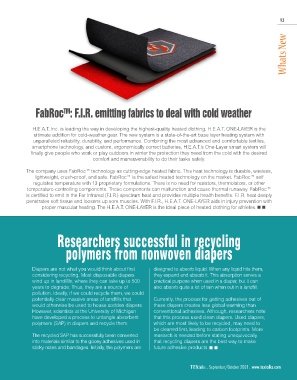
               FabRoc : F.I.R. emitting fabrics to deal with cold weather
                          TM

 Researchers at the University of Alberta have developed sensors to detect the gradual breakdown in
 garments from exposure to heat, moisture, and ultraviolet (UV) light. Such breakthroughs could save the   H.E.A.T. Inc. is leading the way in developing the highest-quality heated clothing. H.E.A.T. ONE-LAYER is the
              ultimate addition for cold-weather gear. The new system is a state-of-the-art base layer heating system with
 precious life of firefighters. Firefighters have no authentic way to know how safe their clothing is just by looking   unparalleled reliability, durability, and performance. Combining the most advanced and comfortable textiles,
 at it. The current recommendation is to wash firefighting garments twice a year. However, all the existing data   smartphone technology, and custom, ergonomically correct batteries, H.E.A.T.'s One-Layer smart system will
 that determines when the clothing needs to be replaced is based on that once or twice-a-year washing.   finally give people who work or play outdoors in winter the protection they need from the cold with the desired
 Damage to the garments may not be visible to the naked eye before performance is  comfort and maneuverability to do their tasks safely.
  reduced, leading to accidents.
           The company uses FabRoc™ technology as cutting-edge heated fabric. This heat technology is durable, wireless,
 Researchers will use the fire-resistant fabrics manufactured by Davey Textile Solutions as part of the sensor
               lightweight, crush-proof, and safe. FabRoc™ is the safest heated technology on the market. FabRoc™ self
 patch. The sensor has been provisionally patented and is still under development. Once fully developed, the   regulates temperature with 13 proprietary formulations. There is no need for resistors, thermolators, or other
 sensor patch would provide a way to assess the garment without destructive testing, such as cutting out
            temperature-controlling components. These components can malfunction and cause thermal runaway. FabRoc™
 samples to test the fabric’s condition through conventional methods such as strength testing. The sensor   is certified to emit in the Far Infrared (F.I.R.) spectrum heat and provides multiple health benefits. F.I.R. heat deeply
 could also be used in the oil and gas, electrical, construction, and mining industries.
            penetrates soft tissue and loosens up sore muscles. With F.I.R., H.E.A.T. ONE-LAYER aids in injury prevention with
                  proper muscular heating. The H.E.A.T. ONE-LAYER is the ideal piece of heated clothing for athletes.
 Kraig Labs expands its spider silk


 production and files two new patents  Researchers successful in recycling


 Kraig Biocraft Laboratories, Inc. is the leading   been the subject of much interest due to spider silk’s   polymers from nonwoven diapers
 developer of spider silk-based fibers. Kraig Labs   incredible toughness. Because of its strength,   Diapers are not what you would think about first   designed to absorb liquid. When any liquid hits them,
 announced the opening of a new spider silk produc-  resilience, and flexibility, spider silk holds great   considering recycling. Most disposable diapers   they expand and absorb it. This absorption serves a
 tion factory located in Vietnam. The Company’s   promise for commercial and consumer applications.   wind up in landfills, where they can take up to 500   practical purpose when used in a diaper, but it can
 Vietnamese subsidiary, Prodigy Textiles, has already   The spiders are cannibalistic; they cannot be raised   years to degrade. Thus, they are a source of   also absorb quite a lot of rain when out in a landfill.
 completed transitioning production operations to the   in concentrated colonies to produce silk. Therefore,   pollution. Ideally, if we could recycle them, we could
 new facility. The first batch of recombinant spider silk   scientists have been able to replicate the proteins   potentially clear massive areas of landfills that   Currently, the process for getting adhesives out of
 cocoons has already been completed at this new   that are the building blocks of spider silk. However,   would otherwise be used to house sodden diapers.   these diapers creates less global warming than
 headquarters for Prodigy Textiles. The company has   two technological barriers have (until now) stymied   However, scientists at the University of Michigan   conventional adhesives. Although, researchers note
 further expanded its leading position in developing   production. These barriers are the inability to form   have developed a process to untangle absorbent   that this process used clean diapers. Used diapers,
 recombinant spider silk by filing two new patent   these proteins into a spider silk fiber with the desired   polymers (SAP) in diapers and recycle them.   which are most likely to be recycled, may need to
 applications. These new innovative patents build upon   mechanical characteristics and effectively doing this.   be cleaned first, leading to carbon footprints. More
 underlying knock-in/knock-out gene-editing technolo-  Kraig invented new technology and acquired the   The recycled SAP has successfully been converted   research is needed before stating unequivocally
 gies that the company first made public in 2020.  exclusive right to use the patented genetic sequenc-  into materials similar to the gooey adhesives used in   that recycling diapers are the best way to make
 es for numerous fundamental spider silk proteins to   sticky notes and bandages. Initially, the polymers are   future adhesive products.
 Protein-based fibers, exemplified by spider silk, have   solve these problems.


 September/October 2021                                                             September/October 2021

