


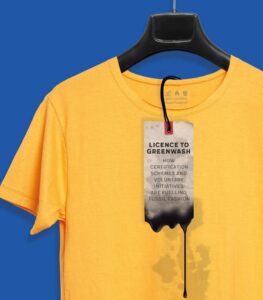
The Changing Markets Foundation has released a new report titled “Licence to Greenwash: How certification schemes and voluntary initiatives are fuelling fossil fashion.” The report investigates 10 major certifications, labels, and voluntary industry initiatives in the fashion sector (Higg Index and SAC, BlueSign, Oekotex, Cradle to Cradle, Ellen MacArthur Foundation, Textile Exchange, The Microfibre Consortium, ZDHC, WRAP, and the EU EcoLabel).
The report finds that most of these schemes act as sustainability decoys for brands, enabling greenwashing on a massive scale. No scheme was found to be fit for purpose, with issues such as a lack of transparency, no accountability, and compromised independence common across the initiatives. Some even rate fossil-fuel-derived fibers as the more sustainable choice and are silent on critical issues such as overproduction and microfibres. Moreover, as fashion’s toll on the environment has worsened, these schemes have proliferated and have become part of the problem by giving the illusion of sustainability in the sector while being unable to show any evidence of change created. Brands also freely use their membership of such initiatives to greenwash and even escape government scrutiny.
 Microfiber Problem
Initiatives are putting all their eggs in one basket for microfibres. They cite a lack of research or measurement tools to justify the lack of action and point to distant targets for action, which let the most significant users of synthetics off the hook. Instead of taking precautionary measures about limiting microfibre release, most brands are relying on TMC, which, although tasked with developing a universal measuring method, has – after years of work – only released this to paying members and not to the public. Additionally, TMC seems to have a concerning bias in favor of synthetics, conspicuously ignoring the science suggesting that plastic microfibres are more persistent in the environment and cause more harm to health.
Fossil fashion: Certified
Schemes and initiatives skirt around the issue of synthetic fibers, mentioning plastic-based fibers or the need to minimize reliance on virgin resources without explicitly stating that fossil fuels are now the dominant raw material or ignoring recognizing key trends, such as the doubling of global virgin polyester production since 2000, which is on course to double again. At worst, schemes such as the Higg Index and WRAP elements actually present synthetics as the better choice environmentally – fuelling the very problem they claim to be tackling
Transparency
Transparency is a weak point for all the initiatives analyzed, with even robust government-mandated schemes, such as the EU Ecolabel, not up to scratch. At worst, these schemes operate as a black box, with no external scrutiny, yet inform major decisions about fiber and material use. Some schemes, such as C2C and the Higg Index, seem to communicate profusely without transparency. The in-depth report discusses various other factors, which can be found here. A serious attitude of brands and government organizations is required to promote real sustainability in the textile sector and save the planet.

