

A new fibre-identification benchmark may help circular-textile systems move from manual judgement to comparable, AI-enabled sorting.
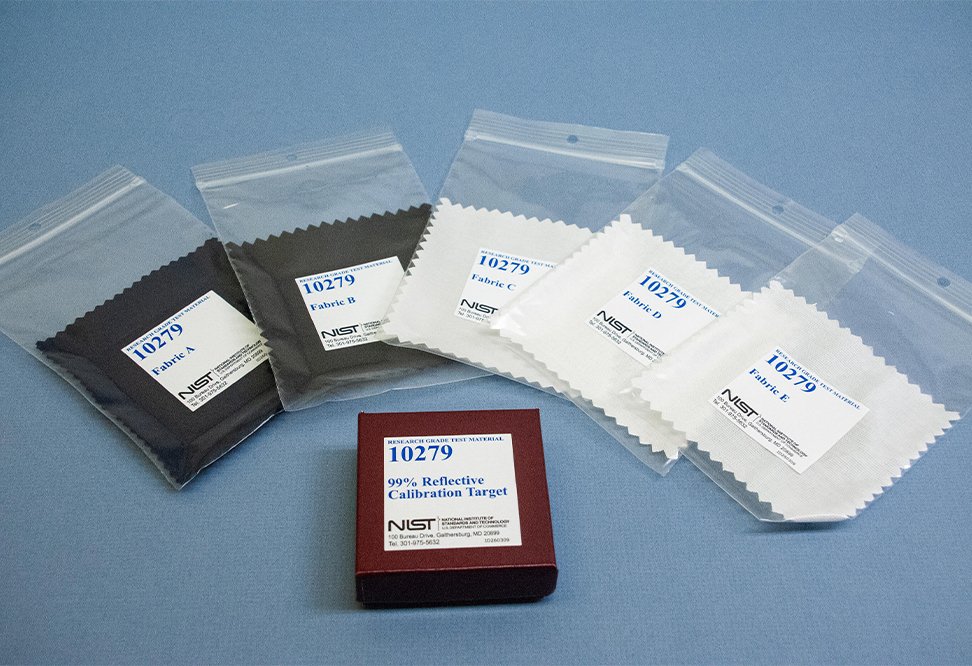
The US National Institute of Standards and Technology has developed a new research-grade textile test material designed to improve fibre identification, sorting and recycling. The material, known as Research Grade Test Material 10279, or RGTM 10279, consists of five fabric squares made from different fibres in dyed and undyed forms. Its purpose is to help laboratories, sorting facilities and technology providers compare how accurately their systems identify textile feedstocks.
Sorting is the weak link
NIST says researchers estimate that 56% of clothing and textiles could be recycled or recovered, but most do not return to the domestic supply chain. One reason is sorting. Large volumes of donated or discarded clothing are still separated slowly and manually, while fibre blends, dyes, finishes and incorrect labels make accurate identification difficult.
Near-infrared spectroscopy is already used in textile sorting. Handheld scanners or automated conveyor systems read how light interacts with a fabric to generate a fibre “fingerprint.” Computer vision and hyperspectral imaging are also being used, often with artificial intelligence algorithms. The problem is that different systems may produce different results, making it hard to compare accuracy across facilities.
A benchmark for machines and algorithms
RGTM 10279 gives the industry a physical reference material for testing. NIST says the sorting and recycling community will use it to assess the accuracy of fibre-identification methods, validate algorithms and explore production quality-control uses. The undisclosed composition is deliberate: participating labs must analyse the material using their own methods and provide feedback.
The material could also help brands verify whether purchased fabrics match declared composition. For example, a fabric sold as 100% cotton but containing polyester would create problems for pricing, product claims, recycling routes and future digital product data.
Why this matters commercially
For circular textiles, better sorting is not a laboratory detail. It determines whether recovered clothing becomes high-value feedstock or low-value waste. NIST is already working on measurement science and standards to support textile reuse and recycling, including fibre sorting by near-infrared spectroscopy, microscopy and other methods.
The immediate study runs through 30 September 2026, with RGTM 10279 available free to participants until 30 July. The larger implication is clear: circularity will need standards, not only collection bins.
