

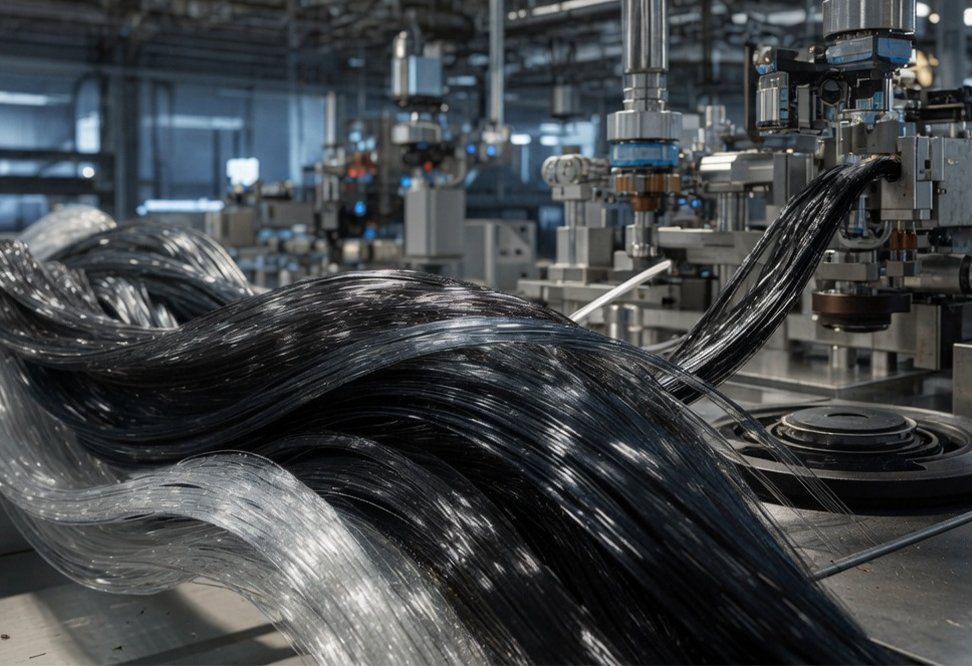
Nylon 6,6 remains a specialist polymer where performance, heat resistance and durability matter more than low-cost volume.
The global nylon 6,6 market was valued at about $6.1 billion in 2025 and is forecast to reach nearly $7.56 billion by 2032, expanding at a 3.1% compound annual growth rate, according to Maximize Market Research. The wider nylon market is larger and faster-growing, with Fortune Business Insights projecting global nylon demand to rise from $36.06 billion in 2026 to $55.58 billion by 2034.
Fibre grade leads the textile story
For textile and technical-textile producers, the most relevant segment is fibre-grade nylon 6,6. Maximize Market Research expects fibre grade to dominate because of its use in tire cords, airbags, industrial fabrics and high-performance textiles. Its appeal lies in high tensile strength, abrasion resistance, dimensional stability, elasticity and better thermal performance than many standard polyamide applications.
This makes nylon 6,6 important in end uses where failure is costly: automotive airbags, reinforcement fabrics, protective textiles, ropes, industrial yarns and demanding apparel or outdoor applications. It is less a commodity apparel fibre and more a performance material for engineered products.
Automotive remains the anchor
Automotive demand is central to the market. Nylon 6,6 is used in both fibre and resin forms, including airbags, tire reinforcement, under-the-hood components and engineering plastics. The shift towards lighter vehicles, fuel efficiency and electric mobility supports demand for high-performance polymers, although substitution pressure from nylon 6, polyester and other engineering plastics remains real.
Tire-cord fabrics remain a related growth area. Mordor Intelligence expects the nylon tire-cord fabrics market to grow at more than 4% annually between 2025 and 2030, supported by tire production and reinforcement requirements.
Feedstock cost is the constraint
The main weakness is cost volatility. Nylon 6,6 depends on petrochemical feedstocks including adipic acid and hexamethylenediamine, making margins sensitive to crude-oil, energy and chemical-supply swings. Maximize also identifies crude-oil price volatility as a constraint on production cost and market growth.
For textile companies, the opportunity is not basic fibre substitution. It is in high-specification yarns, industrial fabrics, airbags, reinforcement textiles and durable performance applications where nylon 6,6 can justify its premium. The next competitive edge will come from consistent quality, recycled-content development, traceable supply and application-specific testing.
