

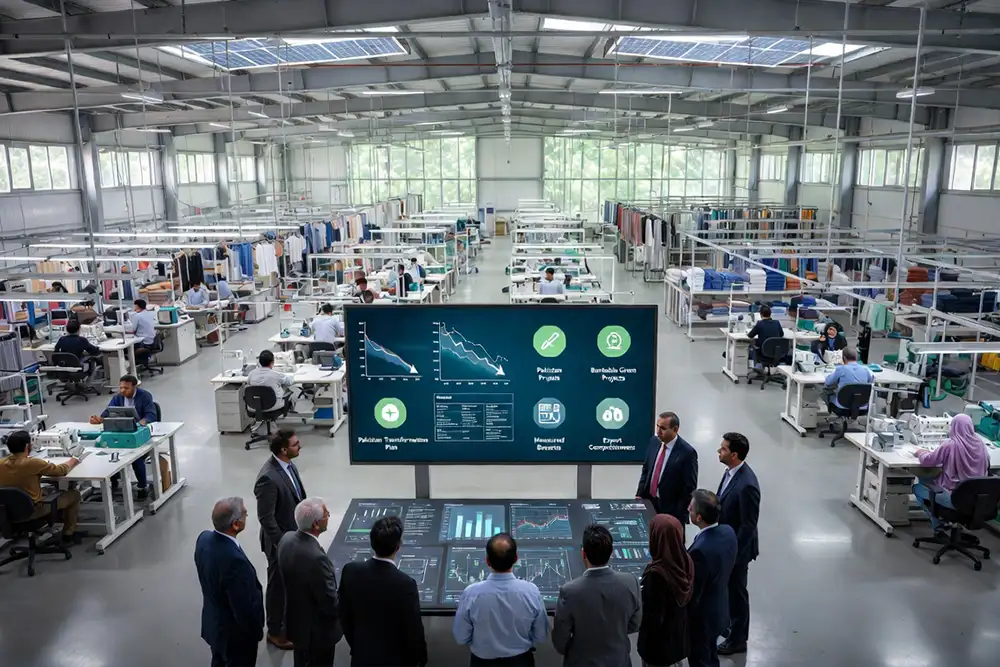
The new Pakistan Transformation Plan can strengthen export competitiveness into measured baselines, bankable projects and practical support for smaller manufacturers.
Pakistan’s garment industry has formally joined the Apparel and Textile Transformation Initiative, establishing ATTI Pakistan through a memorandum of understanding between the Pakistan Readymade Garments Manufacturers and Exporters Association and ATTI. Signed on June 24 during London Climate Action Week, the agreement makes Pakistan the initiative’s third national chapter after Bangladesh and Türkiye.
The announcement is significant because it offers a route beyond disconnected factory-level programmes towards a manufacturer-led national framework. However, the agreement is a starting point, not a decarbonisation outcome. Its value will depend on whether the new chapter produces an operating plan for exporters facing tighter sourcing expectations on energy, emissions, water, chemicals, traceability and climate reporting.
A plan before a project pipeline
ATTI’s approach begins with a Needs Assessment designed to identify transition constraints that companies cannot efficiently solve alone. It covers five areas: data; capacity building and technical assistance; technology and machinery; finance; and policy.
That structure fits Pakistan’s textile and apparel sector, where investment capability varies widely by factory size, product mix, energy source and export market. A robust assessment should identify high-emitting processes, quantify efficiency opportunities, map current initiatives, and distinguish commercially viable upgrades from investments requiring concessional capital or risk-sharing.
Only then can a Pakistan Transformation Plan credibly prioritise energy management, renewable electricity, thermal-efficiency upgrades, water stewardship, chemical control and data systems.
Data and finance will determine credibility
PRGMEA represents more than 500 garment companies, giving the initiative potential reach across a substantial share of value-added apparel manufacturing. Yet this makes inclusion essential. Large exporters may already have buyer-funded audits and sustainability teams; smaller suppliers often need standardised tools, technical assistance and accessible finance before they can invest.
The chapter should therefore avoid becoming another reporting forum. It needs common baseline methods, verified project pipelines, practical guidance for members and financing structures aligned with factory payback periods and currency risks.
From diagnosis to delivery
ATTI and PRGMEA will begin with an in-country kick-off, a scoping trip and an Initiating Technical Committee to guide chapter design and implementation. The first serious test will be whether those steps produce public priorities, measurable targets and a credible deployment timetable.
Pakistan’s opportunity is to become a more dependable low-carbon sourcing base. That will require evidence from factory floors—not another declaration from a conference stage.
