

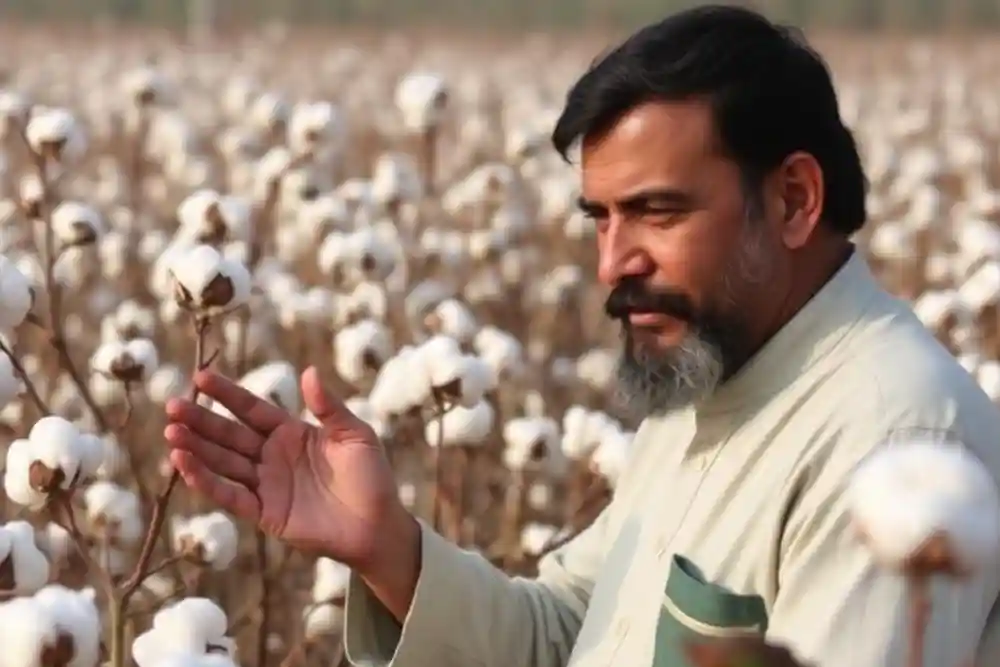
Prime Minister Shehbaz Sharif is right to refocus policy attention on exports. But Pakistan’s recurring failure is not intent; it is diagnosis. The export battle is not being lost at trade missions, tariff tables, or marketing roadshows. It is being lost far earlier—at the cotton field, the picking sheet, and the first point of aggregation.
Official Commerce Division data for FY 2023–24 shows textiles contributing US$16.66 billion, or 54.29 percent of Pakistan’s total exports. When a single value chain dominates the external account to this degree, weaknesses at the first mile are not “micro issues.” They are macroeconomic liabilities.
Cotton Contamination: A Compounding Tax on Exports
Pakistan’s cotton problem is neither abstract nor new. It is physical, measurable, and stubbornly ignored. Cotton is picked largely by hand, often under incentives that reward weight rather than cleanliness. The widespread use of repurposed polypropylene fertiliser bags for picking introduces plastic contamination that survives ginning, spinning, weaving, and finishing. Unlike metals, cotton cannot be “re-melted” into uniformity. Every early defect compounds downstream.
The State Bank of Pakistan has repeatedly treated contamination as a macro-relevant issue. SBP has cited All Pakistan Textile Mills Association estimates placing annual export losses at US$1.4 billion, with alternative estimates rising to US$3 billion. Survey-based assessments referenced by SBP show contamination levels of 18–19 grams per bale in Pakistan, versus an international benchmark of 2.5 grams. Both SBP and APTMA conclude that effective controls could raise cotton value by 10–15 percent.
This is not speculation. It is documented leakage of national income.
Competing on Risk, Not Just Cost
Global buyers do not evaluate Pakistan solely on price. They evaluate risk—variability in quality, predictability of defects, and reliability of shipments. When raw material quality fluctuates, the entire chain fluctuates. Variability becomes an implicit surcharge on Pakistan’s exports, weakening bargaining power and unit values.
Compare Pakistan with cotton leaders such as the United States and Australia. Their advantage is not abstract superiority; it is governance. Cotton is treated as a standardised industrial input, harvested and handled within disciplined systems designed for consistency. Buyers know what they are getting, disputes are fewer, and price differentiation is real.
Then look at Bangladesh—a country with little domestic cotton but dominant garment exports. Its edge lies in predictable factory throughput, stable input access, smoother logistics, and fewer policy shocks. Safety and consistency are rewarded in global supply chains.
Pakistan sits uncomfortably in between: a domestic cotton base with early-stage quality leakage, and a manufacturing base operating under stop-start volatility. Competitors do not defeat Pakistan with a single silver bullet; they defeat it by systematically removing friction.
Quantity Collapse Compounds the Quality Crisis
The crisis is not only contamination. It is also volume. As of July 15, 2025, cotton arrivals stood at 297,751 bales, down 32 percent from the same period in 2024, which itself had already fallen 48.48 percent from 2023. Over two years, production has effectively collapsed by roughly 65 percent over comparable periods—linked in regions such as Rahim Yar Khan to sugarcane expansion and entrenched sugar interests.
The result is predictable: mills turn to imports, working capital strains intensify, and Pakistan’s leverage erodes further.
What Must Change—Structurally, Not Rhetorically
Pakistan has tried episodic fixes before. SBP records from the early 2000s show pilot premiums for clean cotton—Rs 200 per maund for contamination-free cotton, Rs 75 for low-contamination cotton. The idea was sound. The failure was follow-through.
Five structural shifts are now unavoidable:
- Pay for Quality, Not Weight
Procurement systems must visibly reward clean cotton and penalise contaminated lots. Without price signals at the farm gate, losses will continue to be dumped downstream onto ginners, mills, and exporters. - Eliminate Known Contamination Pathways
Polypropylene contamination from fertiliser bags is a known problem. It requires enforcement through procurement rules and rejection, not new committees. - Clean Aggregation Is Not Optional
Covered collection points, clean floors, basic storage discipline, and simple grading can eliminate needless mixing and dragging that destroys value before ginning. - Mechanisation as a System, Not a Slogan
Punjab’s cotton revival plans correctly point to labour shortages and service-provider models for mechanical picking. But mechanisation without agronomic suitability, varietal alignment, logistics, and maintenance capacity merely scales disorder. - Gradual but Credible Traceability
Pakistan does not need gold-plated systems overnight. It does need a pathway toward trackable, classed, and trusted cotton lots.
The Export Logic Is Simple
This is not charity for farmers. It is return on investment for industry and foreign exchange for the state. Buyers do not pay premiums for patriotism. They pay premiums for predictability.
If Pakistan is serious about exports, cotton must be treated not as a sentimental crop but as the first industrial input of the country’s most important value chain. The defect is small. The loss is enormous. And the remedy—ending preventable quality destruction at the beginning of the chain—is economically straightforward, even if politically inconvenient.
Until that happens, Pakistan will continue competing on apology rather than value.

