

Smart textiles are proliferating faster than their end-of-life systems. A new German project aims to make “wearable electronics” recyclable by design—and sortable by machine.
Germany’s Osnabrück University of Applied Sciences has launched ReSiST-AR (Recycling Strategies of Smart Textiles & automated Robotics), a research initiative to automate the sorting of smart textiles—garments and fabrics with embedded electronics—using AI and advanced sensing. The project runs 01.10.2025–30.09.2027 and is funded via the European Regional Development Fund (ERDF/EFRE) and the State of Lower Saxony.
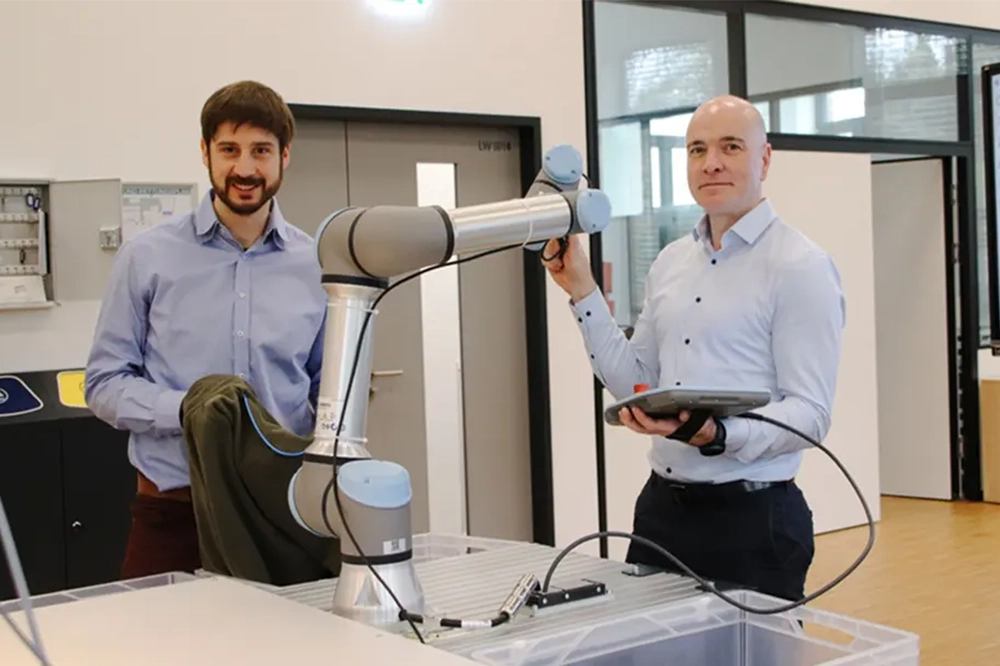
The core output is a robotic sorting concept for conveyor-belt streams that uses multispectral imaging, 3D sensors and AI-based material classification to (1) distinguish textile types and (2) detect embedded electronic components so smart textiles can be separated for appropriate treatment.
E-textiles expose a structural weakness in Europe’s recycling ambitions: most current sorting is still labour-intensive and often offshore, while smart fabrics add non-textile contamination (sensors, conductors, modules) that can damage recycling lines or poison output quality. The project’s explicit goal is to enable regional recycling loops, reducing long-distance shipping and making sorting safer and more scalable.
ReSiST-AR pairs robotics with “design for recycling”: researchers are assessing how electronics are integrated (e.g., embroidery, sewn-in, welded) and aiming to publish guidelines so companies can build smart textiles that remain durable in use yet easier to disassemble or identify at end-of-life. Industry partners (including a robotics firm and a textile specialist) are involved to stress-test feasibility beyond the lab.

