

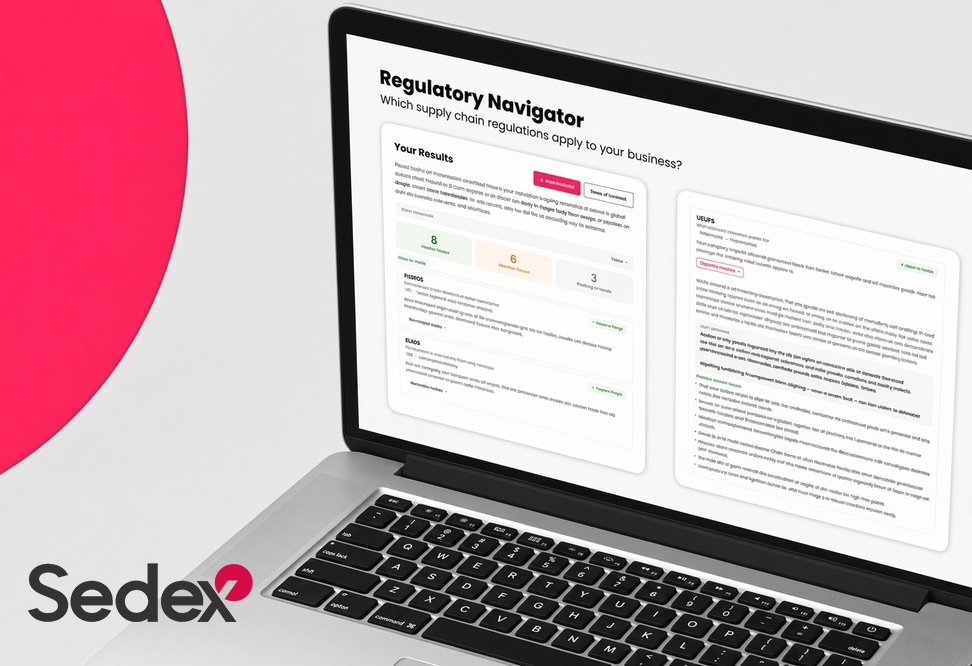
The free tool gives businesses a first-pass view of which due-diligence, reporting and forced-labour rules may apply to their operations and sourcing networks.
Supply-chain sustainability platform Sedex has launched a free Regulatory Navigator designed to help companies identify which major international supply-chain regulations are likely to apply to them.
Launched on August 25, 2026, the self-service tool responds to an increasingly fragmented compliance landscape in which obligations differ according to company size, turnover, headquarters, sourcing markets and import activities.
Eight regulations screened
Users answer a short series of questions covering their headquarters location, approximate annual revenue, global workforce, markets of operation and whether they import goods into the EU or United States.
The Navigator then screens the company against eight major regulations, providing an indicative assessment alongside applicability thresholds, principal requirements and implementation deadlines. Legislation covered includes the EU Corporate Sustainability Due Diligence Directive (CSDDD), Corporate Sustainability Reporting Directive (CSRD), EU Forced Labour Regulation, Canada’s Fighting Against Forced Labour and Child Labour in Supply Chains Act (S-211), and Australia’s Modern Slavery Act.
Sedex says the regulatory content incorporates the latest changes under the EU’s Omnibus Simplification Package I, which altered the scope and implementation timetable of CSDDD and CSRD. Results are indicative and are not intended to replace formal legal advice.
Compliance becomes a data problem
The significance for textile and apparel businesses lies beyond simply identifying legislation. Supply-chain laws increasingly require companies to demonstrate how they map suppliers, identify risks, collect evidence, investigate non-compliances and document corrective action.
Sedex already provides supplier mapping, risk assessment, SMETA audits and corrective-action tracking across multi-tier supply chains. Its network covers about 100,000 members in 180 countries, with more than 540,000 audits conducted through the platform.
Export suppliers face growing data demands
For textile exporters supplying European, North American and other regulated markets, the development reinforces a broader shift: regulatory compliance is moving from periodic social audits toward continuous, traceable supply-chain data management.
Even factories that fall outside the direct legal thresholds may therefore face increased information requests from customers that are themselves regulated. The next competitive issue will be whether suppliers can provide reliable facility, labour, environmental, traceability and due-diligence data quickly enough to become part of their buyers’ compliance systems.
