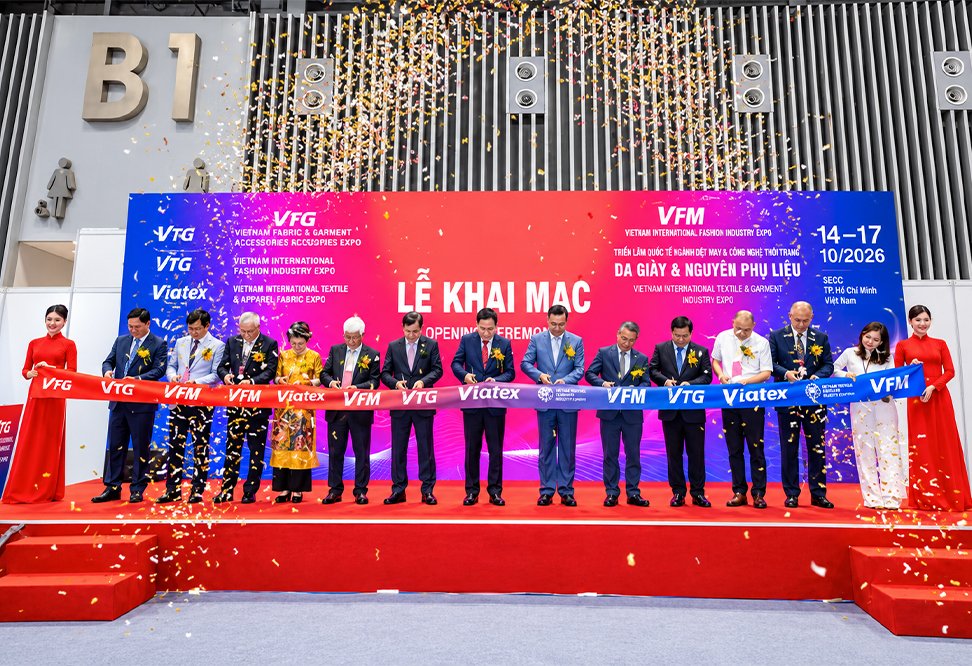
More than 400 global brands are showcasing automation, digital manufacturing, functional materials and greener processing as Vietnam tries to move beyond labour-intensive garment assembly.
Vietnam opened the 24th Vietnam International Textile and Garment Industry Exhibition, VTG 2026, in Ho Chi Minh City on October 14, bringing together more than 400 international brands across 610 booths at the Saigon Exhibition and Convention Centre. The four-day event runs through October 17.
Exhibitors from markets including China, India, Japan, South Korea, Thailand, Singapore, Bangladesh and Bulgaria are presenting technologies spanning textile production, dyeing, garment manufacturing and footwear. The portfolio includes automated machinery, digital systems, functional fabrics, lower-impact chemicals and accessories.
Automation becomes a competitiveness tool
Vietnamese manufacturers are facing pressure simultaneously on cost, delivery speed, quality and production flexibility. AGTEK chairman Pham Xuan Hong said investment in more automated, efficient and precise machinery is consequently becoming increasingly important.
The investment push extends beyond equipment replacement. VITAS says manufacturers are accelerating AI, robotics and digital infrastructure, with these areas representing around 65–68% of investment at many enterprises.
Moving beyond cut-and-sew
Vietnam’s textile and garment exports reached $35.72 billion in January–September 2026, up 3.3%, while garment exports grew only 2.2% to $28.24 billion. Fibre and yarn exports rose a much stronger 13.08% to $3.61 billion. The industry is targeting $47–47.5 billion for the full year.
The numbers reinforce Vietnam’s strategic direction: greater automation, stronger domestic material capability and a shift from basic processing toward FOB, ODM and higher-value products.
Pakistan competitiveness takeaway
For Pakistan, Vietnam illustrates that the next productivity battle will not be won through labour cost alone. Mills and garment factories need investment cases built around automation, AI-assisted production planning, digital quality control, energy-efficient processing and faster changeovers for smaller orders.
Pakistan’s upstream strength in cotton, yarn and fabric remains valuable, but Vietnam is rapidly combining manufacturing scale with technology and supply-chain flexibility. The competitive benchmark is increasingly becoming value added per worker, machine and production minute—not simply cost per garment.