

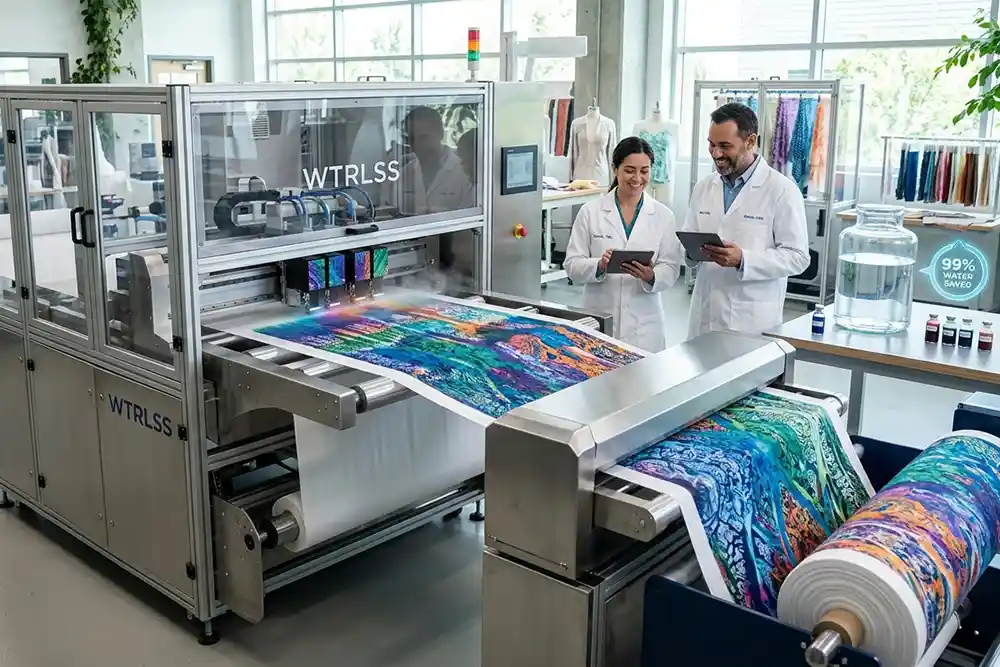
The patented platform combines digital colour application and finishing in a single process, potentially challenging the water-, energy- and chemical-intensive architecture of conventional textile dyeing.
WTRLSS, a technology developed by LA/B Denim, is positioning its one-step digital dyeing and finishing system as a commercially ready alternative to conventional wet coloration. The technology attracted attention at the Future Fabrics Expo 2026 in Brussels, where organisers said internal testing showed water savings of more than 99% at scale, alongside reductions in emissions and toxic auxiliaries
Colour moves after weaving
The underlying LA/B Denim technology changes the sequence of denim manufacturing. Instead of dyeing yarn before weaving through conventional indigo rope or slasher systems, its Post-Weave Colorization (PWC) applies colour digitally to finished greige fabric.
LA/B describes the system as a precision-applied digital process using bio-based chemistry, eliminating conventional dye baths. The company says its denim process uses more than 90% less water than traditional production and can incorporate finishing effects after weaving. It holds international patent application PCT/EP2023/079127, with a priority date of October 2022
A particularly important technical feature is the ability to reproduce denim’s characteristic ring-dyed appearance rather than simply printing blue onto fabric. That could allow manufacturers to retain fading and wear characteristics while removing several traditional wet-processing stages.
From denim platform to broader textile system
The WTRLSS identity appears to signal ambitions beyond denim. LA/B Denim filed US trademark applications in February 2026 covering textile dyes, chemicals, dyeing machinery and textile finishing treatments, indicating development of a broader technology platform.
Future Fabrics Expo describes WTRLSS as both patented and commercially ready, rather than an early laboratory concept.
The commercial test
If industrial deployment confirms the claimed savings, the significance extends beyond water. Removing dye baths could reduce wastewater treatment, steam demand, chemical inventories, process time and potentially minimum production runs—making shorter, digitally controlled colour batches economically more attractive.
The critical next evidence will be industrial data: metres per minute, colour consistency, fixation and fastness, chemistry cost, machine capex, substrate range and independently verified lifecycle impacts. Those numbers will determine whether WTRLSS becomes a specialist denim innovation or a genuinely disruptive alternative to conventional textile dyehouses.
