

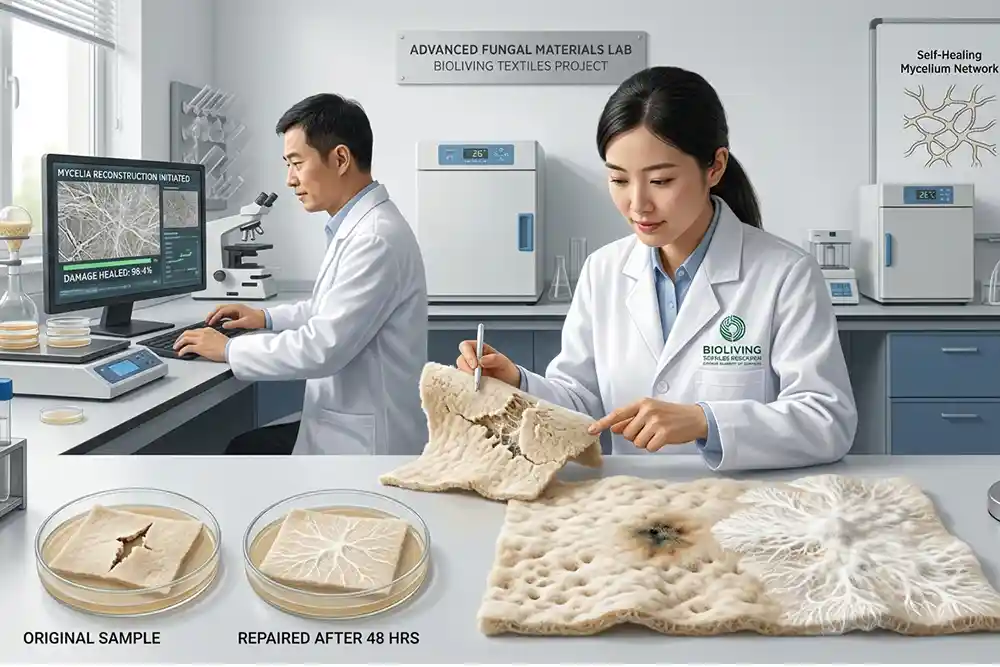
The experimental material keeps fungal mycelium biologically active after fabrication, enabling regeneration, self-cleaning surfaces and programmable functions that conventional mycelium materials typically lose during processing.
Researchers at the Shenzhen Institutes of Advanced Technology, Chinese Academy of Sciences (SIAT) have developed an engineered “living textile” based on Cordyceps militaris mycelium that retains metabolic activity after being formed into flexible sheets. The research, published in Science Advances in July 2026, explores how fungal materials could combine structural performance with biological functions including surface regeneration and damage repair.
Keeping the material alive
Many existing mycelium materials are dried, heated or chemically treated to achieve structural stability, processes that generally eliminate biological activity. The SIAT team instead cultivated C. militaris as interconnected mycelial pellets, moulded and gently dried them into continuous sheets, and used glycerol as a plasticiser to improve flexibility. The resulting material could be folded, twisted, cut and sewn; a cord made from four twisted strips supported a 1 kg load in testing.
When supplied with nutrients and moisture, surviving mycelia could regrow. Researchers induced aerial hyphae on selected areas and demonstrated that larger damaged sections could be filled with fresh fungal pellets, allowing renewed growth to reconnect the material and restore surface functionality.
Functions grown into the textile
The aerial mycelium produced a highly hydrophobic surface with a water contact angle of around 145°, allowing contaminated droplets to roll away and creating a self-cleaning effect without an added synthetic coating.
The team also incorporated engineered Saccharomyces cerevisiae capable of producing different pigments and used melanised Aspergillus niger to add ultraviolet-absorbing functionality. Different sheets were ultimately cut and sewn into a prototype dress, demonstrating conventional garment-forming possibilities at laboratory scale.
Commercialisation remains distant
The material also showed near-complete morphological degradation within 41 days under the researchers’ environmental assessment, highlighting both its end-of-life potential and the challenge of achieving durable service life.
For the textile industry, the larger significance is the shift from simply replacing petrochemical materials with biomaterials toward engineered textiles that retain biological functionality after manufacturing. But washability, abrasion resistance, manufacturing consistency, biological control and scale-up still require substantial development. SIAT currently sees nearer-term potential in controlled-life applications such as biodegradable packaging, artistic textiles and temporary display materials rather than everyday apparel.
