

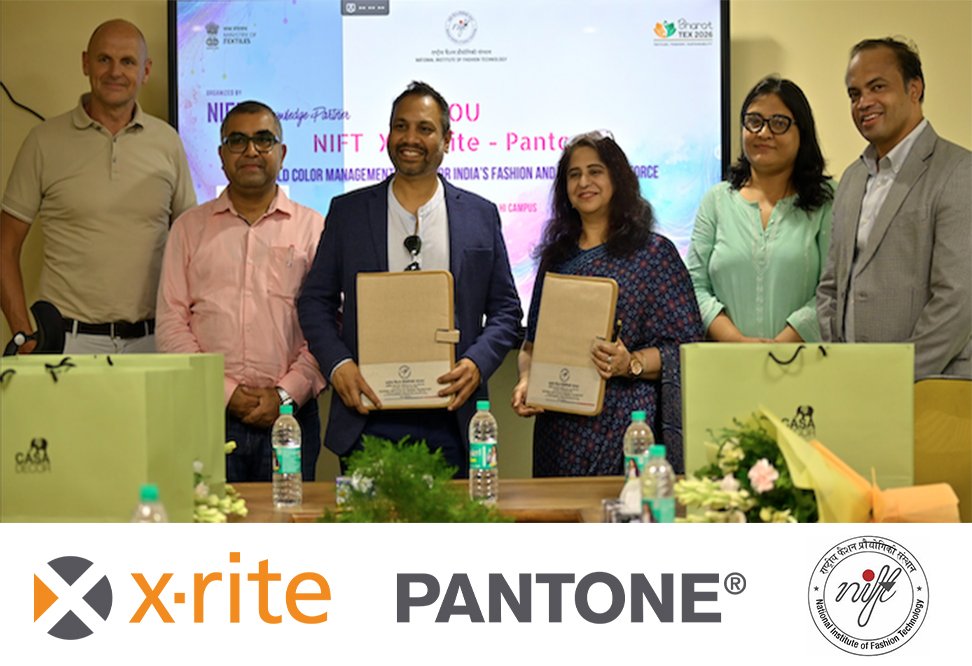
The partnership will give students, faculty and industry professionals hands-on training in colour measurement, digital communication and quality control.
X-Rite Pantone has entered a strategic collaboration with India’s National Institute of Fashion Technology to strengthen colour-management capabilities across the country’s fashion, textile and related manufacturing sectors.
The initiative responds to a persistent supply-chain problem: colour is often communicated subjectively between designers, brands, mills, dyehouses and factories, creating approval delays, shade variation, reprocessing and avoidable cost. The programme aims to connect creative colour intent with objective digital measurement and production control.
Training starts at NIFT Delhi
The collaboration has three initial components. NIFT Delhi will receive classroom access to X-Rite Pantone colour-management technologies and educational resources. Incoming students will attend a dedicated colour-education session, while alumni and faculty will gain access to professional-development programmes at X-Rite Pantone’s Brand Experience Centre in Gurugram.
A two-day Management Development Programme will serve NIFT alumni working in fashion, footwear, jewellery, leather accessories and adjacent industries. Training will cover digital colour workflows, objective measurement, colour communication, quality control and current industry practices.
Faculty become force multipliers
NIFT faculty will also participate in a Trainer of Trainers programme covering colour and appearance fundamentals, measurement technologies, workflow implementation and practical exercises.
This element could give the partnership wider impact than a single student workshop. Faculty trained on commercial systems can incorporate digital colour standards into design, technology and management curricula, reducing the skills gap between academic training and mill or brand operations. NIFT, established in 1986, operates campuses across India and plays a central role in supplying professional talent to the textile and apparel sector.
Colour control becomes a sourcing capability
For manufacturers, stronger colour management can reduce physical sampling, laboratory dips, approval rounds, off-shade production and communication errors across dispersed supply chains. It is particularly relevant to exporters serving brands that increasingly rely on digital product development and remote approvals.
The partners will also explore industry-sponsored and government-led research in colour, design, sustainability and innovation. No investment value, participant targets or implementation timetable were disclosed.
The next test will be whether the programme produces measurable industrial outcomes: shorter colour-approval cycles, higher first-time-right rates, fewer shade claims and wider adoption of instrument-based colour workflows across Indian mills and factories.
