

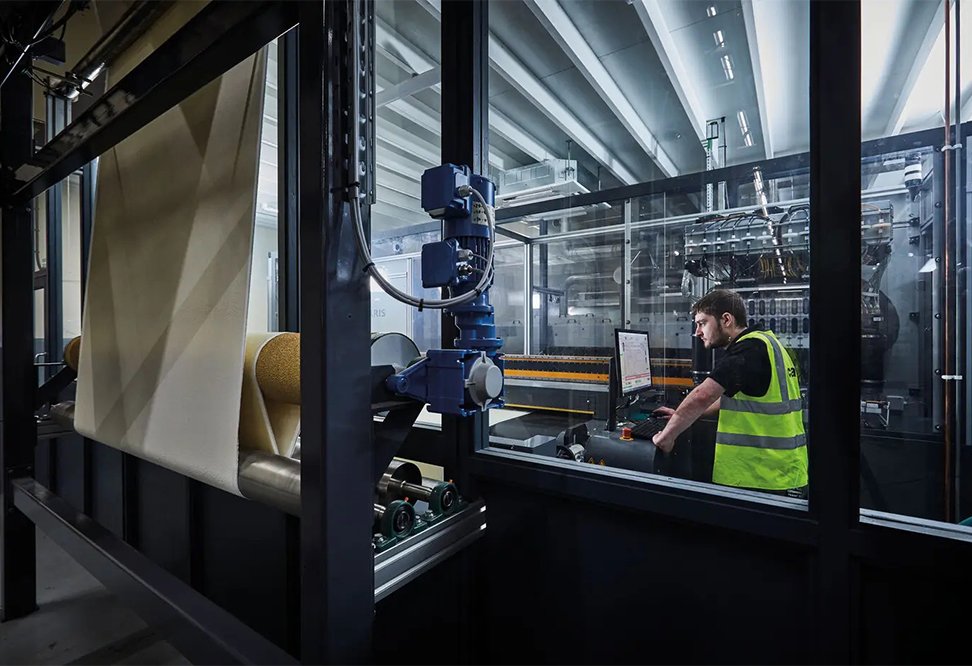
The Austrian machinery maker is positioning digital textile printing as a fully integrated industrial production platform rather than a standalone printing technology.
At ITM 2026 in Istanbul, Austrian textile machinery manufacturer ZIMMER AUSTRIA will showcase its latest advances in digital textile printing, screen printing, and coating systems, with the launch of the redesigned COLARIS-TeX platform taking centre stage.
The company’s message is clear: the next phase of digital textile printing will be defined less by print hardware alone and more by system integration, automation, uptime, and process engineering.
Built for industrial production realities
ZIMMER AUSTRIA’s new COLARIS-TeX has been redesigned around operational efficiency in demanding production environments, particularly multi-shift industrial settings where downtime directly erodes margins.
The platform introduces a new operator-focused architecture aimed at reducing manual intervention, simplifying maintenance, and improving access to critical machine components.
At the heart of the system is a newly engineered print carriage designed for higher mechanical rigidity, greater print precision, and faster servicing. The machine supports up to 12 colour channels and six printheads per channel, using FUJIFILM Dimatix StarFire™ printheads, giving manufacturers flexibility across product types while extending component life and reducing operating costs.
For textile processors, the strategic issue is uptime. ZIMMER has embedded remote diagnostics, predictive maintenance, and real-time technical support connectivity, reflecting a broader machinery trend toward digitally managed asset performance.
As CEO Andreas Rass noted, automation and AI only create value when machine behaviour is stable and process data is reliable.
Expanding application flexibility
A notable differentiator is the platform’s universal ink system, designed to handle multiple dye chemistries and functional fluids. This could be commercially significant for printers seeking to diversify into technical textiles, specialty applications, or shorter production runs without investing in multiple dedicated platforms.
The integrated COLARIS TuneUp automation suite further reduces operator dependency through:
- automatic nozzle-level calibration
- digital printhead alignment
- intelligent banding compensation
This addresses one of digital printing’s most persistent industrial concerns: maintaining consistent quality at speed.
Sustainability and integrated systems strategy
ZIMMER is also responding to environmental pressures with a redesigned blanket cleaning system aimed at reducing water use, optional water recycling modules, and an energy-efficient dryer supporting up to five fabric passes.
The company is also reinforcing its position in carpet printing and technical textiles, where integrated end-to-end solutions remain a competitive advantage.
At ITM 2026, the larger industry question will be whether textile manufacturers are ready to accelerate digital transformation—not just through new printers, but through fully connected production ecosystems.
