

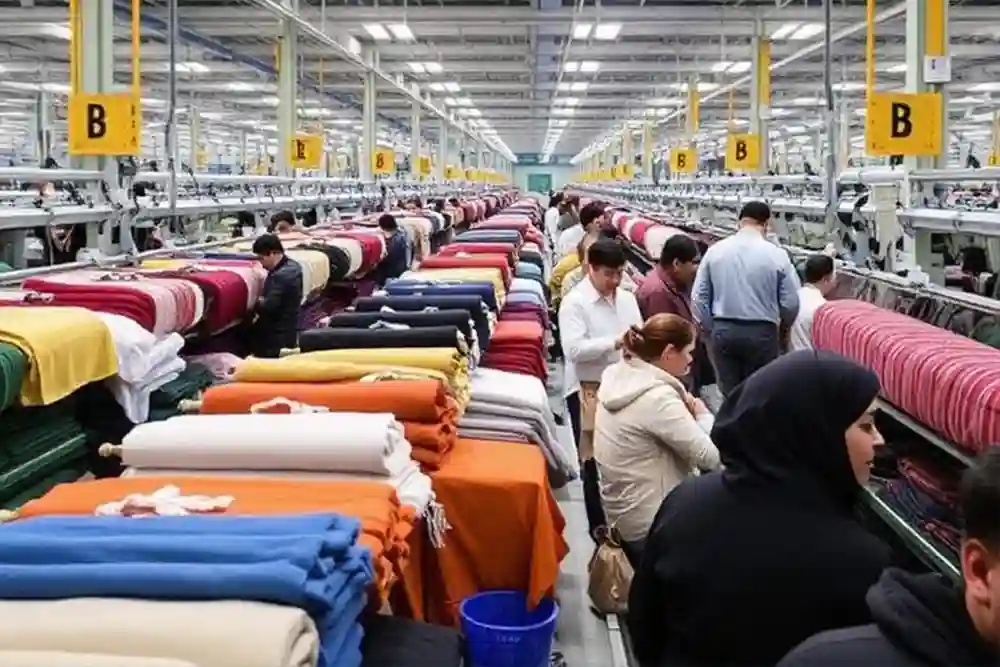
South Korea’s textile industry is facing a structural decline, driven by lost price competitiveness, weak domestic manufacturing investment, and failure to transition decisively into high-value-added and eco-friendly textiles, despite strong global market growth.
According to the Ministry of Trade, Industry and Resources, Korea’s textile exports fell to USD 9.68 billion in 2025, a 7.5% year-on-year decline from USD 10.46 billion. This marks the first time since 1987 that textile exports have dropped below the USD 10 billion threshold—a symbolic and economic milestone for an industry once considered Korea’s export backbone.
From Flagship Export to Structural Decline
- Korea’s textile sector was the first single industry to exceed USD 10 billion in exports in 1987.
- November 11 was designated “Textile Day” to commemorate this achievement.
- Since the early 2000s, exports have fluctuated, but from 2022 onward the decline has become persistent and structural.
Worsening Trade Deficit
- Textile imports have risen sharply, reaching USD 18.75 billion in 2025, nearly doubling from USD 9.74 billion in 2010.
- The sector has recorded a continuous trade deficit since 2016, reflecting rising dependence on foreign textiles and erosion of domestic production capacity.
Core Structural Problems Identified
Industry experts and officials point to several interlinked causes:
- Loss of Price Competitiveness
- Entry of China and other latecomer economies with lower labor costs since the 2000s.
- Korean firms struggled to compete in mass-market apparel textiles.
- Failure to Shift to High-Value Segments
- While global demand has shifted toward industrial, technical, and eco-friendly textiles, Korea’s transition has been slow and incomplete.
- As of 2023:
- Korea’s share of the global industrial textile market: ~3%
- Korea’s share of the eco-friendly textile market: ~2%
- Manufacturing Hollowing-Out
- Declining domestic investment, rising labor shortages, and sustained foreign competition pushed many manufacturers to relocate overseas.
- This has weakened Korea’s domestic manufacturing base, making recovery more difficult.
Missed Opportunity in a Growing Global Market
- The global industrial textile market is projected to grow from USD 146.7 billion (2021) to USD 192.2 billion by 2027, at a 4.7% CAGR.
- Korea has not captured proportional value from this expansion due to:
- Technology gaps
- Insufficient scale-up of advanced textile R&D
- Weak linkage between innovation, production, and commercialization
Industry Outlook
An industry official summarized the situation bluntly: “As domestic facility investment declined and labor shortages intensified, manufacturing shifted overseas, leading to the collapse of the domestic textile manufacturing foundation.
Although industrial textiles are being developed, technology gaps mean we still have a long way to go.”
Bottom Line
Korea’s textile industry is no longer facing a cyclical slowdown but a strategic inflection point. Without urgent reinvestment in domestic manufacturing, accelerated innovation in industrial and eco-textiles, and tighter integration between R&D and production, Korea risks permanent marginalization in a global textile market that is otherwise expanding.
The decline below USD 10 billion in exports is not just symbolic—it is structural.
