

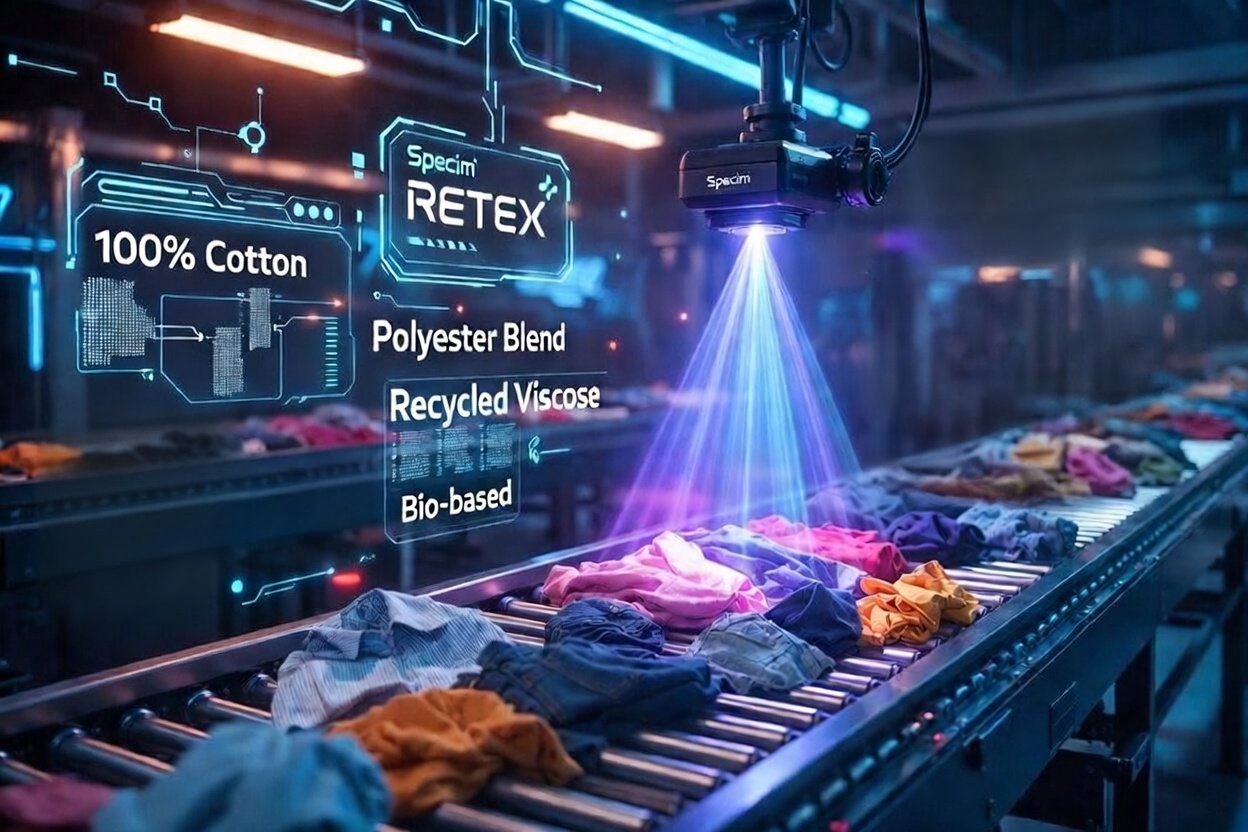
The new platform targets one of textile recycling’s hardest problems: identifying blends, elastane and impurities accurately enough for automated separation.
Specim, part of Konica Minolta, has introduced Specim RETEX, a hyperspectral textile recognition system designed to improve material identification and automated sorting in textile processing and recycling. The company says the system combines hyperspectral imaging with AI-based classification to recognize textile materials in real time, including complex blends and contaminants that conventional vision systems often struggle to distinguish.
The commercial relevance is clear. Textile recycling and sorting operations still face a basic technical bottleneck: many materials look similar visually but differ sharply in fibre composition, blend ratios and recyclability. Specim argues that hyperspectral imaging addresses this by moving beyond RGB and standard multispectral systems, capturing spectral signatures outside the visible range to identify chemical composition more precisely. That is particularly important for visually similar textiles, blended fabrics and elastane-containing articles, where sorting errors can undermine output quality and downstream recycling economics.
Built for industrial throughput
According to the company, Specim RETEX is designed for integration into existing industrial environments and combines hyperspectral cameras, AI classification software and configurable system components. Specim says the platform can identify fibres including cotton, polyester, polyamide, viscose, wool and acrylic, while also detecting blends, elastane, impurities and colour in real time.
A modular route from lab to line
The architecture is modular rather than one-size-fits-all. Specim says the offering includes an AI classification engine for integration into existing systems, laboratory setups for testing and validation, modules for OEMs and integrators, and complete systems for automated textile processing. That gives the product a broader addressable market, from research use and pilot projects to full-scale industrial recycling and sorting lines.
The larger significance is that textile recycling is moving from a waste-handling problem toward a data and identification problem. If systems like RETEX can deliver consistent accuracy at industrial speed, they could help improve material purity, raise automation levels and make fibre-to-fibre recycling more commercially viable.
