

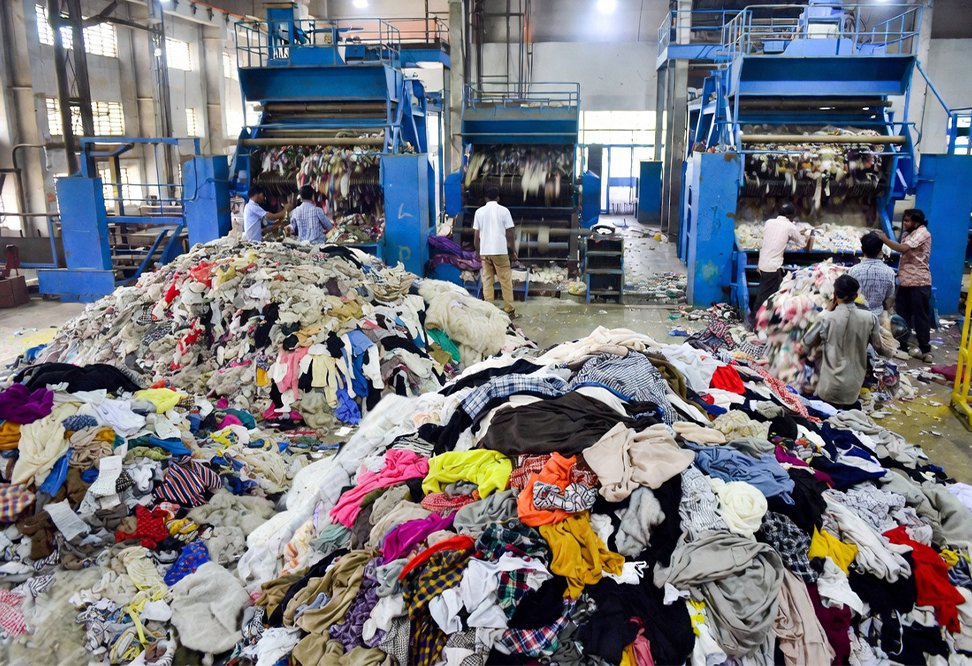
New government-backed mapping shows India already recovers most textile waste, but future growth depends on formal recycling infrastructure, cluster-level processing and stronger circular value chains.
India’s textile recycling market could grow to $3.5 billion by 2030 and generate about 100,000 green jobs, according to a new report released by Union Textiles Minister Giriraj Singh. The report, “Mapping of Textile Waste Value Chain in India,” assesses textile waste generation, recovery channels, recycling technologies and policy options to strengthen circularity across one of the world’s largest textile economies.
A large waste stream, partly captured
The report estimates that India generates around 70.73 lakh tonnes of textile waste annually. About 42% comes from pre-consumer sources such as manufacturing waste, while 58% comes from post-consumer disposal.
More than 70% of total textile waste is already recovered and routed into recycling, upcycling, downcycling or reuse. The recovery rate is particularly high in pre-consumer waste, where about 95% is captured. This reflects the strength of India’s existing collection, sorting and reprocessing networks, especially around industrial clusters.
Panipat and the recycling geography
Panipat has emerged as a major centre for mechanical textile recycling, receiving waste from several textile-producing regions. The report suggests that India can improve efficiency by developing recycling infrastructure closer to textile clusters, reducing transport, improving traceability and enabling faster movement of waste into appropriate reuse or recycling channels.
The spinning sector is highlighted as a strong example of closed-loop practice. Nearly 100% of spinning waste is reintegrated into production in situ, helped by homogeneous waste streams, proximity between waste generation and processing, and established quality specifications for recycled inputs.
Informal systems, formal opportunity
India’s post-consumer textile recovery still relies heavily on informal networks. About 55% of post-consumer textile waste is diverted from landfills, largely through collection and sorting systems that support an estimated 40–45 lakh livelihoods, many held by women from marginalised communities.
The strategic challenge is to formalise without displacing. India’s circular textile opportunity will depend on upgrading sorting, fibre identification, recycling technology and cluster-level infrastructure while preserving livelihoods. The next signal to watch is whether policy support can convert today’s informal recovery strength into a scalable, investment-ready recycling industry.
