

Company presentations at INDEX™26 reveal how sensory analysis, simulation, AI and precision fluid application are accelerating innovation in absorbent hygiene materials.
Experts Driving Innovation at INDEX™26 Exhibitor Product Presentations
Nonwovens can be disposable – for single use, or with a limited life – or durable, with a much longer life, depending on application and their key functions include, but are not limited to, absorbency, bacterial barrier, filtering, cushioning, flame retardancy and liquid repellency.
Because a myriad of options are at the disposal of manufacturers in the development of new products, the testing and measurement of diverse fibres, functional properties and processing parameters is always crucial.
Smell
Odour performance, for example, is a key quality attribute in absorbent hygiene products (AHPs), affecting product acceptance and brand perception.
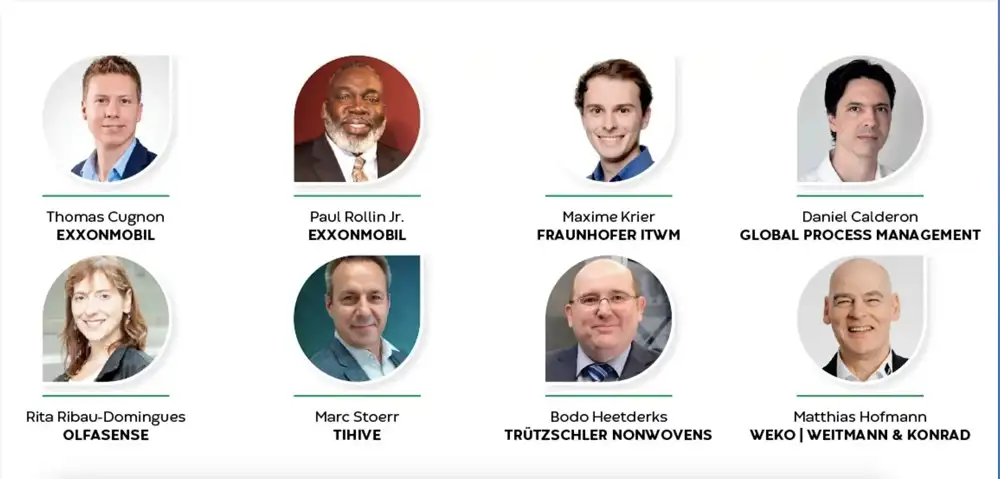
As part of the extensive company presentations taking place at INDEX™26, Rita Ribau-Domingues, Senior Consultant at Olfasense, will review the current analytical and sensory approaches for odour assessment and explain how these test methods support positive decision making in product development and quality control.
The methodology developed by Olfasense for the odour testing of AHPs has been developed to create test conditions that mimic a real-life situation as closely as possible by applying a certain amount of human urine or an appropriate reference substance to the product at frequent intervals.
Based on established odour methodology guidelines, the company’s systems can frequently evaluate odour intensity and tone. The results of this sensory analysis are being used to demonstrate the performance of the products over time, with increasing urine volume.
Softness
Another central attribute for AHPs is softness, and while again very subjective, it is generally accepted that a cushiony, high-loft feel is a sensory attribute making a key contribution to the softness valued by consumers.
Creating the softest nonwovens for diaper backsheets starts with mastering microfibres as fine a 0.6 denier – a real challenge since these delicate fibres easily knot or cling to rough edges.
Bodo Heetderks director of technology at Trütszchler will outline how the German-headquartered technology leader’s advanced opening machines and NC-X cards minimise risks and enable such fine fibres to be processed, for flawless performance and unmatched softness and reliability.
ExxonMobil Signature Polymers has also developed polymer solutions aiming to enhance softness and in a joint presentation, the company’s EMEAF Hygiene Market Development Lead Thomas Cugnon and Senior Principal Scientist for Global Hygiene Paul Rollin, will outline the extensively tested and proven benefits of Vistamaxx™ branded products.
Vistamaxx™ is a semi-crystalline polyolefin which can enable a wide variety of unique product attributes to be engineered into nonwovens, including toughness, cling, sealability, clarity, dispersion, adhesion, elasticity and flexibility, in addition to softness. ExxonMobil continues to pursue new advances in AHP components through material science and formulation strategies.
SAP distribution
Marc Stoerr, Business and Marketing Director for French testing instrument developer TiHive, will introduce the SAPscan, a new non-destructive lab analyzer designed specifically for AHPs.
Powered by patented Terahertz technology and AI vision, it delivers high resolution mapping of SAP distribution across the full diaper core without cutting or altering samples.
In under four minutes, SAPscan generates detailed density maps and customisable zones to support defect detection, benchmarking, faster R&D and wet‑test reuse – all in a compact, safe, plug‑and‑play system that is now being adopted by leading diaper manufacturers around the world.
AI
Advances in AI are also being exploited by both Westland, New Zealand-based Global Process Management and the Fraunhofer Institute for Industrial Mathematics (ITWM) in Germany.
During INDEX™26, Global Process Management’s Technology and Innovation Director Daniel Calderon will explain how the company’s integrated process control platform can provide AHP manufacturers with real-time visibility into key performance indicators, process variables and machine conditions.
The platform improves decision-making, supports quality consistency and identifies opportunities for overall equipment efficiency gains, enabling operations to run more efficiently and predictably.
The Fraunhofer ITWM has meanwhile developed simulation-based approaches to testing and is creating digital twins of nonwoven products.
“Experimental trial-and-error methods in nonwoven development limit the exploration of process and material combinations, compromising optimalisation and innovation,” ITWM scientist Maxime Krier will explain. “By contrast, simulation-based approaches enable efficient comparison and validation of diverse designs without requiring physical samples. I will outline the development of a nonwoven digital twin – from raw material selection to product quality assessment – showcasing the optimisation potential through simulations at each stage.”
Contact less spray
Moving away from testing and raw materials to practicalities in processing, the contactless minimal application of fluids and powders on a wide variety of materials is the focus of German machine builder Weko / Weitmann & Konrad.
Its fluid application systems that provide nonwovens with the precise amount of moisture to create optimum processing conditions will be outlined by Key Account Manager Matthias Hofmann.
The company’s Weko-Sigma is a contactless rotor spray system complemented by the Weko-Flow or Weko-Basic units for precise and automatic metering at high web speeds.
Across testing, materials and processing, the latest innovations are bringing greater precision, insight and control to nonwoven development, enabling manufacturers to deliver consistently higher performance and meet increasingly demanding expectations in hygiene applications.
