

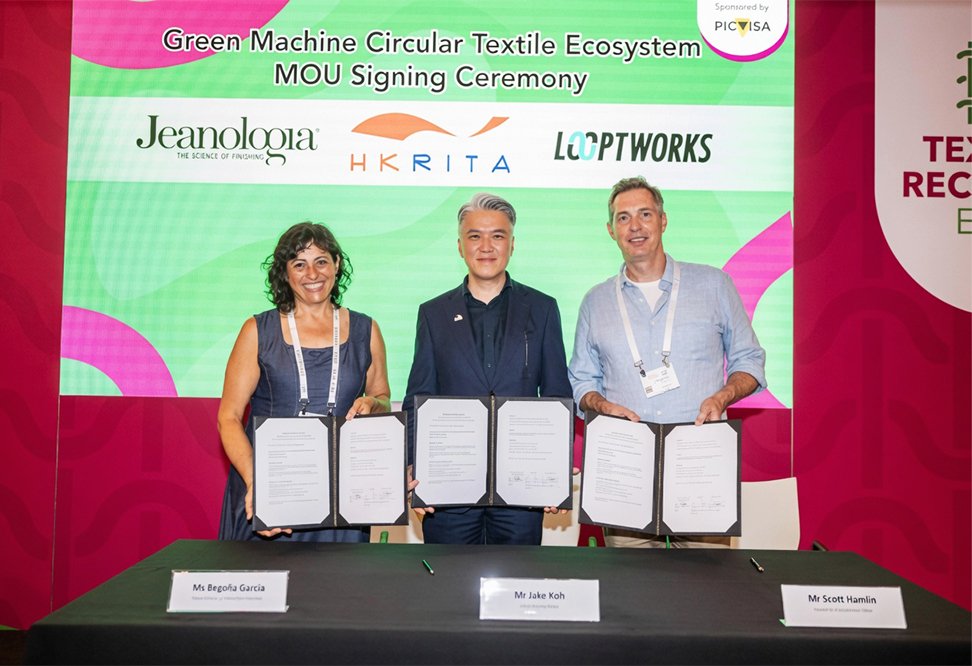
The partnership connects separation technology, machinery engineering and recycling operations—but commercial economics must now be demonstrated.
HKRITA, Jeanologia and Looptworks have signed a memorandum of understanding to create the Green Machine Circular Textile Ecosystem, a three-party effort to industrialise recycling of cotton–polyester blends. The June 24 agreement makes Jeanologia the technology’s first official machinery partner and Looptworks a prospective adopter. It brings together research, machinery engineering and a recycler able to process pre- and post-consumer feedstock—functions often disconnected in textile-recycling pilots.
Separating an awkward feedstock
Green Machine 4.0 applies hydrothermal treatment to convert cotton in blended textiles into cellulose powder while separating polyester fibres without depolymerising them. HKRITA says the latest iteration recovers polyester at 98% purity or above. Its Phase 2 programme reports recovery of more than 97% of polyester within two hours, using heat, water and a small amount of green chemical. The polyester is intended for re-spinning, while cellulose can serve regenerated-cellulose and other applications.
From process to equipment
Jeanologia will supply machinery designed to European standards and compatible with CE high-pressure requirements. Looptworks is expected to support deployment and transform textile inputs into GRS-certified fibre outputs. The aim is wider than equipment sales: to integrate process technology, machinery, feedstock handling and downstream recycling.
The technology is not starting from zero. HKRITA says PT Kahatex in Indonesia operates the first industrial-scale Green Machine system, with capacity of 1.5 tonnes a day, and denim producer ISKO has a licence. But the MoU does not disclose a plant location, capital commitment, processing target or brand offtake agreement.
Commercial proof now matters
For denim mills, recyclers and fashion brands, poly-cotton is an important but difficult waste stream: fibre separation must work with variable blend ratios, dyes, finishes, trims and contamination. The alliance could help close the gap between a successful separation process and an operational supply chain.
The next test is hard numbers: feedstock specifications, recovery yield, cost per tonne, energy and water use, output quality, and binding buyers for both polyester and cellulose streams. The partnership gives Green Machine a stronger route to market; a named, operating industrial deployment will determine whether that route can be scaled.
