

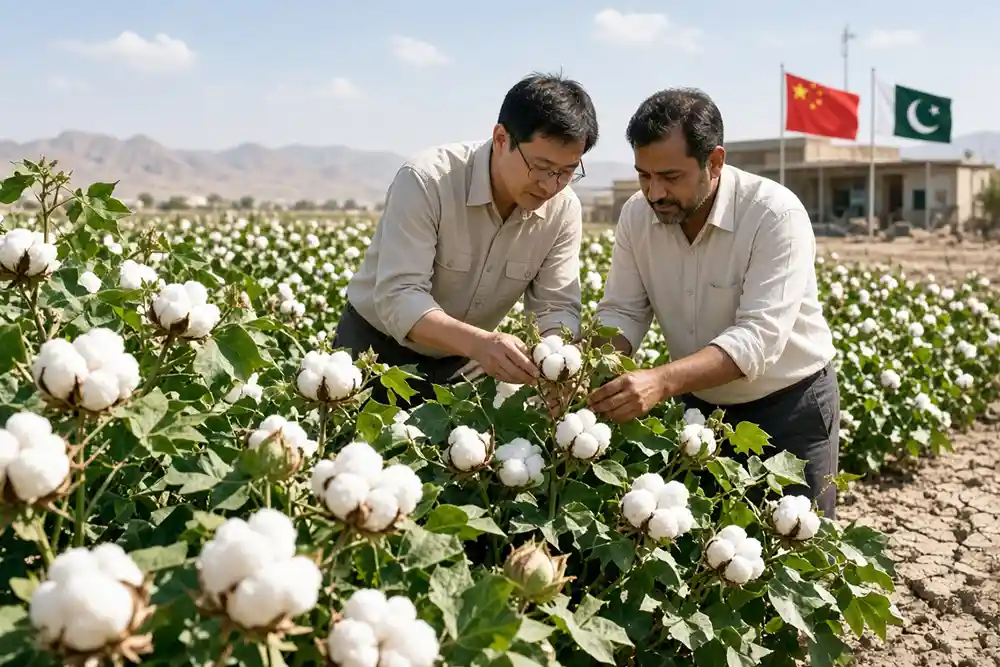
The new agreement targets germplasm, biotechnology and mechanised cultivation as Pakistan seeks to rebuild domestic cotton supply and reduce the textile industry’s dependence on imported fibre.
China’s Institute of Cotton Research, part of the Chinese Academy of Agricultural Sciences, and Pakistan’s Muhammad Nawaz Shareef University of Agriculture Multan have signed a memorandum of understanding for long-term cooperation in cotton germplasm, biotechnology and breeding research. The agreement was concluded during a Pakistani delegation’s visit to the institute in Anyang, Henan.
Climate resilience moves to the centre
The partners plan joint research using their respective germplasm collections and scientific capabilities. Priority areas discussed include molecular breeding, gene editing, disease resistance, heat tolerance and mechanised cotton cultivation, alongside researcher training and possible joint laboratory development.
These capabilities address several structural problems in Pakistan’s cotton sector. MNSUAM Vice Chancellor Asif Ali highlighted shrinking planted area, declining yields, limited germplasm resources and intensifying exposure to extreme climatic conditions.
China already brings considerable breeding scale to the partnership. Previous China-Pakistan research has evaluated germplasm across different environments for tolerance to heat, drought, diseases and insect pressure, although Chinese varieties cannot simply be transferred directly because local temperature and agronomic conditions differ.
Textile mills need more domestic fibre
Pakistan has set a 2026/27 cotton production target of 9.64 million local bales from 2.16 million hectares, reflecting the strategic importance of restoring domestic output.
For textile manufacturers, improved varieties could eventually deliver more than higher farm yields. Fibre length, strength, micronaire consistency, contamination and ginning outturn directly influence spinning efficiency, yarn quality and raw-material cost. Reducing crop volatility would also lessen mills’ exposure to imported-cotton prices, foreign exchange and shipping risks.
Research must reach the field
The MoU is an enabling agreement rather than a commercial breeding programme: no investment value, variety-release timetable or quantified yield targets have been announced.
The decisive test will therefore be whether joint research produces locally adapted varieties that survive multilocation trials, enter certified seed multiplication and achieve widespread farmer adoption. Pakistan’s textile sector will benefit only when biotechnology translates into reliable volumes of competitive, spinnable cotton at farm scale.
