

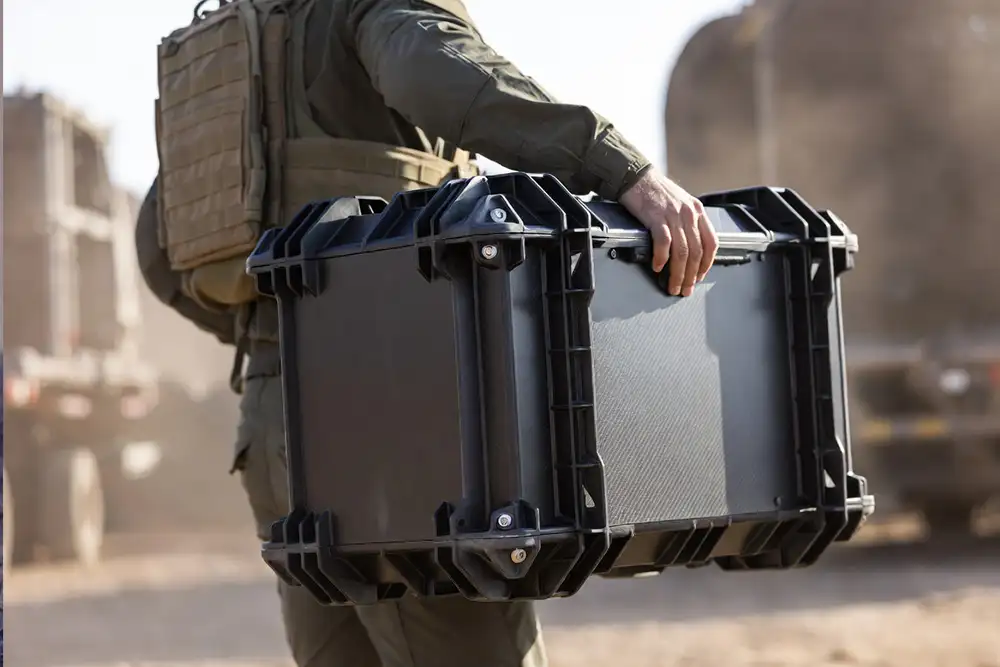
For defence logistics, the value of carbon fibre lies not only in lower mass, but in protecting increasingly sensitive electronics through repeated transport, deployment and field exposure.
ECS Composites has announced further development of carbon-fibre composite protective enclosures for military and field-based equipment, reinforcing the role of advanced textile reinforcements in defence mobility and mission readiness.
The Oregon-based company designs protective transit and rackmount systems for sensitive military, aerospace and technical equipment. Its latest announcement centres on lighter carbon-fibre composite constructions that it says retain the impact resistance and structural integrity needed in harsh operating environments.
A system-level weight reduction
ECS says its advanced composite designs can reduce enclosure thickness and overall weight by as much as half compared with traditional fibreglass systems, without compromising durability or protection.
That claim is strategically relevant for defence users because protective cases are moved repeatedly across complex logistics chains. Lower enclosure weight can improve manual handling, reduce transport burden and preserve more of the available payload for communications, sensing, computing and other mission equipment.
The operational requirement remains demanding. Enclosures must protect internal systems from shock, vibration, sand, dust, moisture, repeated loading and environmental exposure while remaining practical to deploy, repair and transport.
Carbon fibre moves beyond aerospace structures
The announcement illustrates a broader commercial opportunity for carbon-fibre textiles and composites. Defence demand is not limited to aircraft structures, armour or vehicles. It increasingly includes ruggedised cases, mobile command systems, field electronics, drone equipment, radar components and other portable mission platforms.
For composite suppliers, this expands the value proposition from supplying carbon fabric or prepreg to delivering engineered systems with verified structural, environmental and lifecycle performance.
ECS’s carbon-fibre cases are available in transit and rackmount configurations, with options including cooling modules, grounding cables, drawers, equipment slides and other custom features. This highlights the importance of integrating material selection with enclosure design, thermal management and equipment accessibility.
Manufacturing control matters
ECS also points to proprietary moulding processes and in-house tooling as central to controlling quality and consistency. In defence applications, reproducibility is as important as low weight. A technically advanced composite has limited value if production variability affects fit, sealing, impact performance or long-term reliability.
The next commercial test is independent validation. Buyers will want quantified performance data on impact resistance, ingress protection, vibration, thermal stability, repairability and total cost of ownership. Carbon fibre can reduce the logistics burden, but adoption will depend on evidence that lighter structures also deliver dependable protection over long service lives.
