

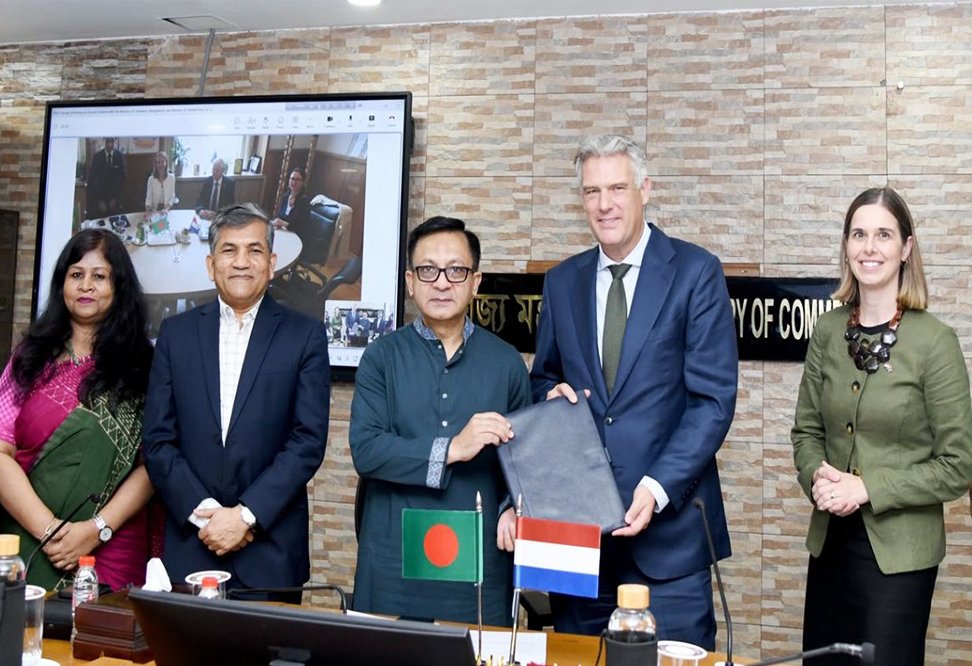
The agreement targets textile recycling, cleaner production and traceability as Bangladesh prepares its export industry for tighter sustainability requirements in major markets.
Bangladesh and the Netherlands have signed a memorandum of understanding to accelerate circular-economy practices across Bangladesh’s textile and ready-made garment industry. Signed on August 17, 2026, the agreement covers resource efficiency, waste reduction, textile recycling, sustainable production, green industrialisation and knowledge exchange across the value chain.
Circularity moves into industrial policy
The agreement was concluded between Bangladesh’s Ministry of Commerce and the Netherlands’ Ministry of Economic Affairs and Climate Policy. Bangladesh Commerce Minister Khandakar Abdul Muktadir described circularity as increasingly important to export competitiveness, investment attraction and preparation for changing international market requirements.
The cooperation comes as Bangladesh approaches graduation from Least Developed Country status, increasing pressure on manufacturers to compete through productivity, environmental performance and higher-value production rather than preferential market access alone.
Waste becomes a manufacturing resource
The initiative builds on earlier Dutch-Bangladeshi cooperation in circular textiles. A Netherlands Enterprise Agency programme has already identified three priority areas: recycling post-production textile waste, improving traceability and cleaner production using fewer chemicals, water and fossil fuels.
These priorities are commercially significant for Bangladesh because its large garment-manufacturing base generates substantial cutting waste that can potentially become feedstock for fibre-to-fibre recycling rather than leaving the country as low-value waste.
Implementation is the real test
The MoU establishes cooperation rather than binding recycling targets, investment commitments or producer-responsibility requirements. No funding value, recycling-capacity target or implementation timetable has yet been announced.
For mills and exporters, the immediate opportunity is to develop traceable waste streams, segregate fibre types, measure resource efficiency and build partnerships with recycling technology providers. The next signal will be whether the governments convert the agreement into funded industrial projects, recycling infrastructure and commercial offtake arrangements capable of turning Bangladesh’s manufacturing waste into new textile raw material.
