

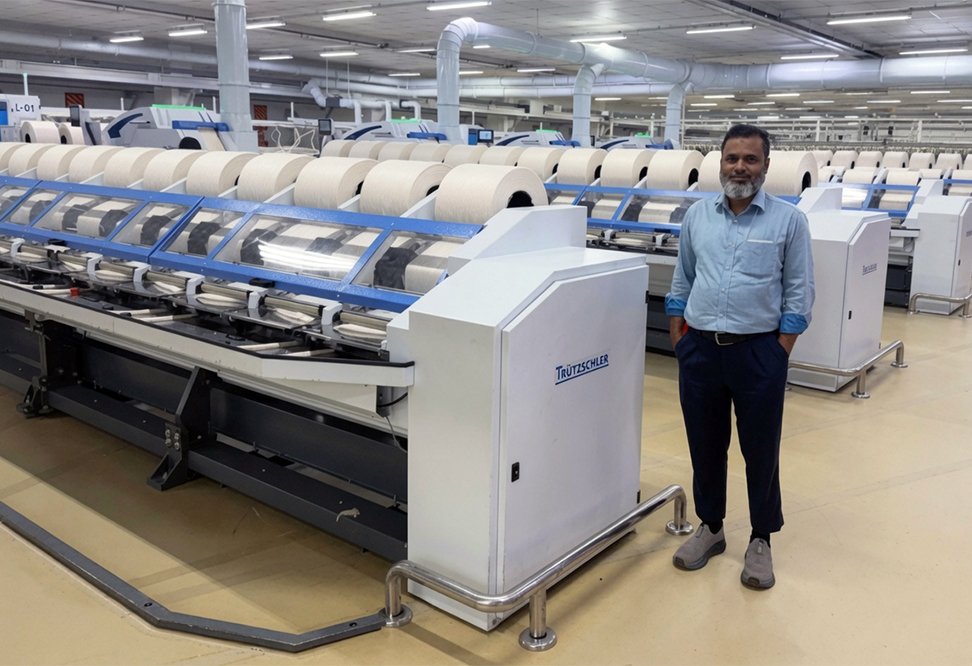
The investment targets higher combing output, tighter sliver-count control and lower conversion costs as Bangladesh’s spinning sector moves towards more automated production.
Bangladesh’s Badsha Textiles Ltd. has installed ten Trützschler TCO 21XL combers and placed a follow-on order for eight additional machines, extending a machinery partnership that began in 2004. The expansion strengthens the mill’s spinning-preparation capacity while reducing the floor space and energy required for each unit of combed sliver produced.
Badsha Group reports that Badsha Textiles and Kamal Yarn expanded their combined yarn output from 430 metric tons per day in 2024 to 710 metric tons per day in 2025. The operations produce carded, combed, open-end, blended and recycled yarns in counts ranging from Ne 6 to Ne 40.
Twelve heads change mill economics
Unlike the conventional eight-head configuration, the TCO 21XL operates with 12 combing heads. Trützschler says this delivers around 50% more productivity while requiring 25% less production space for an equivalent number of combing heads. The machinery manufacturer also claims a 30% reduction in the building width needed for comparable combing capacity.
At its stated maximum output of up to 150 kilograms per hour, two TCO 21XL machines can nominally provide the production capacity of three conventional combers. For high-volume mills, that configuration can reduce machinery count, material handling, maintenance points and the cost of expanding the combing room.
Count stability moves online
Badsha highlighted the machine’s COUNT CONTROL system as a significant quality feature. DISC MONITOR sensors continuously measure delivered sliver, while COUNT CONTROL adjusts the drafting system when a deviation is detected. This maintains sliver-count stability without changing lap tension, supporting more consistent yarn count and reducing dependence on corrective laboratory intervention.
The TCO 21XL also incorporates automatic piecing-point optimisation and independently controlled drive systems designed to maintain uniform combing performance at higher production rates.
Efficiency becomes the investment test
The additional eight-machine order indicates that Badsha is moving beyond initial technology validation towards wider deployment. The next measure of success will be the operating data: kilograms produced per machine-hour, energy consumption per kilogram, noil levels, stoppages and downstream yarn-quality consistency. Those indicators will determine whether the 12-head architecture becomes a broader replacement standard for large Asian spinning mills.
