

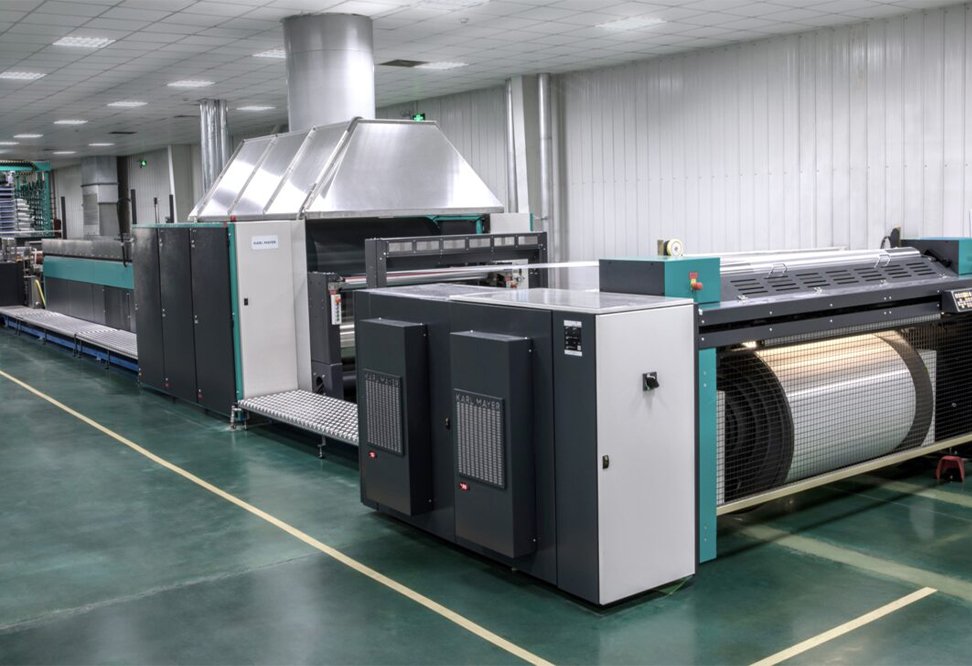
High-performance AI servers require increasingly complex printed circuit boards, creating an unexpected growth market for precision textile machinery used to manufacture electronic-grade glass fabrics.
The rapid build-out of artificial-intelligence infrastructure is generating new demand for textile machinery. KARL MAYER says orders for its warp-preparation systems are benefiting from rising production of woven glass fabrics used to reinforce copper-clad laminates—the base material for printed circuit boards in servers and other electronics.
Glass-fabric capacity expands
KARL MAYER estimates that around 4 billion metres of electronic glass fabric are currently produced globally each year and expects another 2 billion metres of capacity by 2028. The company describes itself as a major supplier to this specialised market, where its core systems include the FILSIZE-G sizing machine and AM-G assembling machine.

“Currently, around four billion meters of glass fabric are produced worldwide each year. By 2028, another two billion meters will be added – a massive market in which we lead with a major market share.”
Its involvement dates to 2007, when the first systems were supplied to customers in China and Taiwan. KARL MAYER delivered its 100th electronic-glass machine in China in 2020.
AI raises textile precision requirements
The opportunity is not simply more fabric volume. AI servers demand more sophisticated PCB architectures. KARL MAYER says copper-clad laminate constructions have progressed from around six layers in conventional electronics, to 12 in applications such as electric vehicles and mobile phones, and more than 24 layers in AI data centres.
That places tighter requirements on glass-fabric uniformity. During warp preparation, small variations in yarn tension can create local density differences in the woven structure. At high signal frequencies, these variations can contribute to propagation-time differences known as the fibre-weave effect, or intra-pair skew.
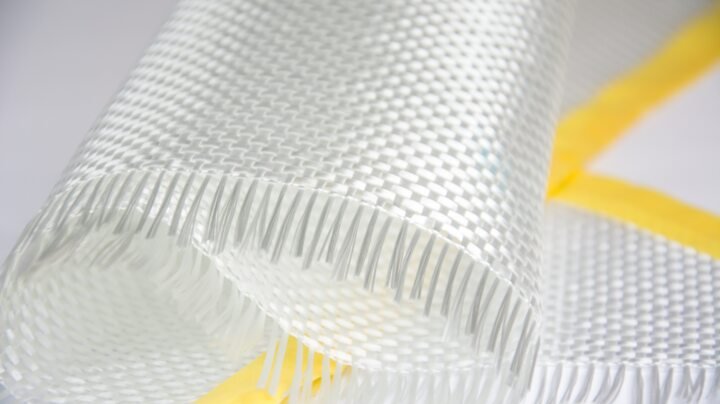 Technical textiles gain another growth engine
For textile machinery manufacturers, AI infrastructure creates a high-value application far removed from conventional apparel demand. Precision warp preparation, controlled sizing and repeatable fabric geometry become part of electronics performance rather than simply textile quality.
The next test will be whether KARL MAYER’s projected two-billion-metre capacity expansion materialises at the expected pace. For technical-textile producers, electronic-grade glass fabric illustrates how growth in AI, semiconductors and data centres can create new machinery and advanced-material opportunities beyond traditional textile markets.
