

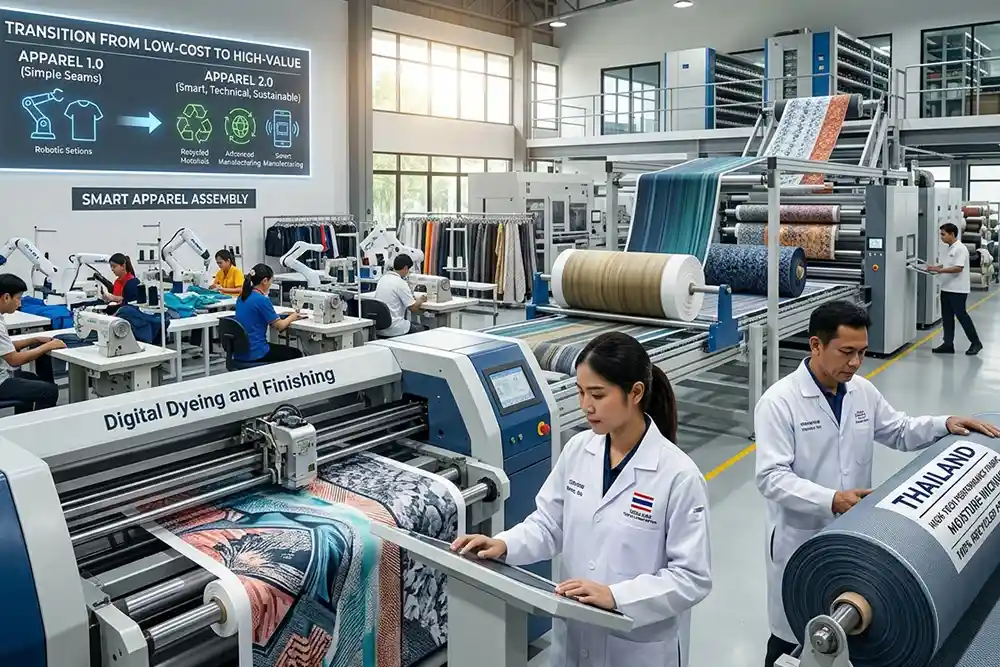
Thailand is positioning itself as a higher-value China+1 sourcing base built around functional textiles, ODM capability, shorter runs and supply-chain integration rather than competing with Asia’s lowest-cost garment producers.
Thailand’s textile and apparel industry is seeking a larger role in the restructuring of Asian sourcing, using the China+1 strategy to reposition itself around design, technical capability and higher-value manufacturing.
The push was visible across three textile and fashion events held in Bangkok in June and July 2026. Industry leaders told buyers that Thailand’s opportunity lies less in mass-market sewing and more in ODM, functional and sustainable fabrics, technology-intensive production and flexible smaller orders.
Apparel outperforms upstream textiles
Official Thailand Textile Institute data show the complexity of that transition. In 2025, textile and apparel exports totalled $6.15 billion, down 0.9% year on year. Textile exports fell 4.1% to $3.83 billion, while apparel exports increased 4.9% to $2.32 billion.
Momentum remained subdued in early 2026: January-March textile and apparel exports reached $1.51 billion, down 2.6%, including $982.3 million of textiles and $528.1 million of apparel.
Thailand therefore faces a different competitive equation from Bangladesh, Cambodia or Vietnam. Higher labour costs make commodity garment production difficult, encouraging manufacturers to compete on skills, product development, quality, speed and integrated services.
Technical textiles offer an upgrade path
Government investment policy reinforces the move upstream. Thailand’s 2026 Board of Investment promotion framework specifically covers manufacturing of technical or functional fibres, functional yarns and fabrics, and recycled fibres, subject to qualifying conditions.
That creates a stronger proposition for performance apparel, automotive textiles, medical materials and other higher-margin applications.
China+1 does not mean China-free
Thailand’s strategy is diversification, not disengagement from China. China supplied 51.5% of Thailand’s textile and apparel imports in 2025, with imports from China rising 13.3%.
The commercial test is therefore whether Thailand can combine Chinese material and investment linkages with local design, manufacturing expertise and ASEAN access to become a higher-value regional sourcing hub. Its success will depend less on wage competition and more on how quickly mills and garment manufacturers convert those advantages into differentiated products and dependable full-package services.
