

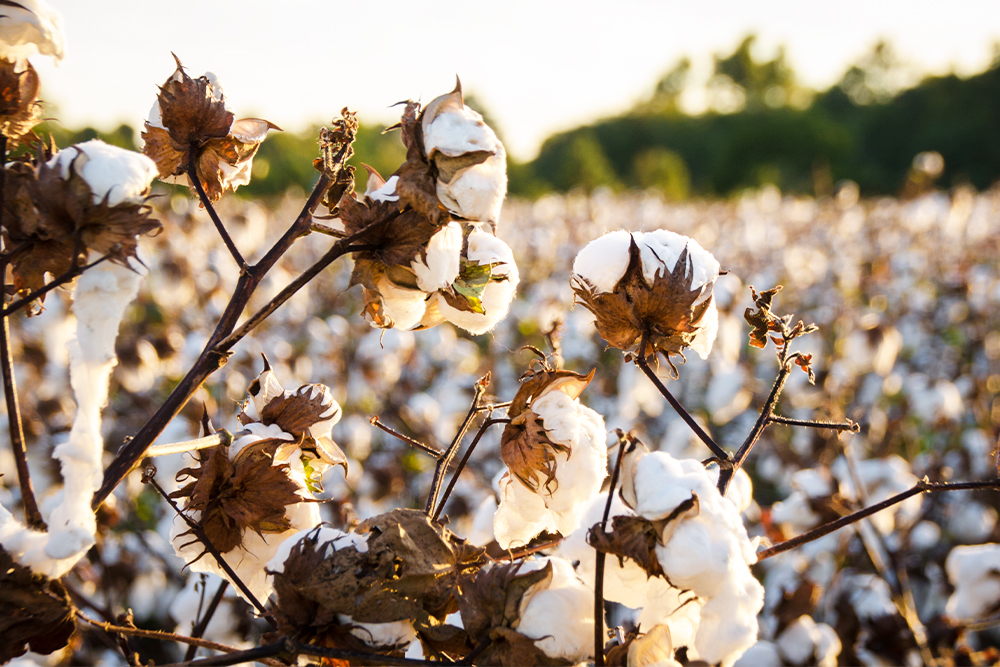
Pakistan’s cotton production is reviving due to promising weather conditions and increased cultivation, countering the devastation of last year’s flash floods.
As the trading of Pakistan’s local market remained firm and trading volumes increased the Spot Rate Committee of the Karachi Cotton Association (KCA) increased the spot rate by Rs 200 per maund on Thursday. The latest spot price stands at Rs 18,200 per maund.
The rate of new crops of cotton in Sindh is on the rise and ranges between Rs 18,100 to Rs 18,300 per maund. The rate of Phutti in Sindh is also inching up but is still less than the government-indicated price. It ranged during the week between Rs 7,200 to Rs 8,200 per 40 kg. The rate of cotton in Punjab is higher despite the fact it is the largest producer of cotton in the country. But the majority of spinning units are also located in Punjab. The cotton price in the province fluctuated between Rs 18,300 to Rs 18,700 per maund while the rate of Phutti was between Rs 7,200 to Rs 8,500 per 40 kg. The rate of cotton in Balochistan matched that of Sindh being ranged between Rs 18,100 to Rs 18,300 per maund while the rate of Phutti was better at between Rs 7,400 to Rs 8,400 per 40 kg.
Meanwhile, the other textile fiber Polyester Fiber was available at Rs 360 per kg.
Data collected from different cotton sales locations in the country on Thursday reveals that 400 bales of Hyderabad were sold at Rs 18,100 per maund, 200 bales of Mir Pur Khas were sold at Rs 18,300 per maund, 1400 bales of Shahdad Pur were sold at Rs 18,100 to Rs 18,300 per maund, 400 bales of Sarhari were sold at Rs 18,100 per maund, 400 bales of Sarkand were sold at Rs 18,100 per maund, 1200 bales of Saleh Pat were sold at Rs 18,100 to Rs 18,300 per maund, 200 bales of Moro were sold at Rs 18,100 per maund, 2000 bales of Tando Adam, 1000 bales of Sanghar were sold at Rs 18,200 to Rs 18,300 per maund, 600 bales of Mian Channu were sold at Rs 18,650 to Rs 18,700 per maund, 200 bales of Layyah were sold at Rs 18,700 per maund, 800 bales of Peer Mahal were sold at Rs 18,600 per maund, 200 bales of Hasil Pur were sold at Rs 18,500 per maund, 1600 bales of Vehari were sold at Rs 18,300 to Rs 18,550 per maund, 1200 bales of Haroonabad were sold at Rs 18,400 to Rs 18,500 per maund, 600 bales of Chichawatni were sold at Rs 18,400 to Rs 18,500 per maund, 200 bales of Faqeer Wali were sold at Rs 18,500 per maund, 400 bales of Fort Abbas were sold at Rs 18,400 per maund, 200 bales of Chistian were sold at Rs 18,375 per maund and 600 bales of Yazman Mandi were sold at Rs 18,300 to Rs 18,375 per maund and 400 bales of Burewala were sold at Rs 18,000 per maund.
A recent report by Karachi-based brokerage Insight Securities highlights a promising start to the new cotton season and the arrival of a robust crop, instilling renewed optimism in a sector that faced challenges in the previous year, including catastrophic floods and subdued textile demand. According to the report, cotton sowing has seen a substantial rise of 34 percent year-on-year, encompassing 2.767 million hectares by June. This surge in cultivation is expected to yield 12.77 million bales, a significant jump from the previous year’s 4.91 million bales. The anticipated yield per hectare stands at an impressive 785 kg, surpassing the decade-long average of 658 kg.
This year’s gains are the result of favorable weather patterns, particularly timely monsoon rains in July, which have aided crop growth and reduced pest incursions. Although the monsoon has not yet ended, the crop is still under threat of rain. In tandem with this positive trajectory, the Pakistan Cotton Ginners Association reported the arrival of 1.4 million bales of cotton by July, signifying an early influx of the new crop. The government established a support price of Rs8,500 per maund (40 kg) to incentivize cotton cultivation, but market dynamics have led to lower actual prices ranging between Rs. 7,000 to Rs. 8,500 per maund for multiple reasons. To maintain market stability and ensure an ample domestic supply, the state-owned Trading Corporation of Pakistan (TCP) has undertaken the decision to purchase one million bales from farmers.
As the fresh cotton crop in India has just started trickling into the market many states see a shortage of the commodity. Tamil Nadu for instance has asked for permission to import duty-free cotton imports under a quota system. The state chief minister, M K Stalin, has made a demand to the central government to release a quota of 20-25 lakh bales of duty-free cotton import for the current non-arrival season. The cotton deficit in the Tamil Nadu-based industry has led to calls for an urgent release of duty-free imports or a permanent removal of the import duty on natural fiber. Stalin said in a letter that Tamil Nadu that most of the more than 2,000 spinning mills, running solely on cotton will cease production if the quota is not immediately granted. He stated that the new cotton will arrive in October.
Meanwhile, in the United States, the US Department of Agriculture (USDA) has unexpectedly cut by 2.51 million bales 13.99 million bales as its southwest crop continues to deteriorate from heat stress.
Cotton futures traded sideways this week, holding steady with the anticipated release of the WASDE. Macro headwinds pressured the market much of the week and worrying economic news out of China did not help. On the opposite side, worries about how heat stress has affected crops and continued Reserve Sales out of China helped curb losses early in the week. A vital Export Sales Report helped bump prices up to close out the week on a high note. The December futures settled at 86.15 cents per pound, up 145 points from the week prior. Although daily volumes traded this week were lower, total open interest managed to increase 2,503 contracts to 212,259.
The release of the Consumer Price Index (CPI) on Thursday was the headline in broader markets this week. July CPI rose 3.2 percent year-over-year, which was slightly weaker than market expectations. The overall neutral report has many analysts expecting an interest rate pause in September. The report helped push significant indexes higher to finish the week. In addition to the neutral inflation news, an increase in weekly unemployment claims put pressure on the U.S. Dollar, which helped boost commodity prices in general. Crude oil prices continued to strengthen, and with cotton prices being correlated with oil prices, the increase has helped bolster prices this week.
This week’s Export Sales Report was the final report for the 2022/23 season and also contained the activity for the first few days of the 2023/24 marketing year. The outgoing marketing year ended without any major fireworks. The last week of the 2022/23 season showed a total of 195,800 Upland bales were exported. This was lower than what was needed to meet the export estimate of 12.9 million bales and a total of 2,152,500 Upland bales will be carried to the 2023/24 marketing year. Total accumulated exports for the 2022/23 crop year finished at 11,777,500 bales. The 2023/24 marketing year began on August 1. A net total of 277,700 Upland bales were booked for the beginning of the crop year and a total of 129,000 bales were shipped. To no surprise, China was the biggest buyer this week, booking 154,100 bales. China was followed by Pakistan with 132,800 bales, Vietnam with 13,900 bales, and Honduras with 11,900 bales. Net sales of Pima for 2023/24 totaled 900 bales, with no sales reported for the 2022/23 crop year. A small 1,000 bales of the 2023/24 crop were exported.
Exports for the last week of 2022/23 totaled 2,100 bales, meaning carryover from the 2022/23 crop. From a purely cotton point of view, the WASDE was this week’s main event. The 2022/23 crop was primarily kept unchanged. Production was kept at 14.47 million bales, consumption stayed at 2.05 million bales, but exports decreased by 100,000 bales to 12.8 million bales.
While the Export Sales Report did not contain fireworks, the 2023/24 update to the balance sheet sent the market up. A substantial decrease of 2.51 million bales in production, bringing the total to 13.99 million bales, took the market by surprise. A cut was expected with production, but one of that size was not. Domestic consumption decreased by 50,000 bales to 2.15 million bales, and exports decreased by 1.25 million bales to 12.5 million bales. The first look at production numbers was released simultaneously with the WASDE. Projected production in Texas is expected to be 4.2 million bales, Oklahoma is expected to have 520,000 bales, and Kansas has 250,000 bales.
Globally, the 2022/23 balance sheet showed a rise in consumption of 710,000 bales to bring the total to 110.48. Endings stocks also increased by 180,000 bales to 94.13 million bales. The 2023/24 balance sheet brought consumption up 490,000 bales to 116.
94 million bales but cut ending stocks by 2.92 million bales to 91.60 million bales.
The hot, dry weather continues to put stress on the crop in West Texas, Oklahoma, and Kansas. Although little relief has been found, scattered thunderstorms and spotty rain were reported across many areas. Much more rain and seasonable temperatures will be needed soon to provide relief to the heat-stressed crop.
Harvest is progressing rapidly across South Texas. Unlike West Texas, the dry weather that is forecast in the coming week will be welcome to ensure harvest continues without interruption. The deterioration of the crop in the Southwest has caused the overall crop in the U.S. to continue to decline.
With a fresh WASDE in hand, attention will likely shift back to the usual watchpoints.
Although it appears inflation worries are easing, broader economic concerns will continue to be watched as they have been a source of movement for cotton prices lately. Crop progress and condition, weather, and the Export Sales Report will continue to hold their usual importance on the fundamental front.

