

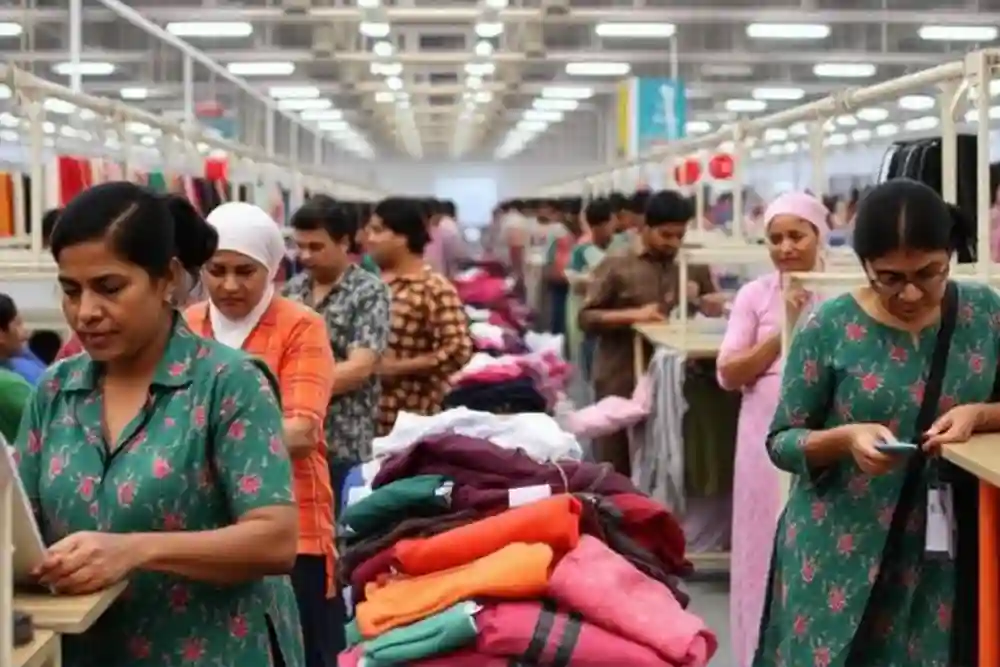
Bangladesh has signaled a breakthrough in trade negotiations with the United States, raising hopes for lower tariffs and expanded market access for its critical textile and apparel sector.
Following high-level talks in Washington, Bangladesh’s Chief Adviser Muhammad Yunus described the discussions as “an important step forward” in building a stronger and more mutually beneficial economic partnership with the US.
Key Developments
- Tariff Reduction Request:
The US Trade Representative Ambassador Jamieson Greer has agreed to raise with President Donald Trump the possibility of reducing Bangladesh’s current 20% reciprocal tariff.
The request was formally conveyed by Bangladesh’s National Security Adviser Dr Khalilur Rahman. - Level Playing Field for Bangladesh:
A tariff cut would bring Bangladesh’s access closer to that of regional competitors, directly boosting competitiveness of its garment exports—the backbone of the country’s economy and employment.
Proposed “Win-Win” Textile Arrangement
Officials also discussed a preferential market access mechanism under which:
- Bangladesh could receive tariff-free access to the US market for textiles and apparel,
- Linked directly to imports of US cotton and man-made fibre inputs, calculated on a square-metre equivalent basis.
This model aims to:
- Support Bangladeshi manufacturers and workers,
- Increase demand for US textile raw materials,
- Strengthen bilateral supply-chain integration.
Yunus described the proposal as:
“A creative, win-win approach that strengthens bilateral trade, supports Bangladeshi manufacturers and workers, and deepens supply-chain ties with U.S. producers.”
Trade Context
- Total US–Bangladesh trade (2024): USD 12.4 billion (+3% YoY)
- US exports to Bangladesh: USD 2.3 billion
- US imports from Bangladesh: USD 8.4 billion
- US goods trade deficit: USD 6.1 billion
Textiles and apparel account for the vast majority of Bangladesh’s exports to the US, making tariff reform strategically significant for both sides.
Why This Matters
- For Bangladesh:
Lower tariffs could protect market share, sustain employment, and reinforce its position as a leading global apparel exporter amid rising competition. - For the United States:
The proposal ties market access to US cotton and fibre exports, potentially supporting American farmers and upstream textile producers.
Bottom Line
The talks mark a potential inflection point in US–Bangladesh trade relations. If implemented, tariff reductions and a cotton-linked preferential scheme could reshape apparel sourcing dynamics—strengthening Bangladesh’s competitiveness while anchoring US inputs deeper into global textile supply chains.

