

The German project is challenging a long-held assumption in man-made fibres: that polyethylene belongs in packaging and technical products, not mainstream apparel.
bioPEtex, a German research consortium, is developing 100% bio-based polyethylene yarns for textile applications, with initial work spanning polymer compounding, melt spinning, false-twist texturing and knitting trials. The project brings together TECNARO, RWTH Aachen University’s Institute for Textile Technology, BB Engineering and hosiery-and-sportswear producer FALKE.
The objective is ambitious. Polyethylene is lightweight, hydrophobic, chemically stable and widely available, but it has rarely been used in apparel because its low crystallisation temperature creates a narrow processing window and its low polarity makes conventional dyeing difficult.
From polymer challenge to yarn process
The consortium is addressing those constraints through spinnable bio-PE compounds containing bio-based pigments, enabling spun-dyeing rather than conventional wet coloration. This can avoid one of PE’s central textile limitations while potentially reducing water, energy and chemical demand associated with dyeing.
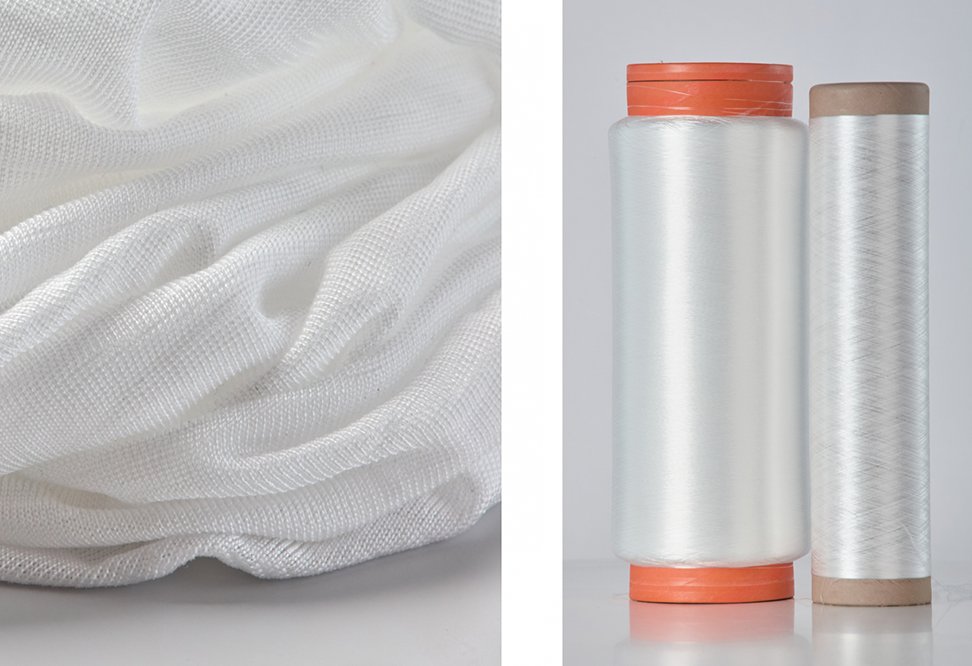
Initial trials have produced partially oriented yarn at melt-spinning speeds of about 2,500 metres per minute, with reported tensile strength near 20 cN/tex. The yarn has subsequently been false-twist textured in laboratory and semi-industrial trials, while FALKE has conducted knitting tests and produced an initial white T-shirt demonstrator.
Texturing is a critical step. It determines bulk, handle, stretch behaviour, thermal feel and much of the fibre’s practical textile performance. For PE, it may be the difference between a technically spinnable filament and a yarn suitable for clothing.
A different proposition from polyester
Bio-based PE is chemically identical to fossil-based PE; its potential environmental advantage comes from renewable feedstock rather than a different polymer structure. It should therefore not be confused with a biodegradable textile solution.
Its strongest potential applications are likely to be products where low weight, rapid drying, hydrophobicity, chemical resistance and simple polymer composition are commercially useful: sportswear, outdoor layers, hygiene applications and selected technical textiles.
The recycling proposition is also notable. A mono-material PE textile could, in principle, fit established polyethylene recycling streams more readily than complex polyester–elastane or polyamide-blend garments. That advantage will depend on dyes, finishes, trims and garment construction being designed around the same logic.
Commercial proof is still ahead
The project has crossed an important technical threshold by showing that bio-based PE can be spun, textured and knitted. Yet market adoption will require evidence on abrasion resistance, pilling, comfort, dimensional stability, dye fastness, wash durability, recyclability after use and cost at industrial scale.
The next test is whether bioPEtex can convert its demonstrator into repeatable textile performance for brands and mills. The prize is not simply a new “bio-based” fibre, but a commercially credible alternative for specific applications where polyester is no longer the only viable synthetic option.
