

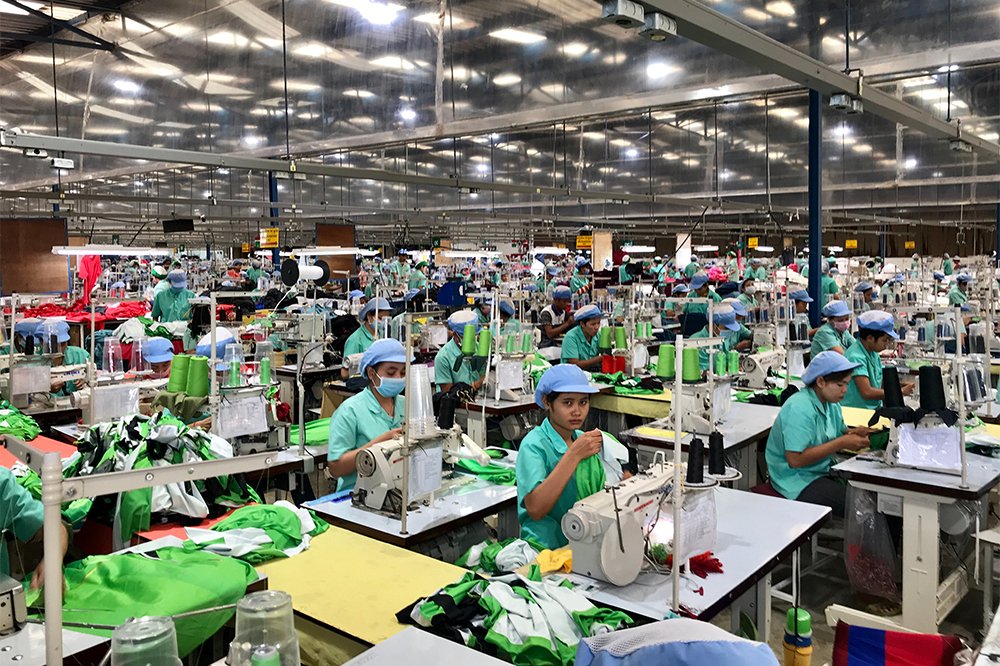
The sector remains Cambodia’s biggest export engine, and its latest gains suggest that broader market access is helping sustain momentum even in a difficult global trade environment.
Cambodia exported $3.8 billion worth of garment, textile, footwear and travel goods in the first quarter of 2026, up 7.7% year on year, according to the Ministry of Commerce. Within that total, apparel and textiles generated $2.77 billion, up 7.6%, while footwear reached $516 million, up 11.8%, and travel goods totaled nearly $513 million, up 4.2%.
The performance matters because these industries remain central to Cambodia’s export model. The same reporting says garment, textile, footwear and travel goods account for 46% of the country’s total export value, underscoring how heavily Cambodia still relies on this cluster for foreign-exchange earnings. The labor footprint is also large: the sector comprises more than 1,800 factories and branches and employs about 1.1 million workers, most of them women.
A key reason for the resilience appears to be market diversification. Cambodia is a member of RCEP and has bilateral trade agreements in force with China, South Korea, and the United Arab Emirates, which entered into force in 2022, 2022, and 2024 respectively. That wider trade architecture is helping Cambodia improve market access and integrate more deeply into regional supply chains beyond its traditional export destinations.
The broader trade backdrop is supportive. Cambodia’s total merchandise exports reached $8.09 billion in Q1 2026, up 17.7%, according to customs-based reporting, suggesting that the garment and textile complex is contributing to a wider export upswing rather than carrying the economy alone.
The next question is whether Cambodia can turn this growth into deeper industrial upgrading. Export momentum is encouraging, but long-term competitiveness will still depend on moving further into higher-value products, stronger local sourcing and more resilient supply chains.
